
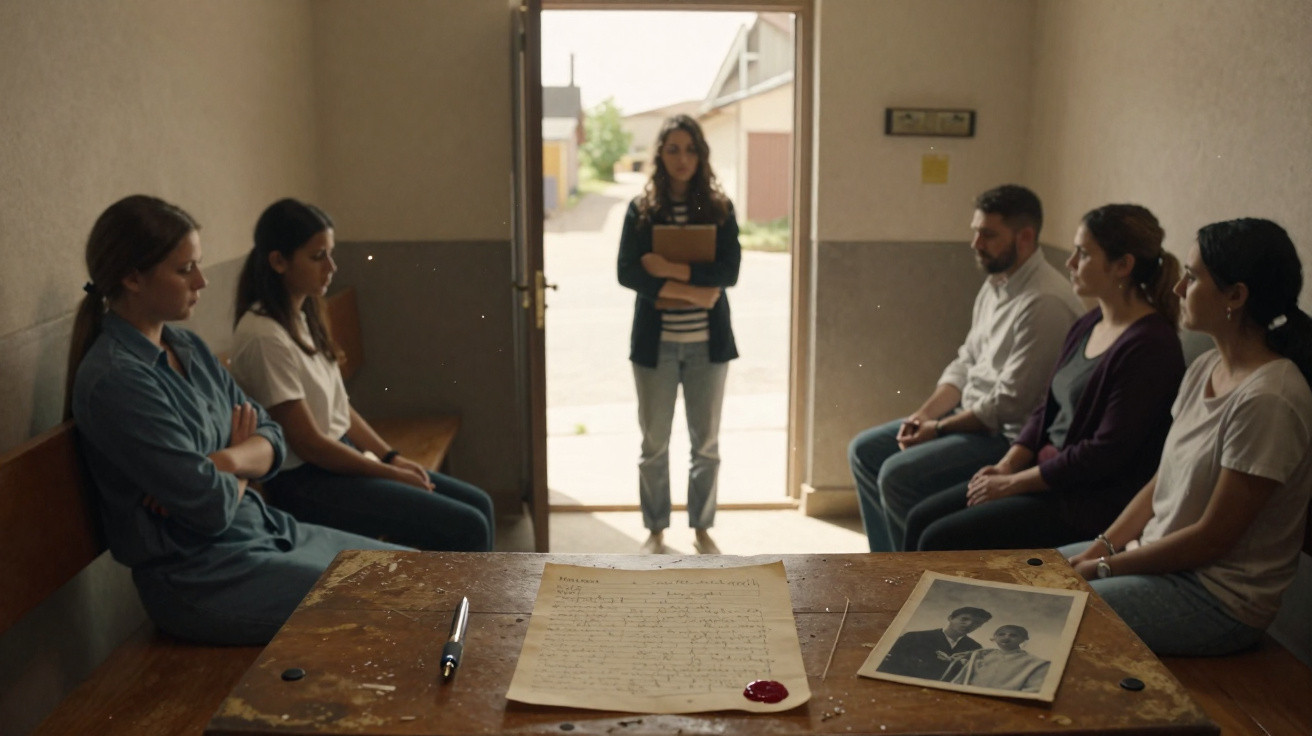
The first surprise was not the will itself. It was the unfamiliar man in a navy jacket at the rear of the village solicitor’s office, his hands in his pockets and his gaze fixed on the floor as though he wanted it to swallow him whole.
Beyond the window, tractors droned and a dog barked for no apparent reason. In the office, three adult siblings held cups of lukewarm coffee as the solicitor cleared his throat and opened a document that abruptly seemed to weigh down the entire room. Their father’s name appeared at the top. There was an inventory of assets. Then came another name: a woman none of them recognised. Finally, there were the words: “To my son, Daniel.”
The room seemed to tip sideways.
This is the account of one will that divided more than a house and a field: it split an entire village. And, in truth, it could happen almost anywhere.
The day a will tears a family apart
The solicitor says he has never witnessed a reading quite like it. To his left sit the “official” children, three siblings from the stone house beside the church, their expressions growing harder with every passing second. On his right is their late father’s brother, cast as an unwanted referee.
When the undisclosed heir eventually looks up, he bears a striking resemblance to the man in the framed photograph on the solicitor’s shelf. The eyebrows are the same, as is the chin and the nervous habit of playing with his keys. The eldest daughter suddenly realises it is not a prank. She rises too quickly, scraping her chair across the floor. Papers drift down. Outside, a neighbour walks past again, pretending not to look through the window.
In that modest office, forty years of family history have been destroyed in ten minutes.
Stories of this kind are increasingly becoming a quiet reality in rural towns and small courts. Solicitors describe a “silent wave” of inheritance disputes driven by second families, relationships begun later in life and the secrecy of an older generation.
In a recent case in another village, two sisters spent three years and exhausted their savings challenging a will that gave half the family home to a woman their father had secretly seen for two decades. Her existence became known only at the funeral, when she arrived wearing a battered ring and carrying a key to a flat the family did not know existed.
The judge ultimately allocated the property precisely as the will directed. By the time the ruling was delivered, the sisters had stopped speaking to one another, separated by legal costs, village gossip and long-standing resentments reignited at every new hearing.
Beneath the legal language, the process is painfully straightforward. A will should safeguard someone’s final wishes, yet a concealed branch of the family tree can make it explode the histories everyone assumed had been put to rest.
In many countries, the law attempts to reconcile children’s rights with a person’s freedom to leave part of their estate to a partner or another beneficiary. The arrival of a secret heir pushes that balance to its limits.
The “official” children feel cheated, even where the figures are technically fair. The unexpected heir feels like an accusation made flesh, required to defend the fact that they exist. Meanwhile, the judge must divide a life into percentages and shares while those in the room are really fighting over love, betrayal and who mattered most on Sunday afternoons.
How an inheritance war becomes an arms race
After the initial shock fades, the family conflict often turns colder and more calculated. Siblings begin contacting separate solicitors. Aunts and uncles choose their sides. Someone retrieves old text messages, bank records and blurred photographs from a phone nobody knew their father owned.
One sibling may urgently challenge the will, arguing that their father lacked mental capacity. Another visits neighbours, gently asking what they recall about “that woman” or the half-brother who has suddenly entered their lives. What began as mourning becomes a contest of paperwork, screenshots and hushed witness accounts.
The late father’s other family is quietly preparing too. They have spent years unseen. They know they are entering a storm, and they arrive ready for it.
Within the village, the dispute takes on a second existence in the café, bakery and WhatsApp groups. One person remembers the father’s car outside a rented flat in the neighbouring town years earlier. Another insists they once saw the mysterious heir at the local football ground, seated well away from the crowd.
People form camps with remarkable speed. There are the loyalists: “His real children are the ones he raised, full stop.” Then come the pragmatists: “If he wrote it, he meant it.” And there are those who recognise their own hidden histories in the secret heir: relationships that never appeared in the family photo album.
Figures on contested wills rarely reach the headlines. They remain in court records and legal newsletters. On the ground, however, every case resembles a small civil war replayed over Christmas meals and in the icy silence when siblings meet in the supermarket.
Viewed from a distance, these disputes can appear excessive, as though they concern only money or land. At close quarters, the real currency is far more elemental: acknowledgement, legitimacy and the urge to prove that years spent caring, visiting and forgiving were “worth” more than a late-life relationship in a rented flat.
Solicitors refer to “patrimony” and “forced heirship”, while everyone else is fighting over something that cannot truly be contained in legal wording. Who qualifies as family. Who may wear the father’s watch, not for its financial value but because it was warmed by his wrist for decades.
Let us be honest: hardly anyone studies inheritance law until they are sitting in that chair opposite the solicitor. At that stage, the story has already been set down, and every sentence bears the burden of timid love, concealed shame and half-truths the deceased never dared explain in life.
What this bitter inheritance war reveals about love, law and secrets
If these stories offer one understated lesson, it is brutally clear: postponed conversations magnify conflict. The father in this village may have believed that keeping his two lives separate protected everyone. On paper, his will attempted to join them together at the final moment.
But the manner in which he did so ensured the most damaging possible collision. There was no explanatory letter. No family discussion while he could still speak. There was only a legal shock, dropped like a stone into water and sending ripples through generations.
For families looking on, one practical action matters above all. Speaking sooner, however awkwardly, almost always hurts less than receiving a flawlessly drafted will without warning.
Many people are paralysed by the prospect of this discussion. Explaining to adult children that they have a half-sibling, or that part of the estate will pass to someone they barely know, can feel like opening a wound one would prefer to cover quietly.
So they delay. They say “after the wedding”, “after the treatment”, “when things calm down”. Then time suddenly runs out, and the only remaining voice is that of a solicitor reading a document the family discovers together under fluorescent lights that make grief seem harsher still.
That is the trap into which so many people fall. It is not because they are unkind, but because they fear causing pain face-to-face. The hurt they tried to prevent simply returns later, louder and before a judge.
“We’ve all been there, that moment when you swallow a hard truth because speaking it out loud feels like too much. The problem with inheritance secrets is that they don’t dissolve with silence. They ferment.”
- Speak while you are healthy, rather than from a hospital bed surrounded by tubes and panic.
- Include a straightforward letter with the will that explains the “why”, rather than only the “how much”.
- Bring everyone concerned into one shared discussion instead of dropping hints to separate sides.
- Expect anger and allow it to happen. Remaining present through it is worth a hundred perfectly formed legal phrases.
- Revise the will whenever life changes: a new partner, a new child, a separation or a new promise.
A divided village, a reflection for everyone else
Back in the village, the case continues. On some days, the siblings consider abandoning the legal battle simply to purchase peace. Then fresh evidence appears - an old insurance policy, a savings account or a letter discovered in a drawer - and the anger ignites once more.
The secret heir walks the same streets with tense shoulders, conscious of every glance. He did not choose to be born. He did not draft the will. Yet he bears the consequences of a decision another person made decades before he knew any of them existed.
There is a particular cruelty in the way a dead person’s silence can so forcefully reshape the lives of those left behind.
At times, the courts achieve what the family cannot: an uneasy legal peace. The estate is distributed under the law and the will, with every portion converted into figures and signatures. On paper, fairness has been restored.
In ordinary life, though, the fractures remain. Two branches of one family tree pass each other in the street and turn away. Old friends no longer invite both sides to the same barbecue because the atmosphere is too tense.
This village is not unusual. It merely exposes what many families carry in private: hidden chapters, late romances, undisclosed children and wills written like sticking plasters over profound, unspoken fears.
There is no tidy moral, nor any magic phrase that can prevent a bitter inheritance war from beginning. People will continue to fall in love out of sequence, conceal parts of themselves and hope a document signed in a quiet office will spare everyone the commotion.
The simple truth is that money does not create conflict; it magnifies whatever was already vulnerable. A will exposing a hidden second family does not conjure a broken family from nowhere: it reveals cracks that existed all along.
Perhaps the only meaningful question is this: should our final word arrive in a sealed envelope carried by a stranger, or in our own voice - unsteady, imperfect, but still warm? Either way, that last word will arrive. And everyone else will have to live within it.
| Key point | Detail | Value for the reader |
|---|---|---|
| Talk before the will | Early, candid conversations about hidden relationships and heirs can lessen the eventual legal shock | Lowers the risk of brutal courtroom disputes and lasting family fractures |
| Explain the “why”, not just the “how much” | A simple letter or meeting can set out the reasons behind the choices in a will | Enables relatives to understand decisions as human choices, rather than merely figures on paper |
| Update with every life change | New partners, children, separations or reconciliations call for a revised will | Keeps the legal account aligned with real life, reducing the likelihood of surprise heirs and resentment |
FAQ:
- Question 1 Can a “secret” child genuinely claim a share of an inheritance?
- Question 2 What can I do if I believe my parent was pressured to alter their will?
- Question 3 Is dividing everything equally among all children the better approach?
- Question 4 How can I raise the subject of a second family with my own parents?
- Question 5 Can relatives repair their relationship after a court dispute over a will?






Comments
No comments yet. Be the first to comment!
Leave a Comment