
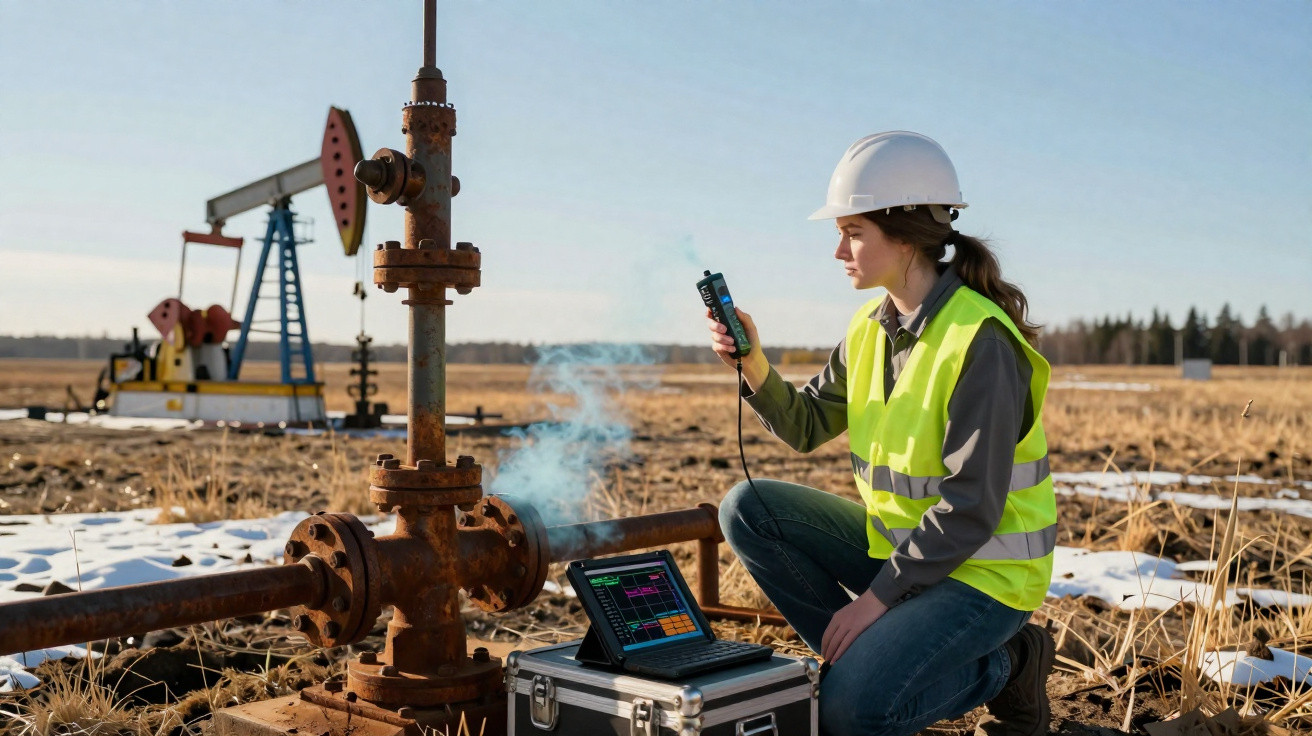
Dormant oil and gas wells across Canada emit methane produced by microbes at rates roughly 1,000 times greater than previous estimates, new research suggests.
The findings indicate that certain wells may continue supplying methane to the atmosphere long after the oil or gas targeted by drilling has been depleted.
What the samples revealed
Microbe-produced methane was detected much more frequently across 401 non-producing wells than earlier estimates suggested.
Mary Kang of McGill University linked a substantial share of this previously overlooked pollution to gas moving upwards from shallow geological formations.
Rather than replacing the explanation involving deeper sources, the evidence indicates that ageing wells can release methane from several underground layers.
This overlap makes the leak apparent even when the pathway feeding it has not yet been completely identified.
Why shallow gas matters
Microbial methane is created underground by tiny organisms in oxygen-free conditions, and the study demonstrates that old wells can release this gas.
In contrast with gas generated deep within petroleum zones, this shallower source may persist beyond the reservoir that operators originally drilled.
“Methane is a powerful greenhouse gas when released into the atmosphere, regardless of its origin,” said Kang.
Reducing methane is important in the near term because, over 100 years, it retains more than 28 times as much heat as carbon dioxide.
Tracing the sources of methane
Researchers used stable isotopic signatures - chemical fingerprints that can indicate where a gas was formed - to distinguish between methane sources.
Together with the composition of the gas itself, these indicators enabled the team to categorise emissions from 100 sampled wells.
Gases from deep petroleum deposits commonly contain other, heavier gases, whereas shallow microbial gases are often chemically less complex.
This more complete fingerprint is significant because repair work may fail when crews incorrectly identify the underground layer supplying a leak.
Gas from shallow and deep sources
Thermogenic methane, created as buried organic material is heated underground over millions of years, was still released by most leaking wells.
However, microbial methane occurred much more often than earlier research had indicated, challenging the previous understanding of emissions from inactive wells.
Several samples also appeared to contain mixtures, implying that both shallow and deep layers were delivering methane through the same ageing well infrastructure.
That shared route helps account for why earlier assessments overlooked a substantial portion of the microbial contribution.
Routes through old wells
Non-producing wells may provide vertical pathways for escape, connecting gas-bearing layers underground with valves, wellheads and leaks close to the surface.
A 2020 study in western Canada reported gas escaping through casing, failed cement and routes outside the well itself.
“However, the exact source of this methane is often unclear because the subsurface is a complex system with multiple gas-bearing formations,” Kang said.
Because of that complexity, crews may seal an obvious leak while failing to close the pathway bringing up further gas.
Identifying the biggest sources
Previous McGill field research found that the highest-emitting 12 percent of wells accounted for 98 percent of emissions.
As such a small share of wells produces most leakage, overall averages can conceal the sites requiring the most urgent attention.
Microbial methane makes this task harder, as comparatively quiet wells can still emit climate pollution from shallower formations.
The practical priority is to identify the largest emitters quickly, while preventing smaller leaks from turning into lasting sources.
A new measure of methane emissions
Earlier estimates generally considered microbial methane uncommon, in part because deep petroleum gases were simpler to identify.
Rather than relying on a single signal that could be altered by gas movement or mixing, the researchers combined several chemical indicators.
Deep gas can sometimes appear misleadingly light, while mixed gases can blur the distinction in the opposite direction.
Applying multiple indicators did not remove all uncertainty, but it reduced the likelihood of wrongly classifying leaks.
What repairs must block
Plugging and monitoring schemes often concentrate on wells already known to leak heavily, but the type of source determines the suitable repair.
Gas travelling through the main steel pipe may require one solution, whereas methane entering from nearby formations may demand another.
Samples collected from valves near the top of wells sometimes indicated shallower formations, suggesting that surface equipment can expose different escape routes.
This has budget implications, since crews may spend time sealing visible symptoms while the underground pathway remains unblocked.
Targeting methane from old oil wells
Canada has nearly 500,000 non-producing oil and gas wells, meaning that even a minority that leak can create a substantial total.
The majority of these wells are in western provinces, where long histories of oil and gas extraction have created an extensive clean-up obligation.
Comparable leaking wells have been recorded in California and other US drilling regions, showing that the issue extends across borders.
The revised source map is the key change: some older wells seem to release methane from layers that no one had previously targeted.
Old wells are not merely abandoned equipment; they can be active routes for methane escaping from multiple underground sources.
This revised understanding should direct monitoring towards repairs suited to each leak, while researchers investigate how gas continues to travel through buried rock.






Comments
No comments yet. Be the first to comment!
Leave a Comment