
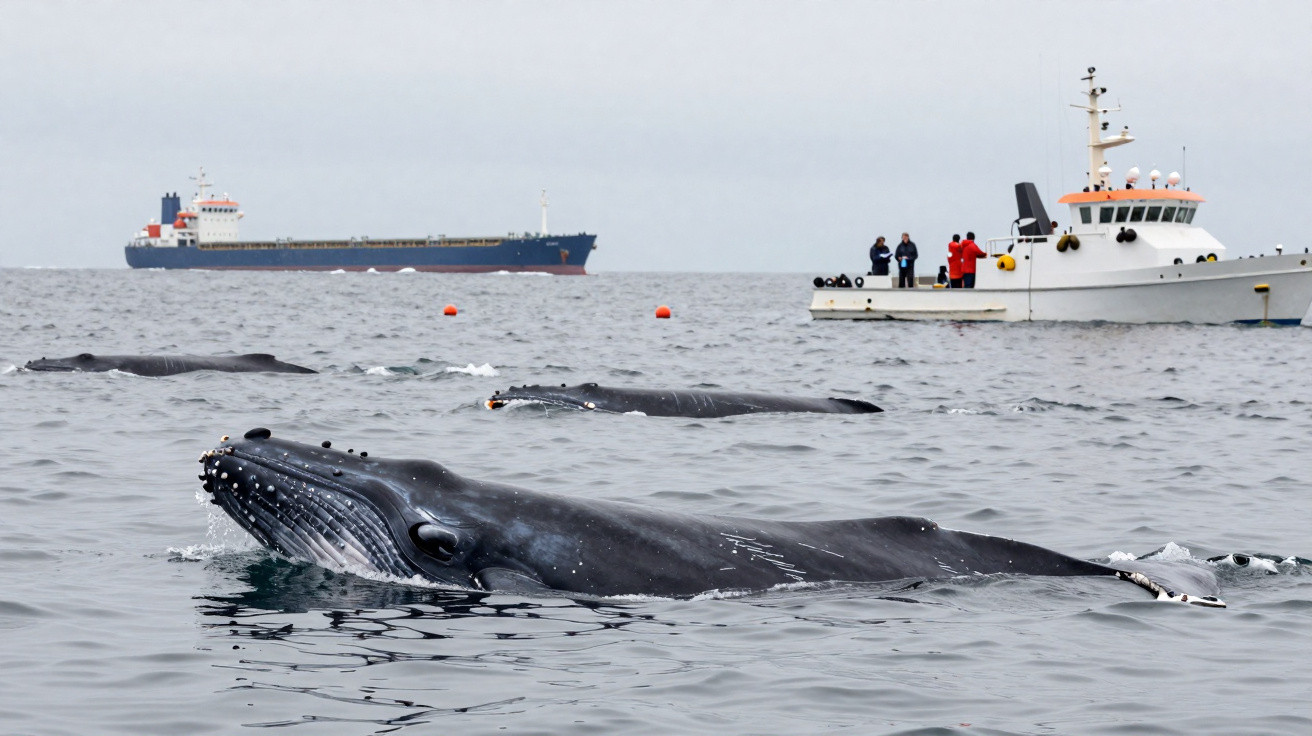
The outlook is complicated. North Atlantic right whales carry the damage of centuries into an era shaped by new protections, changing food supplies and congested shipping routes. This season, several encouraging figures point to a slim route beyond crisis, provided people continue to remove the deadliest threats.
A fragile rise after a brutal century
North Atlantic right whales (Eubalaena glacialis) were once hunted because their carcasses floated, leaving just a few hundred animals when commercial whaling ended. Their recovery since then has swung between encouraging progress and painful reverses. The North Atlantic Right Whale Consortium currently puts the 2024 population at about 384 whales, a modest 2% increase from the preceding year. This is not a dramatic surge, but it does represent a change in direction.
Researchers reported no confirmed right whale deaths in 2025 to date, after years marked by relentless losses from ship strikes and fishing gear.
What the numbers actually say
That slight rise needs to be read carefully. Scientists recorded five deaths in 2024, among them breeding females. Each adult female is crucial because the species breeds slowly. Many females now have calves only every six to ten years, compared with around three years in previous decades. This longer interval reflects stress, injury and limited food. Nevertheless, the most recent calving season produced 11 newborns, including four born to first-time mothers older than expected. These delayed first calves suggest that some females had recovered sufficient body condition to sustain pregnancy.
Entanglement is the common thread across much of the whales’ lives. NOAA Fisheries has determined that more than 85% of right whales have been entangled in fishing gear at least once. Most animals survive their first encounter, but repeated incidents inflict lasting damage. Scars constrict their tails, while lines chafe their jaws and flippers. Less obvious injuries may drain energy for years and lengthen the time between calves.
More than four out of five right whales bear entanglement scars. Longer calving gaps tell the story of chronic strain.
How protection starts to work
Human activity has altered conditions at sea, at least to some degree. Seasonal speed restrictions slow large ships in important corridors. Dynamic closures shift in response to real-time whale sightings. Gear regulations call for weak links and fewer vertical ropes. These measures cannot eliminate danger, but they reduce its most acute forms.
Fishermen test gear without ropes
An approach now progressing from pilot schemes to practical use is “on‑demand” or rope‑less fishing. Traps are placed on the seabed, then crews trigger their release using an acoustic signal, meaning there is no fixed vertical rope in the water column for a whale to become caught in. Trials off Canada’s Atlantic coast landed more than 400,000 kilograms of snow crab while allowing the fishery to remain open. The technology still requires greater reliability, affordability and common operating protocols, but it indicates that fishing catches and conservation can work together.
| Pressure | What it does | Current response |
|---|---|---|
| Ship strikes | Fatal injuries caused by collisions on heavily used routes | Seasonal speed rules, dynamic slow zones, routing advisories, better whale alerts |
| Gear entanglement | Long-term wounds, reduced feeding, lost calves | Weak links, line reductions, gear marking, on‑demand systems under trial |
| Climate-driven prey shifts | Whales pursue plankton into new waters with less protection | Adaptive closures, cross-border coordination, expanded surveillance |
| Noise | Masks calls and disrupts contact between mothers and calves | Speed limits that also quiet vessels, research on quieter propellers |
Climate shifts redraw the map
Warmer seas are pushing the whales’ food source-copepods and other plankton-northwards and eastwards. North Atlantic right whales are following it. This pursuit has brought them into the Gulf of St. Lawrence, the Scotian Shelf and the fringes of busy shipping lanes, where safeguards were previously limited. Authorities in the United States and Canada increasingly use aerial and acoustic monitoring to move closures alongside the whales. This approach creates time, but it also relies on dependable funding and cooperation from mariners and fishing fleets adapting to new requirements each season.
What happens next
Two realities define the way forward. First, a small population can move rapidly from promise to decline. One large entanglement event or a series of ship strikes could erase gains accumulated over several years. Second, consistent improvements build upon one another. With annual growth of 2%, a population of 384 would need roughly 35 years to double. That period becomes shorter if births increase while injuries fall at the same time.
Conservation managers are now focused on safety margins rather than perfection. What would make a season safe? Few, if any, deaths; minimal serious injuries; calving at or above a dozen; strong adherence to speed restrictions; more on-demand gear in high-risk areas; and better detection so protections begin before whales appear. Every measure reduces the chance that a calf loses its mother or that a breeding female loses another year.
- Mariners can consult active slow zones and maintain a constant lookout at dawn, dusk and in poor visibility.
- Coastal residents can report sightings to regional hotlines and record distinctive callosity patterns.
- Seafood purchasers can question suppliers about whale-safe gear trials and reductions in rope.
- Anglers and boaters can secure loose rope, remove abandoned line from propellers once ashore, and record the locations of debris.
Key terms you will hear this year
On-demand gear: a trap system with no permanent surface rope. Crews activate a release using an acoustic code, after which a lift bag or line rises to allow retrieval. Its benefit is a lower risk of whale entanglement. Its obstacles include cost, digital coordination between boats and gear conflicts on the seabed.
Serious injury: a regulatory threshold agencies use when an incident is likely to affect survival. It is monitored alongside deaths because both take animals out of the breeding population. Reducing serious injuries speeds recovery even before birth rates improve.
A simple scenario to keep the stakes clear
Consider 384 whales, including 40 breeding females. If 12 calves survive but two breeding females die, population growth could halt. If those same females avoid entanglement, calving intervals become shorter, and the season yields 16 calves with no adult female deaths, numbers rise slightly. The outcome can depend on compliance with speed rules on a foggy morning and on whether one rope lies across a migration route.
Progress depends on relentless small wins: fewer ropes in the water, slower ships in the right weeks, faster alerts when whales shift.
Right whales may live for close to 70 years. Their lifespan provides a framework for recovery, allowing one mother to raise several calves over decades-if she remains healthy and undisturbed. The recent increase, the absence of confirmed deaths so far this year, and the continued adaptation of fishing and shipping practices all indicate a viable plan. The margin remains narrow. The tools are available. For once, time may be on the whales’ side.





Comments
No comments yet. Be the first to comment!
Leave a Comment