
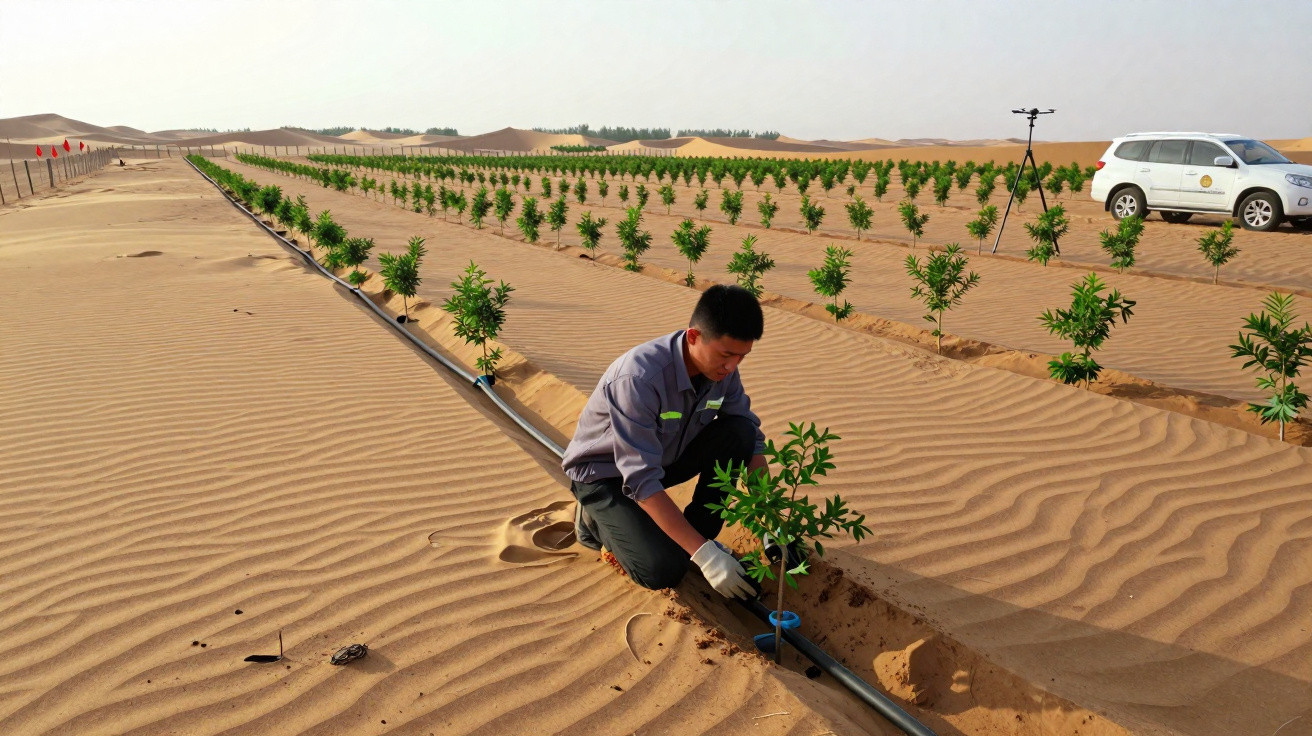
As dawn broke over Inner Mongolia, the bus windows misted up, while pale pink light washed across a landscape that seemed almost post-apocalyptic. To one side, dunes rolled away into the distance, broken by the spectral frames of dead poplars. To the other stood an abrupt, vivid strip of green: young trees set out in ruler-straight rows, each sheathed in plastic like a patient just out of surgery.
The driver eased off the accelerator, sounding almost proud. “All new,” he said, pointing towards the saplings advancing into the dust. “We stop the sand.”
Somewhere between his subdued pride and the stillness of the dying trees behind us lies the real story of China’s billion-tree gamble.
No one agrees about its ending.
When a desert turns green… on paper
Viewed from space, northern China appears to be a miracle underway. Satellite photographs reveal a pale yellow belt gradually outlined in green, as forests and shelterbelts wind along the encroaching Gobi Desert and beyond. Chinese leaders often describe it as the “Great Green Wall”, a living barrier extending for thousands of kilometres.
At ground level, the picture is less tidy. Places near Beijing and parts of Inner Mongolia have plainly changed: sandstorms are less frequent, trees and shrubs are more common, and fields are no longer consumed by dunes overnight. Residents speak of being able to put washing out in spring again.
Yet move even a short distance beyond the roads and flaws in the success narrative start to emerge.
In the village of Wushen Banner, a herder called Li indicates a row of brittle pines. Their needles have turned brown and they tilt like exhausted soldiers. A decade earlier, a state-supported planting crew passed through, excavated holes and placed thousands of saplings in them.
Everyone lined up for photographs. Local television broadcast enthusiastic reports. The county met its yearly target within only a few weeks.
Now, half of those trees have died. Those remaining are small and struggling, with roots competing for moisture in sandy ground that was never truly suitable for them. A few kilometres away, native shrubs and tough grasses, left undisturbed, are quietly faring better than the imported pine and poplar plantations that looked so convincing in project plans.
That is the uncomfortable contradiction at the centre of China’s tree-planting spectacle. In presentations and speeches, the figures sound heroic: billions of trees, tens of millions of hectares “greened”, and one of the biggest ecological schemes anywhere in the world by any measure.
In reality, results often rely less on the number of trees placed in the ground than on whether anyone is concerned about them in year five or year ten. Monoculture forests drain already pressured aquifers. Their shade changes delicate steppe ecosystems. Some local communities receive new work, while others lose long-established grazing rights.
The desert does not give in merely because a quota has been reached.
China’s Great Green Wall: planting quickly, thinking slowly
Forestry workers in Ningxia and Gansu will tell you that the approach can be harshly straightforward. Lorries arrive carrying lines of identical saplings. Augers drill holes in orderly grids. Crews operate like production lines: plant, firm down, water, photograph, repeat.
Pace matters above all else. Plant at the start of the season, fulfil the target, present the aerial drone images. Genuine ecological restoration, however, follows the rhythm of roots and rain rather than reporting schedules.
Some teams have begun testing mixed species, native shrubs and open areas for moss and grass. These sites look less dramatic from the air. They also appear less likely to die.
Local officials, frequently pressured to “green” the desert, confront an understated dilemma. The simplest achievements come from rapidly growing, non-native trees that rise quickly and look impressive in the statistics. But many of these species were not intended to survive in semi-arid conditions at the edge of the Gobi.
Farmers recount how wells fell after thick plantations were established uphill. Older herders recall years in which dust storms weakened, only to return with force through bare spaces between plantations that never became established.
We have all experienced that point when a quick solution seems impossible to resist, even while instinct suggests it may not last well.
Experts who have crossed these landscapes for decades generally use more careful, nuanced language than the slogans printed on propaganda posters.
“Tree‑planting is not bad,” a Chinese ecologist based in Lanzhou told me. “But a forest is not just trees, and a desert is not just empty land to be conquered. When we forget that, we repeat mistakes at a larger scale.”
- Monoculture plantations – Inexpensive and rapid to establish, but exposed to pests, drought and collapse.
- Mixed, native species – Less swift and less showy, but often more effective at holding soil in place and conserving water.
- Natural regeneration – Closing overgrazed land and allowing it to recover; nearly invisible on television, yet quietly effective.
- Community-led planting – Villagers decide what and where to plant, combining tradition with fresh incentives.
- Paper forests – Schemes that exist mostly in reports, drone footage and metrics, as uncounted seedlings die in the sand.
Triumph, spectacle or land grab?
Look beyond the saplings and statistics, and another, more pointed question rises from the dust: who actually benefits when deserts are “stopped”? In areas of Inner Mongolia and Xinjiang, grasslands formerly shared by herding families have been redesignated as “ecological protection zones”. Fences are erected, access conditions become stricter, and new tree plantations emerge where herds once travelled.
Officially, the aim is to restore vulnerable ecosystems. On the ground, it may feel like a gradual, quiet shift of power from traditional land users to remote agencies and companies.
Let’s be honest: no one studies the small print of a reforestation plan before their grazing route vanishes.
In Alxa League, close to the Tengger Desert, some households took compensation and moved into new blocks of flats on the town’s outskirts. Their former land, scrubby but familiar, now contains commercial shrubs for herbal medicine and extensive rows of drought-tolerant trees that may eventually supply a carbon credit market.
Younger people find employment planting trees or guarding these new “ecological industry parks”. Older herders sit on concrete balconies, seeing dust sweep between the buildings and questioning whether the green in glossy brochures bears much resemblance to the world disappearing around them.
The desert is retreating here, certainly. So too is a way of life that understood how to coexist with it.
For this reason, critics refer to green grabbing – environmental ambitions being used to rezone land, centralise control again and create opportunities for new forms of profit. China is not alone in this: versions of the same pattern can be seen from the Sahel in Africa to carbon forest projects in Latin America.
China’s scale simply enlarges every decision, each error and every quiet achievement. A monoculture in the wrong valley does more than fail; it can alter water tables for a generation. A thoughtful restoration scheme led by the community does more than protect one village; it can become a model discreetly repeated across provinces.
What appears in headlines as a reassuring tree-planting campaign may, decades later, determine who can remain on the land once the climate debate becomes a matter of contracts and credits.
What China’s billion-tree gamble means for the rest of us
Watching China’s billion-tree experiment develop is like seeing the future of climate action played at fast-forward speed. The country is doing what many argue the world needs to do: mobilising on a huge scale, planting as though there is no tomorrow, and forcing sand and dust away from cities already struggling with pollution.
But one uncomfortably simple question remains: are landscapes being restored, or rearranged to look good in an era of climate dashboards and satellite monitoring?
Should the Great Green Wall prove robust, diverse and rooted in local communities, it could redefine what is achievable on damaged land from Mongolia to Morocco. If it dries out, dies or generates new disputes over water and land rights, it will still offer a lesson – only a more severe one.
| Key point | Detail | Value for the reader |
|---|---|---|
| Beyond “tree counts” | Survival rates, species selection and water effects matter more than planting targets | Helps you challenge feel-good climate headlines and seek deeper indicators |
| People and land rights | Some green schemes change who controls land and who is forced out | Explains why reforestation is a social and political story as well as an ecological one |
| Lessons for global climate action | China’s successes and failures foreshadow what rapid “green” transitions can produce | Offers a way to assess future mega-projects where you live or invest |
FAQ:
- Question 1 Is China’s Great Green Wall actually stopping the desert?
- Answer 1 In some regions, yes: sandstorms have decreased, dunes have stabilised and vegetation cover has increased. Elsewhere, particularly where monocultures were planted in dry, sandy ground, many trees have died and the desert is still advancing, only more slowly and through more complicated patterns.
- Question 2 Are these projects mostly environmental or mostly propaganda?
- Answer 2 They are both simultaneously. Genuine ecological improvements and committed scientists exist alongside political pressure to deliver quick, photogenic outcomes. The truth lies between triumph and spectacle, differing greatly between counties and projects.
- Question 3 Why do so many trees die in these schemes?
- Answer 3 Frequent issues include using non-native species, overlooking local water constraints, creating dense monocultures and prioritising annual targets over long-term care. In projects that use native shrubs, mixed species and support natural regeneration, survival is generally far higher.
- Question 4 How are local communities affected by China’s desert control efforts?
- Answer 4 Some people gain work, stronger protection from dust storms and new infrastructure. Others lose grazing rights or are moved when their land is redesignated for ecological protection or commercial plantations. The social consequences can be as dramatic as the environmental shift.
- Question 5 What should we watch for to judge if this gamble will pay off?
- Answer 5 Important indicators include long-term tree survival, groundwater levels, biodiversity and whether local residents can still make a living from the land. If future forests are diverse, water-smart and supported by communities, the gamble may age well. Otherwise, the green wave could leave future generations with a complex, water-hungry legacy.




Comments
No comments yet. Be the first to comment!
Leave a Comment