
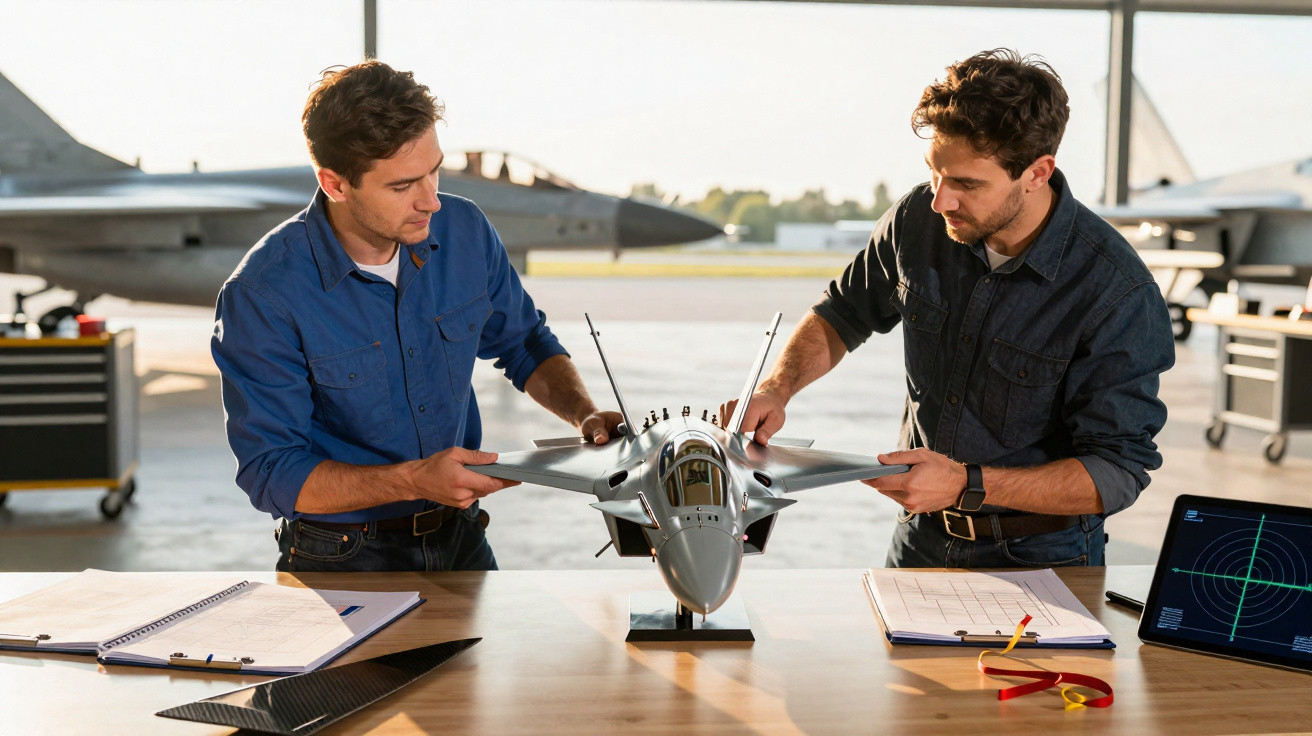
The next generation of European combat aircraft, once promoted as an emblem of unity, is now in danger of becoming a textbook example of strategic divergence between France and Germany.
The SCAF dream on the brink
Launched with considerable fanfare in 2017, the Future Combat Air System (SCAF in French, FCAS in English) was intended to be a joint venture between Paris and Berlin. The shared system was meant to replace France’s Rafale and Germany’s Eurofighter from the 2040s onwards. Spain subsequently joined the programme, adding funding and industrial weight.
SCAF is not simply one aircraft. It is conceived as a system of systems, combining a crewed “new generation fighter”, armed drones, swarms of smaller remote carriers and a combat cloud connecting every element. Its purpose is to match, or at least avoid falling too far behind, US and Chinese progress in networked air warfare.
The manned fighter, the political symbol of the programme, has become its main fault line.
French and German defence establishments continue to agree that modernisation is necessary. However, they differ over how ambitious the new aircraft should be, which country should direct the design work and how industrial rewards should be divided. According to officials familiar with the discussions, those differences have pushed the whole project into a new “major crisis”.
Macron and Merz hold the keys
SCAF decisions have moved beyond the realm of engineers and military commanders. Responsibility now lies firmly with two political figures: French President Emmanuel Macron and German conservative leader Friedrich Merz, who is regarded as a possible future chancellor.
Both are expected to set out their positions around a European Council meeting in Brussels or at the start of 2026. Time is limited, as contracts for the next stage of the programme, covering billions of euros and thousands of jobs, cannot be postponed indefinitely.
For Macron, SCAF has been central to his campaign for European “strategic autonomy”. Abandoning the project would amount to acknowledging that ambitions for a unified European defence industry still collide with entrenched national instincts.
The calculation is different for Merz and Germany’s wider political establishment. Berlin has already allocated vast sums to acquire US F-35s for NATO’s nuclear weapons mission. Approved after Russia’s invasion of Ukraine, the purchase highlighted Germany’s dependence on Washington and deepened French doubts about Berlin’s enduring commitment to a shared aircraft.
Dassault versus Airbus: two industrial cultures collide
The central dispute is between two major industrial groups. Dassault Aviation, based in Saint-Cloud to the west of Paris, represents the home of French combat aircraft production since the Mirage era. Its counterpart is Airbus Defence and Space, headquartered in Germany and familiar with multinational ventures such as the Eurofighter Typhoon and A400M transport aircraft.
Dassault wants a clear prime role and design authority on the fighter; Airbus wants genuine co‑leadership and access to critical know‑how.
Having developed the Rafale largely on its own terms, Dassault maintains that this approach produced a highly capable fighter with export potential. The company is concerned that a “management by committee” arrangement would delay decisions, obscure accountability and undermine the final aircraft.
Airbus argues instead that a European programme financed by three countries cannot operate as a French-led effort supported by subcontractors. German officials seek greater access to sensitive technologies and equal standing in vital work packages, including flight controls, stealth shaping and mission systems.
Diverging military needs
Behind the industrial row are more fundamental strategic divisions. France’s air forces operate globally, often with little notice, from the Sahel to the Middle East, while also maintaining an airborne nuclear deterrent. They require a fighter tailored for demanding missions, prioritising autonomy, long range and the capacity to strike independently without US assistance.
Germany’s armed forces have traditionally concentrated more on territorial defence and NATO operations, placing greater value on compatibility with allied equipment, particularly US systems. Berlin also faces stricter budget constraints as its one-off defence “special fund” begins to diminish.
- France advocates a stealth aircraft designed around national nuclear and expeditionary requirements.
- Germany wants wider industrial benefits and closer integration with NATO-standard equipment.
- Spain seeks roles for its own industry and a replacement for ageing Eurofighters during the 2040s.
A risk of parallel fighters in Europe
Failure is no longer merely a theoretical possibility. French officials are speaking more freely about a “plan B”: a solely national fighter programme derived from Rafale technologies. At the same time, Berlin has reinforced its connections with other European and US programmes.
A messy divorce could leave Europe with several rival fighter programmes, each more expensive and less competitive.
The UK-led Global Combat Air Programme (GCAP), which includes Italy and Japan, is already developing alongside it. Should SCAF collapse and France proceed independently, Europe could end up with two distinct sixth-generation aircraft under development, alongside continuing F-35 and Eurofighter fleets.
Such fragmentation would reduce bargaining strength in export markets and increase long-term support costs for smaller air forces. It would also carry a political message: when strategic pressure intensifies, national instincts still outweigh coordinated planning.
Key scenarios on the table
| Scenario | What happens | Main consequence |
|---|---|---|
| Compromise deal | France, Germany and Spain agree on shared leadership and funding for the fighter | SCAF moves forward, but with delays and trimmed ambitions |
| Soft split | Joint work continues on drones and combat cloud; fighter design diverges | Partial cooperation, higher total costs, mixed political signal |
| Full rupture | France and Germany walk away; each backs different jets | Deeper divide in European defence and greater reliance on US tech |
Why this matters beyond defence geeks
The SCAF argument extends beyond radar cones and stealth coatings. It concerns how Europe plans to defend itself in the 2040s and 2050s, when today’s fighter aircraft reach the end of their operational lives.
Modern aerial warfare depends as much on networks, artificial intelligence and data fusion as it does on raw engine power. SCAF’s planned “combat cloud” is intended to exchange information in real time between aircraft, drones, satellites and ground stations. Delivering this requires highly secure data links, cloud-style computing and command systems able to withstand cyber attacks.
Leaving SCAF would probably lead European nations to purchase more ready-made US systems or connect themselves to US-led architectures. While that could deliver leading capability in the short term, it would reduce Europe’s ability to act independently.
Explanations and concrete examples
The debate is shaped by two concepts: “strategic autonomy” and “design authority”. Often promoted in Paris, strategic autonomy means having the capacity to plan and carry out major military operations without relying on another nation’s political approval or software updates.
Design authority describes who has the ultimate decision-making power over an aircraft’s architecture and crucial software. If Dassault retains design authority for flight controls and mission computers, for instance, it could quickly alter the aircraft to add new missiles, sensors or electronic warfare pods without awaiting a multinational committee.
Consider a North African crisis in the 2040s in which France wishes to deploy its air force rapidly while Germany favours only a limited involvement. If France controlled its SCAF variant, Paris could independently update mission packages and operating rules. Under a fully shared, closely integrated design, modifications could require German and Spanish approval, or at least coordination, delaying the response.
Conversely, a wholly joint design would distribute costs, combine innovation and establish a broader export base. Smaller countries acquiring the future aircraft could draw on three support networks rather than one, while standardised pilot training could make coalition operations easier.
Risks and potential benefits ahead
The most immediate danger is delay. Each year of political uncertainty pushes SCAF’s entry into service further into the future, requiring Rafale and Eurofighter fleets to remain in use beyond their ideal lifespan. This may increase maintenance costs and restrict upgrades.
There is a political danger as well. The failure of SCAF would weaken the case for deeper industrial integration in areas such as missiles, drones and space, where comparable joint projects are necessary to remain competitive against the US and China.
A managed reset could nevertheless bring benefits if negotiators can achieve one. A more limited and realistic SCAF centred on essential common requirements could avoid the excessive ambition that has hindered earlier European projects. France and Germany might agree to work together on drones and digital infrastructure while accepting that certain fighter capabilities remain national.
For the moment, the outcome depends on whether Macron and Merz conclude that the political price of compromise is lower than the strategic cost of pursuing separate paths. The time available for that judgement is shrinking.





Comments
No comments yet. Be the first to comment!
Leave a Comment