
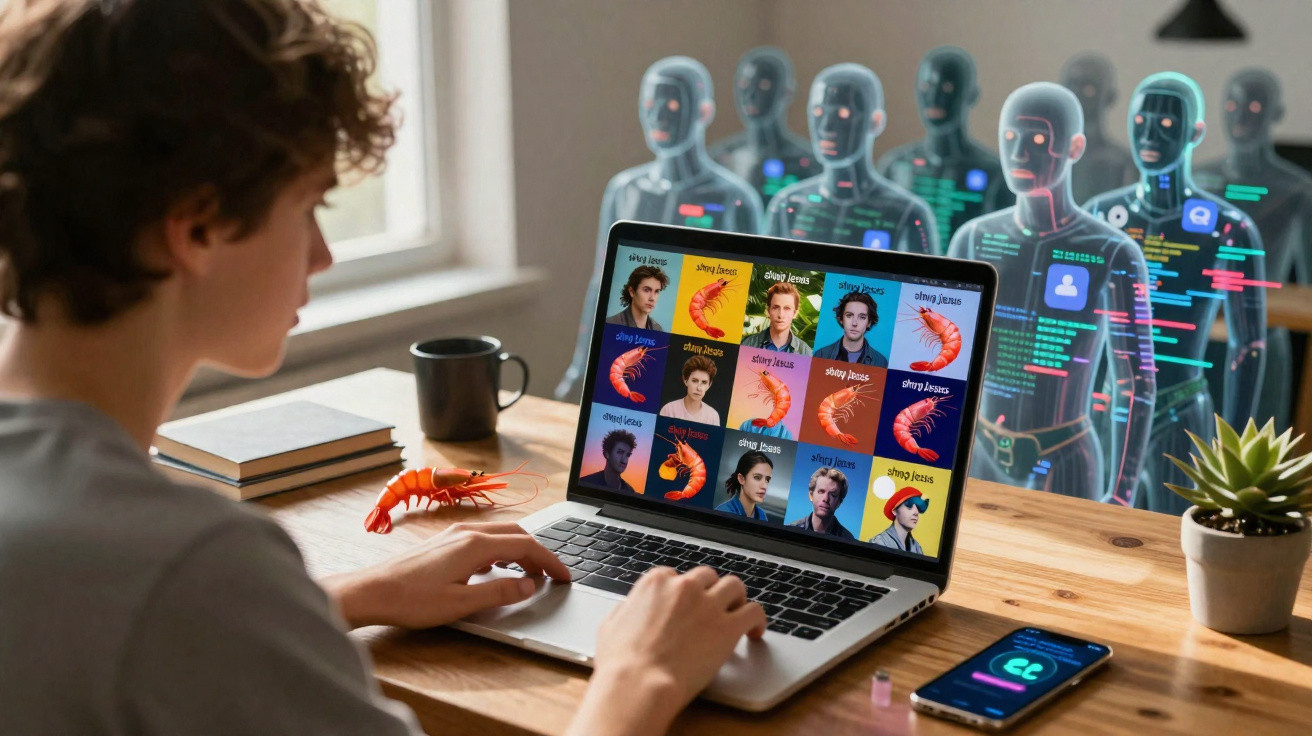
Searching Facebook for "shrimp Jesus" may bring up dozens of artificial intelligence (AI)-generated images showing crustaceans fused, in various ways, with a stereotypical depiction of Jesus Christ.
Some of these highly realistic pictures have attracted more than 20,000 likes and comments. What, then, is happening?
The "dead internet theory" offers one explanation: AI- and bot-generated material has overtaken content made by people online. But where did this notion originate, and is there any truth to it?
What is the dead internet theory?
At its core, the dead internet theory argues that much of the internet's activity and content - including social media profiles - is now produced and run largely by artificial intelligence agents.
These agents can quickly generate posts and AI-created images intended to harvest engagement, such as clicks, likes and comments, across platforms including Facebook, Instagram and TikTok. In the case of shrimp Jesus, AI seems to have identified the present viral formula: a blend of absurdity and religious imagery.
The theory extends further still. Many accounts interacting with this material also seem to be operated by artificial intelligence agents. The result is a self-perpetuating loop of artificial engagement, with no obvious purpose and, eventually, no human involvement at all.
Harmless engagement farming or sophisticated propaganda?
Initially, the incentive for accounts to manufacture interest can seem straightforward: engagement on social media generates advertising income. Someone who creates an account with artificially boosted engagement may receive a portion of advertising revenue from social media organisations such as Meta.
But does the dead internet theory end with relatively harmless engagement farming? Or could there be a sophisticated, well-funded operation beneath it, designed to back autocratic regimes, target opponents and circulate propaganda?
Although the shrimp Jesus trend may appear harmless, if strange, there may be a longer-term strategy involved.
As AI-operated accounts gain followers - many of them fake, though some genuine - their large follower totals can make them appear legitimate to real users. This is creating an army of accounts with substantial followings that could be used by whoever offers the highest bid.
This matters greatly because social media has become the leading news source for many people worldwide. In Australia, 46% of 18 to 24-year-olds named social media as their main news source last year. That figure rose from 28% in 2022, overtaking established sources such as radio and television.
Bot-fuelled disinformation
There is already compelling evidence that these inflated bot networks are manipulating social media to influence public opinion through disinformation - and they have done so for years.
A 2018 study examined 14 million tweets posted during a ten-month period across 2016 and 2017. It concluded that social media bots played a substantial role in distributing articles from untrustworthy sources. Accounts with large follower counts gave misinformation and disinformation an appearance of credibility, encouraging real users to trust, interact with and repost content published by bots.
Research has found this form of social media manipulation following mass shooting events in the United States. A 2019 study concluded that bot-produced posts on X, formerly Twitter, make a major contribution to public discussion by amplifying or distorting possible narratives surrounding extreme events.
More recently, a number of large-scale pro-Russian disinformation operations have sought to weaken support for Ukraine and foster pro-Russian views.
Activists and journalists who exposed these coordinated campaigns found that they relied on bots and AI to produce and distribute false information to millions of social media users.
On X alone, the operation used more than 10,000 bot accounts to quickly publish tens of thousands of pro-Kremlin messages attributed to US and European celebrities who appeared to support the continuing war against Ukraine.
That level of influence is substantial. Some reports have found that bots accounted for nearly half of all internet traffic in 2022. As generative AI develops further - including OpenAI's ChatGPT models and Google's Gemini - fake material is likely to become ever more convincing.
Social media organisations are attempting to tackle the abuse of their platforms. Elon Musk, notably, has considered making X users pay for membership as a way to prevent bot farms.
Social media giants could remove vast amounts of identified bot activity if they chose to do so. (Bad news for our friendly shrimp Jesus.)
Keep the dead internet in mind
The dead internet theory does not really suggest that most of your individual online interactions are fake.
Instead, it provides an interesting way to view the internet: as something no longer made by humans, for humans. In that sense, the internet we once knew and enjoyed is "dead".
The ability to create and share our ideas online and through social media is what gave the internet its power. It is unsurprising that bad actors want to seize control of that power.
The dead internet theory serves as a prompt to remain sceptical and approach social media and other websites with critical thinking.
Any interaction, trend or, particularly, "overall sentiment" may be synthetic - created to subtly alter how you see the world.
Jake Renzella, Lecturer, Director of Studies (Computer Science), UNSW Sydney and Vlada Rozova, Research Fellow in Applied Machine Learning, The University of Melbourne
This article is republished from The Conversation under a Creative Commons licence. Read the original article.





Comments
No comments yet. Be the first to comment!
Leave a Comment