
Human languages are remarkably intricate and flexible. They express our intelligence and cultures, as well as our desire both to make sense of the world and to be understood by others.
Languages generally operate according to particular patterns. Small units of grammatical meaning can be embedded in the broader framework of a sentence, creating multiple, complex syntactic layers.
For a long time, these nested linguistic patterns – called supra-regular recursive grammar – were thought to set humans apart from every other animal on Earth.
However, mounting evidence indicates that some of our fellow terrestrial species could employ comparable grammatical methods when communicating.
Supra-regular recursive grammar in primate calls
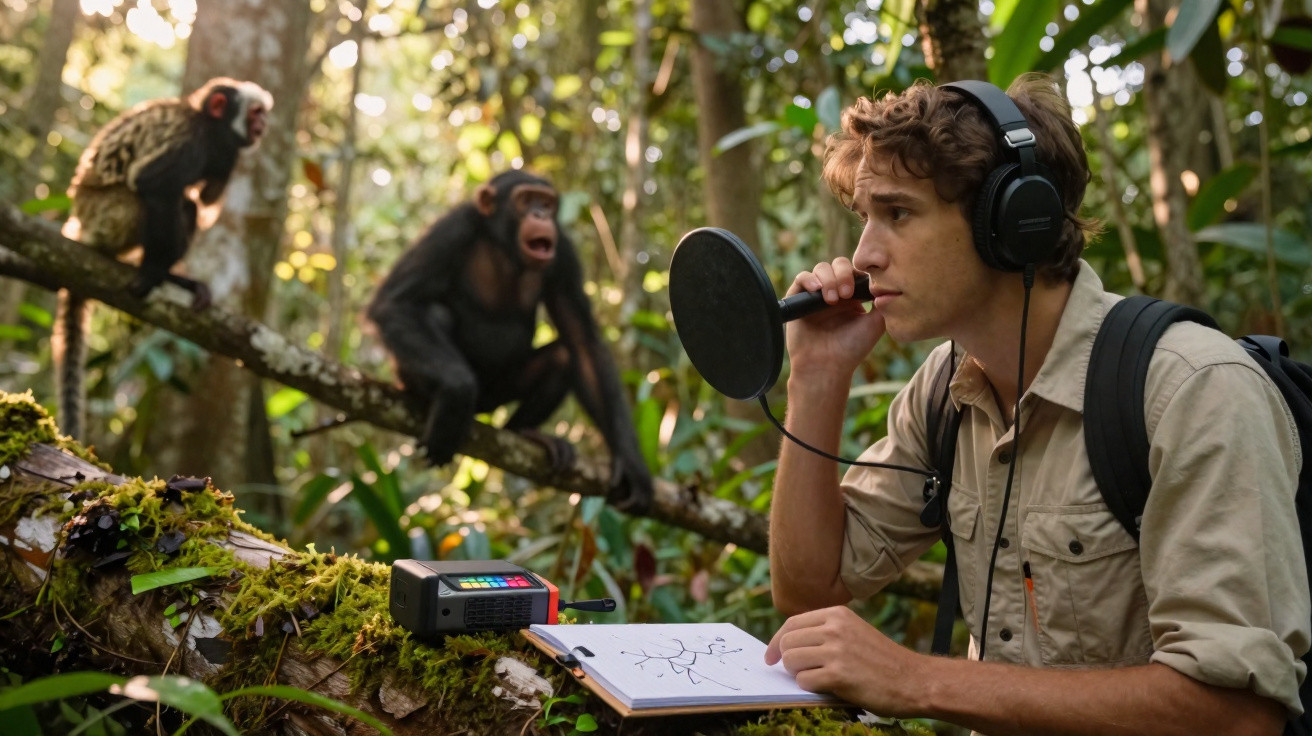
New research proposes that three non-human primate species may occasionally rely on supra-regular recursive grammar in their vocal exchanges: the common marmoset (Callithrix jacchus), the olive colobus monkey (Procolobus verus), and the bonobo (Pan paniscus).
"We show for the first time that animals generate call sequences that can be captured by supra-regular recursive grammars and hence share more similarities with human language than previously thought," writes University of Zurich linguist Remo Nitschke and his colleagues.
The work is available as a preprint on the bioRxiv server and has not yet undergone peer review, though it offers an early look at the team's research.
Because scientists do not know what individual elements of primate vocalisations mean or how they are combined, the team applied complex mathematics to examine sequences of calls.
They developed two mathematical models for assessing audio recordings of human speech and sound alongside primate calls. Both models predicted which call sequences might follow, but each made those predictions using different assumptions.
One model predicted the development of a call sequence on the basis that sounds occur in a linear order. This is also known as probabilistic regular grammar.
The second model incorporated nested hierarchies. It considered the placement of smaller sound units within a call sequence when forecasting what might come next, an approach also called probabilistic context-free grammar.
Together, the models represent important distinctions between regular grammar, which some animals are known to possess, and supra-regular grammar, supposedly exclusive to humans.
The researchers first trialled the method on human recordings. According to the authors, this supported the reliability of the models, at least for the purposes of this study.
What the models found in marmosets, colobus monkeys and bonobos
Once the models were applied to primate vocalisations, calls from all three species seemed to include aspects of supra-regular grammar.
"These findings challenge syntax as the major transition in hominid evolution and opens up prospects for alternative evolutionary scenarios," the authors write.
Even so, it remains too soon to state with certainty that these primates truly use supra-regular grammar to communicate.
The findings rest on probabilities: models were used to interpret the structures of communication sequences whose meanings are not actually understood. Consequently, it is likely that the calls featured supra-regular grammar, but this is not definite.
"Yet another possibility is that the groupings reflect a purely formal structure, similar to the syntax of music in humans or song in animals," the authors note. "Disentangling these possibilities requires much further research."
The datasets were relatively small as well. Broader studies of calls from these primates will be necessary to determine whether the observed patterns consistently persist across larger datasets.
"Despite these limitations, it is clear that the traditional view needs to be revised: some parts of call sequences of nonhuman primates are in fact most likely generated by supra-regular grammars," the authors add.
This may suggest that the linguistic divide between humans and our primate relatives is narrower than previously believed.
"The absence of a supra-regular capacity has long been held to be the single-most important demarcation line in hominin evolution," Nitschke and team conclude.
"Our findings reset the agenda for research on the evolution of language: if not syntax, what is the critical step that enabled the evolution of language from a primate-like communication system?"
This preprint is available at bioRxiv.
This article was fact-checked by Fiona MacDonald and edited by Fiona MacDonald. Although we take pride in our process, we are only human. If you notice an error, please let us know.






Comments
No comments yet. Be the first to comment!
Leave a Comment