
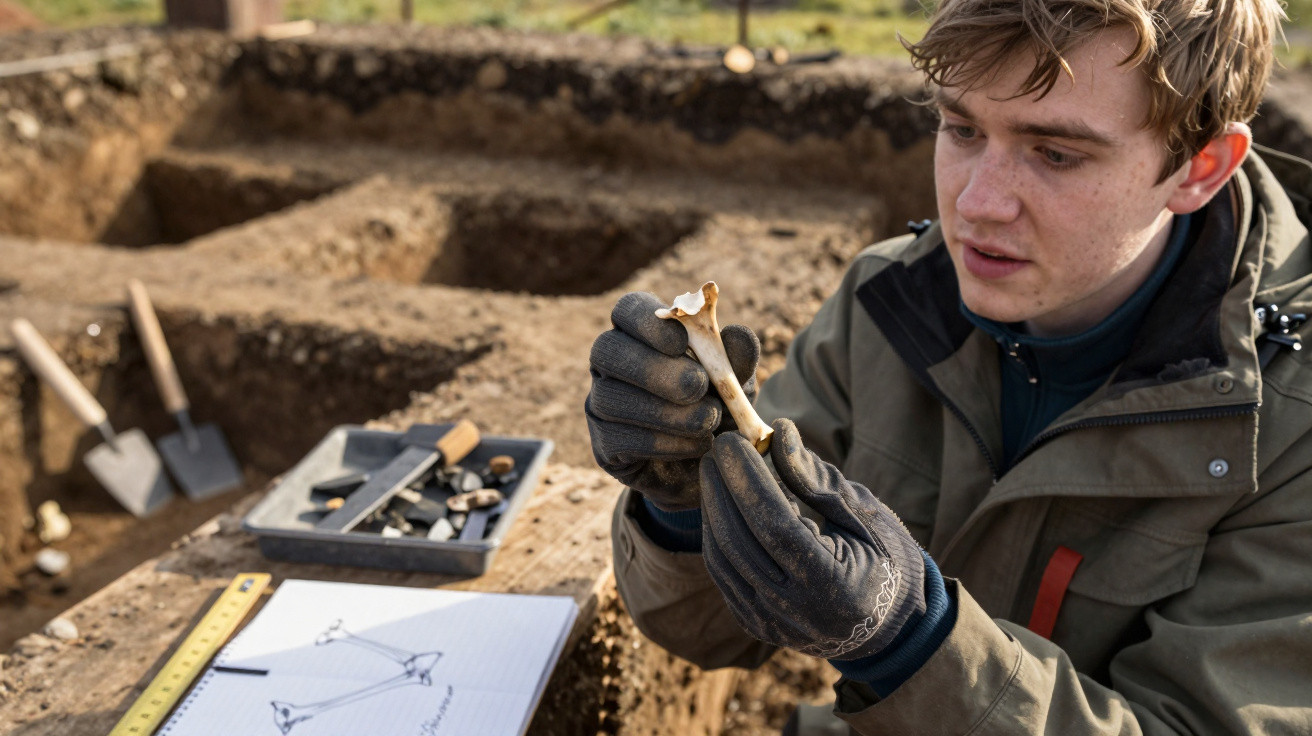
A bone fragment found in England and overlooked for decades has ultimately revealed a technology dating back around 500,000 years. Fresh analysis has shown that the piece of elephant or mammoth bone was carefully shaped into a precision hammer, which ancient humans used to repair and sharpen stone tools.
Why did this bone fragment surprise researchers?
The artefact was unearthed at the Boxgrove archaeological site in West Sussex, southern England, in the early 1990s. Its purpose remained uncertain for years. However, a reassessment by researchers from University College London and London’s Natural History Museum found that it had been intentionally made into a tool.
According to the study published in the journal Science Advances, the object measures roughly 11 centimetres long, six centimetres wide and three centimetres thick. It was fashioned from cortical bone, the tough outer layer of large bones, most likely from an elephant or mammoth that lived in the area about half a million years ago.
What was this prehistoric hammer used for?
Despite being described as a hammer, the tool was not intended for heavy blows. The bone acted as a softer hammer than stone, allowing its user to remove tiny flakes from the edges of flint implements without causing major breaks. This gave prehistoric toolmakers far greater control over the process.
The method made it possible to restore the cutting edge of hand axes and other worn cutting implements. Rather than throwing away a damaged tool, these humans could repair it and extend its working life. This behaviour indicates planning, an understanding of available materials and highly developed manual skill.
What marks proved the bone was a tool?
The team examined the artefact’s surface using 3D scanning, electron microscopy and other modern methods. Their work identified small indentations, areas damaged by repeated impacts and even microscopic flint fragments embedded in the marks, creating a body of evidence that is difficult to account for through natural processes.
- The fragment was shaped before it was used, demonstrating deliberate preparation.
- Impact marks indicate that the object was used repeatedly.
- Tiny flint residues became lodged in the areas struck during use.
- Fresh bone provided the strength and flexibility needed to work stone tools.
Simon Parfitt, of the UCL Institute of Archaeology and the Natural History Museum, said the find demonstrates these ancestors’ adaptability and technical knowledge. In his view, elephant bone was a scarce but exceptionally useful resource, suggesting that the item may have held considerable value for its owner.
What does the Boxgrove bone tool reveal about ancient human intelligence?
The authors believe the tool may have been made by early Neanderthals or by Homo heidelbergensis. Crucially, its maker did not simply select any available material. They recognised a particular property of bone, shaped the fragment and repeatedly used it for a task requiring precision and experience.
Silvia Bello, a researcher at London’s Natural History Museum, links this behaviour with an advanced level of complex and abstract thought. Gathering an appropriate material, altering it and using it repeatedly to keep other tools in working order points to planning abilities far removed from the image of primitive humans acting solely through improvisation.
Why could Boxgrove change our view of prehistory?
Tools made from the bones of large animals are exceptionally rare in Europe’s archaeological record. Older examples, dating to around 1.5 million years ago, have been found at Olduvai Gorge in Tanzania, but before the Boxgrove discovery, known European examples made from elephant bone were approximately 450,000 years old.
The English artefact pushes this history further back, showing that specialised technologies were already part of human life half a million years ago. Re-examining old collections with new techniques may uncover further tools that have been hiding in plain sight. These studies are worth following, as every forgotten object could alter what we know about our ancestors’ abilities.






Comments
No comments yet. Be the first to comment!
Leave a Comment