
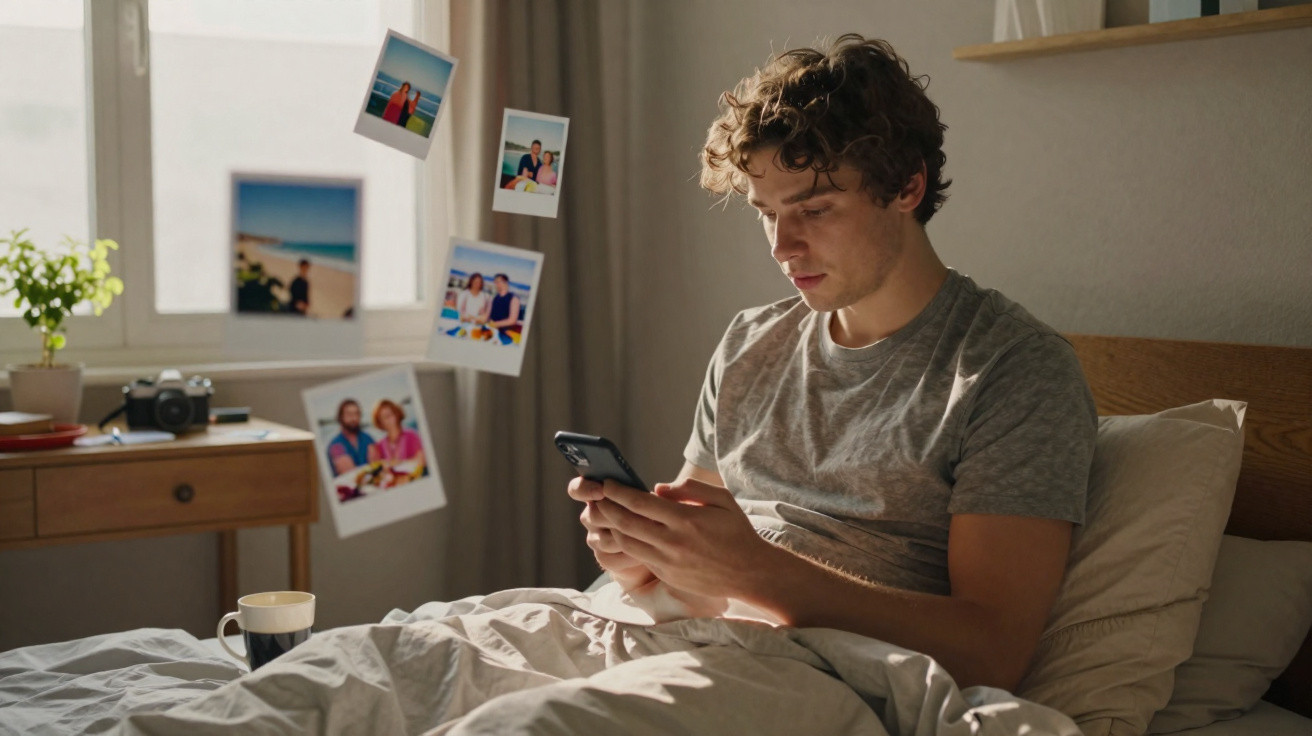
Although social media recommendation algorithms exert a powerful influence over what we consume, we also naturally help them make our lives seem more boring than they truly are.
Social media feeds make the exceptional seem normal
When we open our Instagram or TikTok feeds, or endlessly scroll through YouTube Shorts, much of what we see makes what is out of reach for ordinary people appear normal. Fitness influencers with bodybuilder physiques lounging on the terrace of a four-star hotel in Bali; skydivers leaping from Dubai’s Burj Khalifa; celebrities posing in front of the Colosseum, photographing themselves beneath Iceland’s northern lights; or digital nomads reinventing their working lives every six months, invariably settling somewhere idyllic.
Once we look away from those videos, we return to everyday life: the commute-work-sleep routine, the dreaded Monday ahead, punctuated by interminable meetings smelling of lukewarm coffee, or the car that has just blown its second head gasket in six months. Real life, with all its ups and downs, leaves us with the bitter feeling that the lives we see on social media must be better than our own.
How rareness bias diffusion shapes perception
We are comparing things that cannot be compared: a cognitive bias dubbed “rareness bias diffusion” by Virginia Tech researchers in a study published in the journal MIS Quarterly on 28 January 2026. The idea could be rendered as “the spread of rarity bias”. The more an item depicts an extreme or exceptional experience, the more likely it is to be shared and promoted by algorithms, eventually leading us to believe that the extraordinary is ordinary. Harmful for children and, in some respects, toxic for adults, social media runs at full speed on our dissatisfaction and frustration.
The industrial production of inadequacy
Alice Jang, a professor of information systems, and Viswanath Venkatesh, the department’s chair, carried out six experiments to examine how we decide what to post online and how that selection, in turn, warps our view of reality. Under their protocol, participants were placed in a fictional scenario in which monsters attacked a dystopian city. Researchers showed some attacks far more frequently than others, then asked participants which ones they would choose to share on a social network. When posting online, they invariably selected the attacks they had seen least often.
To test whether this individual bias held at a larger scale, the researchers created a fictional social network populated by thousands of fictional users, each programmed to share content according to the preferences observed among real participants. The outcome was the same, but magnified: rare content took over the entire network’s *feed*.
In truth, our brains are biologically primed to seek novelty, while our need for social validation encourages us to circulate, above all, whatever triggers a strong emotional response. These two natural impulses, when played out collectively in the virtual sphere, strip the ordinary from our screens and leave only a concentrate of exceptions, compressed into an entirely artificial norm.
“People imagine that everyone else is travelling to Paris or doing extraordinary things while they are stuck at home going round in circles,” Jang says. “It creates the impression that they are missing out on life, when in reality most people live perfectly ordinary lives and simply post only their highlights,” she continues.
Lying to ourselves: second nature
Platform algorithms are clearly finely tuned to act as megaphones for the vast collective mirage they have helped create, since their entire business model rests on the attention economy. Yet Jang and Venkatesh show that we are also handing them the stick to beat us with. Before algorithms make any recommendations, we ourselves contribute to distorting reality, because the first selective filter is human rather than computational.
“It is a bias that we simply cannot correct. It is impossible to correct,” Jang admits, adding that “previous academic literature largely overlooks this fact and assumes that people are rational”. Although Venkatesh says that we could lessen this bias’s harmful effects by recognising that social media offers us a distorted reflection of reality, it must be acknowledged that this advice falls rather flat.
If merely knowing that a poison is harmful were enough to keep us away from it, we would long ago have removed cigarettes, alcohol, refined sugar, toxic relationships, fast fashion and junk food from our lives. The same comparison can be made with our tendency to feel miserable in the face of other people’s successes, even when we know how artificial they are. Clear-sightedness is a very poor defence against cognitive dissonance: it may stop us from being completely ignorant, but it does nothing to immunise us against our own vulnerabilities. After all, philosopher Emil Cioran wrote in 1949 in his essay A Short History of Decay: “To live means: to believe and hope, to lie and to lie to oneself.” An irrepressible human condition to which social media has added nothing, except a screen on which to watch it seventy times a day.




Comments
No comments yet. Be the first to comment!
Leave a Comment