
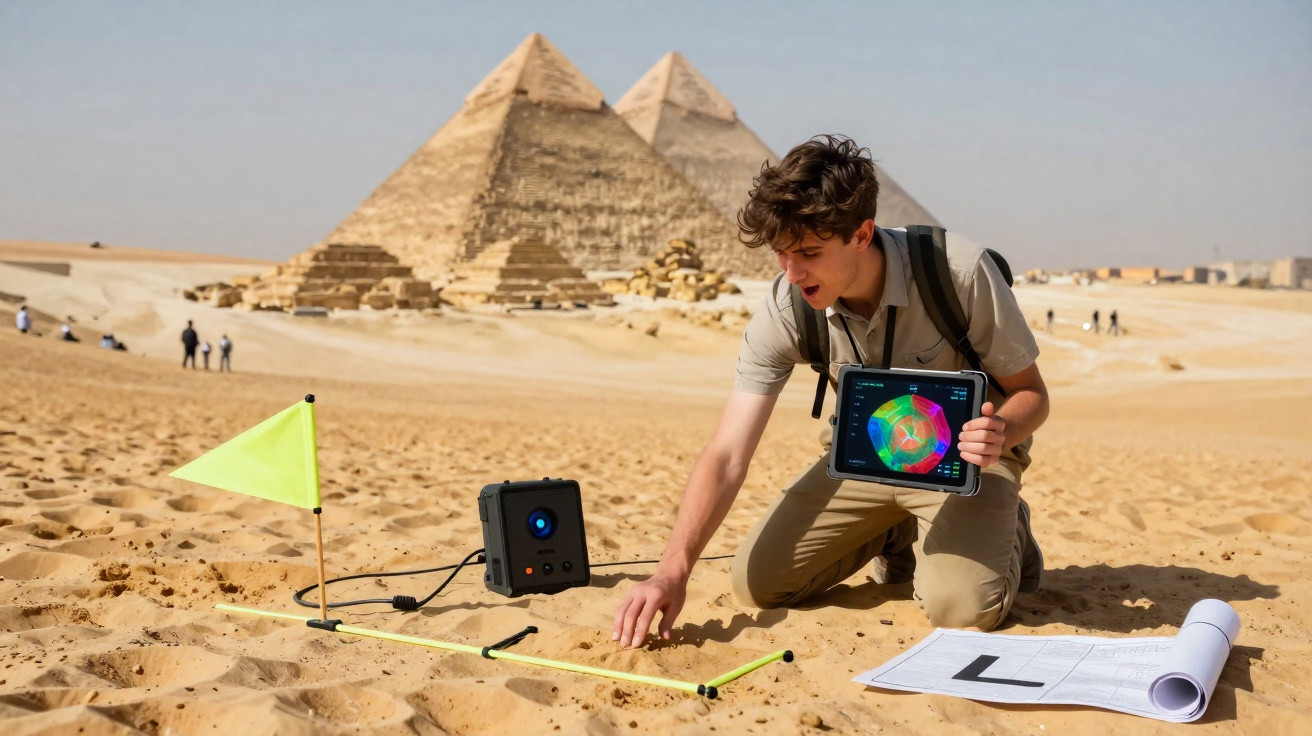
Even in one of the planet’s most thoroughly studied archaeological areas, the sand may still conceal major surprises. Near the Great Pyramid of Giza, researchers have identified an L-shaped underground structure and another, far deeper anomaly in an area where nothing on the surface had drawn attention.
Where was the mysterious structure found?
The finding was made in Giza’s Western Cemetery, situated to the west of the Great Pyramid. In ancient Egypt, this area was used to bury members of the royal family and high-ranking officials, and is chiefly known for its mastabas: rectangular tombs with flat roofs.
However, the section selected by the researchers had received less scrutiny because it contained no visible structures. That seemingly empty appearance is precisely what makes the result so intriguing. A 2024 study published in the journal Archaeological Prospection revealed that something unexpected was hidden beneath this part of the site.
How did researchers detect something buried without excavating?
The team, led by researchers from Tohoku University, combined two geophysical methods. Ground-penetrating radar (GPR) sends pulses beneath the surface and records their reflections, while electrical resistivity tomography (ERT) measures variations in how electrical currents pass through the ground.
By combining the results, the researchers were able to identify contrasts suggesting buried structures. The survey found:
- An L-shaped structure around 2 metres below the surface.
- A formation roughly 10 metres long that appears to have been deliberately backfilled.
- A second anomaly lying far deeper beneath the first structure.
- Marked electrical differences underground that may indicate different materials or empty spaces.
What lies beneath the L-shaped structure?
The instruments identified a second anomaly at depths of roughly 5 to 10 metres. It showed electrical resistance that differed considerably from the surrounding soil, indicating that an underground feature is affecting measurements at that specific point in the Western Cemetery.
The study’s authors considered several explanations, including a mixture of sand and gravel or the presence of air-filled voids. However, they made an important qualification in the paper itself: the data do not make it possible to determine which material is causing the anomaly, although it may represent a large underground archaeological structure.
Do archaeologists believe they have found a tomb?
Not at this stage. The clearly defined geometry of the upper formation has attracted interest because it appears unlikely to be natural. Motoyuki Sato, one of the researchers involved, noted that the shape is highly pronounced, strengthening the possibility of human intervention at the site.
One proposed hypothesis is that the L-shaped structure could serve as an entrance to something larger below. Even so, the scientists remained cautious: no tomb has been confirmed. Without excavation, it is impossible to know whether the signal represents a built structure, a cavity or another underground feature.
Why could this discovery still produce major surprises?
The case is especially striking because it emerged at Giza, a region investigated by generations of archaeologists. It demonstrates how technologies that examine the subsurface without disturbing it can uncover promising areas, even in places where the landscape may appear to be almost completely understood.
The definitive answer, however, remains buried. Until further investigations or excavations take place, the structure will remain an enigma beneath the sands of Giza. It is worth following future studies, as a few metres of sand may be all that separates archaeologists from a discovery capable of explaining what is really there.






Comments
No comments yet. Be the first to comment!
Leave a Comment