
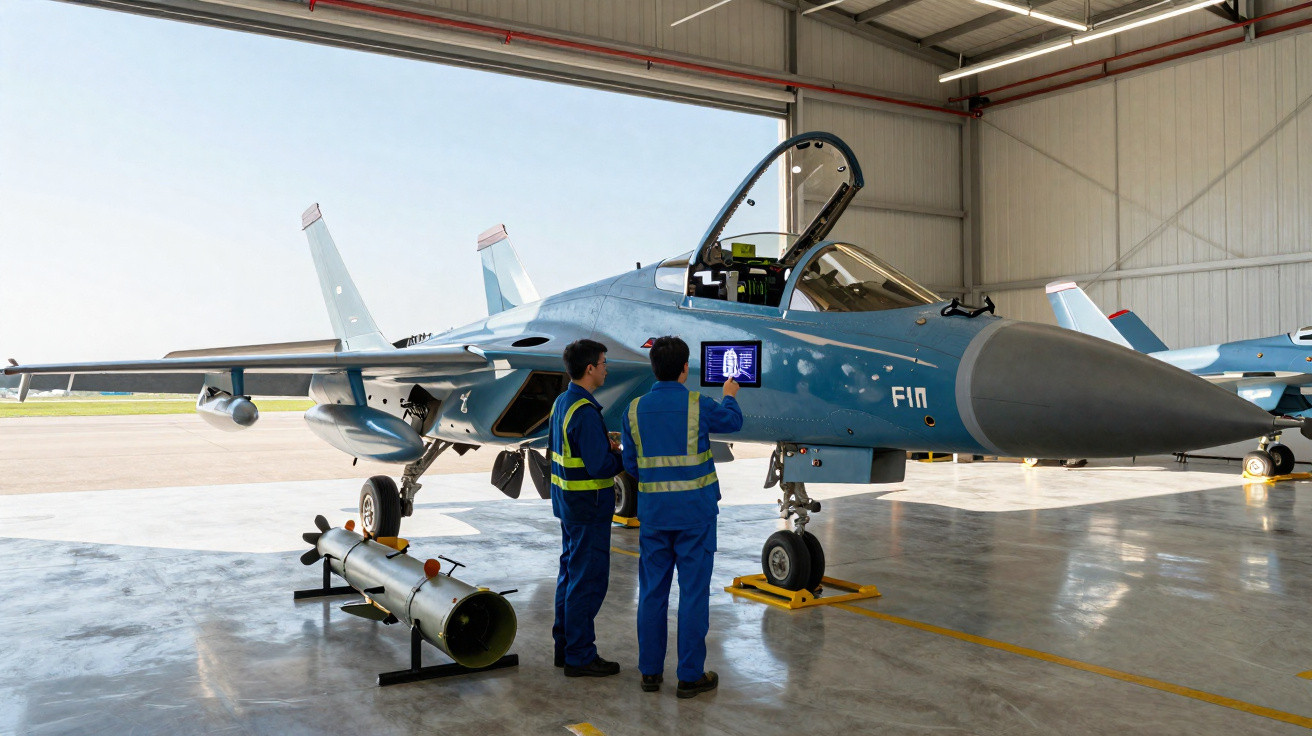
Mitsubishi F-2 fighters operated by the Japan Air Self-Defense Force could receive a modernisation package supplied by Northrop Grumman, a project that would significantly enhance the Japanese combat aircraft’s capabilities and extend its service life. The initiative could offer Japan an option should the multinational sixth-generation GCAP programme face delays.
Japan’s Traffic News reported yesterday that the US company Northrop Grumman “...presented a plan to improve the capabilities of the F-2 fighter aircraft at a media event held in Tokyo on 22 April 2026...”. The proposed Japan Air Self-Defense Force F-2 upgrade includes a radar replacement and the integration of the AN/ALQ-257 IVEWS (Integrated Viper Electronic Warfare Suite) electronic warfare system.
The Mitsubishi F-2 was the first production fighter aircraft fitted with an AESA radar, namely the J/APG-1. Over time, this system was upgraded to the J/APG-2 standard to enable the integration of the AAM-4B medium-range missile. Northrop Grumman’s proposal includes the AN/APG-83 radar, which equips F-16 Block 70/72 aircraft and is used to modernise older Fighting Falcon variants.
Japan’s Air Self-Defense Force is currently introducing the fifth-generation F-35A/B Lightning II fighter, a programme that will be complemented by the multinational Global Combat Air Programme (GCAP), intended to deliver a sixth-generation fighter. The United Kingdom, Italy and Japan are participating in the effort.
Although GCAP received a boost at the beginning of April this year when a key contract was awarded to Edgewing, the joint venture created specifically to lead the future sixth-generation combat aircraft’s design, the programme could still encounter delays, a recurring challenge in projects of this scale. Upgrading the F-2 would therefore allow Japan’s Air Self-Defense Force to gain several years while retaining a highly capable platform.
Mitsubishi F-2 development and production
The Mitsubishi F-2 combat aircraft began its development in November 1988, after Japan and the United States signed a Memorandum of Understanding covering the fighter’s development. Its design would be based on the then General Dynamics F-16 Fighting Falcon.
“...The F-2 has a wing area approximately 25% greater than that of the F-16. This increased area allows more fuel to be carried internally and provides two additional weapons stations. Japan chose to build the wing substructure using graphite epoxy and state-of-the-art co-cured composite technology to maximise strength and minimise weight. In addition to the larger wing area, the F-2 fuselage is approximately 43 cm longer than that of the F-16. The horizontal stabilisers are also larger...”, Lockheed Martin explains.
The first prototype flew seven years after the agreement was signed, with series production beginning in 1996. The first F-2 fighter was delivered to the Japan Air Self-Defense Force in September 2020. Mitsubishi Heavy Industries served as the lead manufacturer, supported domestically by Kawasaki Heavy Industries and SUBARU Corporation, while Lockheed Martin participated as the foreign subcontractor.
The Japan Air Self-Defense Force is the F-2’s sole operator, having acquired 94 production F-2 aircraft in addition to four prototypes. The final aircraft was delivered in September 2011, which also marked the end of the series production line.
Mitsubishi F-2 upgrades and weapons
Over the years, the F-2 fleet has received several upgrades and modernisation measures. These include bringing its J/APG-1 radar up to the J/APG-2 standard, enabling the use of AAM-4B medium-range air-to-air missiles. In 2015, the aircraft received the AN/AAQ-33 Sniper pod and compatibility with the Link 16 tactical data link.
In terms of armament, the F-2 has enhanced both its air-to-air and air-to-surface capabilities. The latter was achieved through the integration of the laser-guided/GPS-guided GBU-54/56 LJDAM bomb. One of the most recent efforts involves the Type 12 anti-ship missile. “...Aircraft that have undergone these modifications will be designated the ‘Enhanced Capability F-2 Model’ and are scheduled to begin operating from Japan Air Self-Defense Force Hyakuri Air Base in Ibaraki Prefecture from fiscal year 2027...”, Traffic News reported.
The weapons system is scheduled to be retired in 2035, by which time GCAP should already have been realised. However, improving the F-2’s capabilities would enable the Japan Air Self-Defense Force to retain a platform suited to the regional context.




Comments
No comments yet. Be the first to comment!
Leave a Comment