
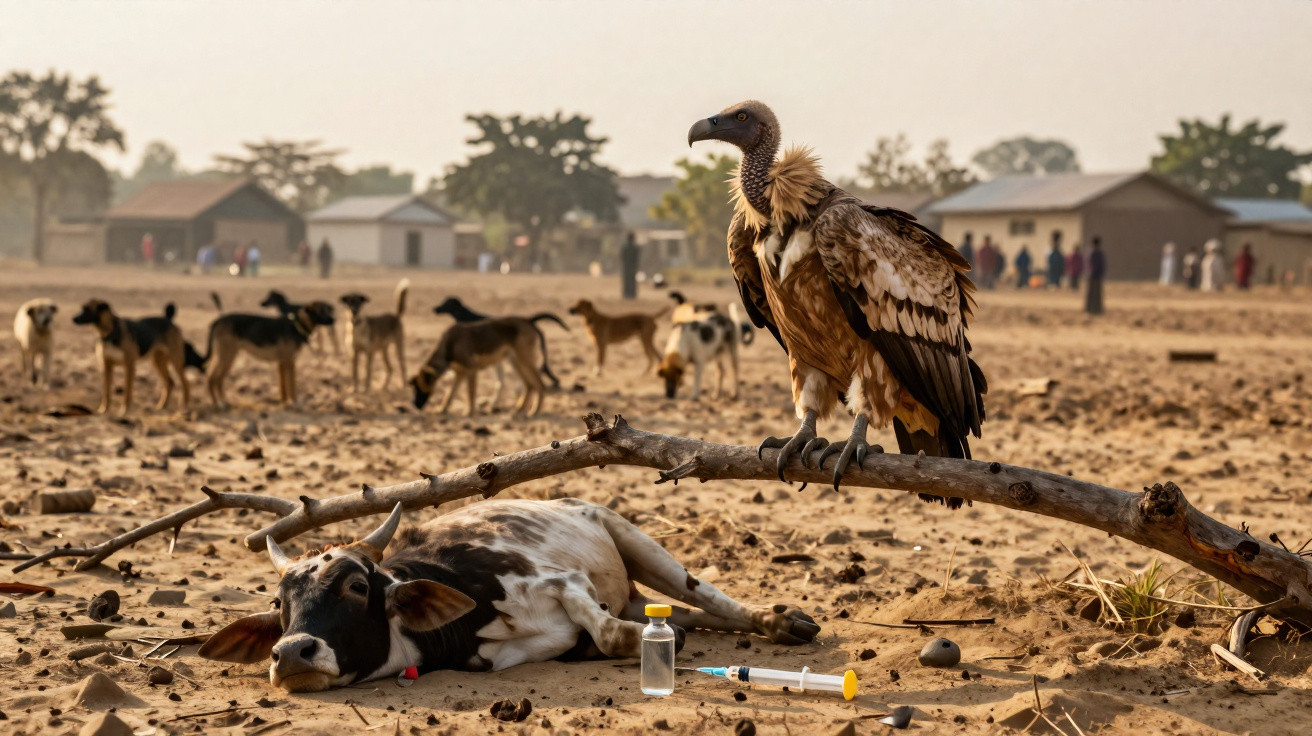
A painkiller for cattle introduced during the 1990s triggered an unforeseen collapse in India’s vulture populations, which have yet to return to their previous abundance.
While some may have regarded the disappearance of this frequently maligned bird, so closely linked with death, as no great loss, it has carried a catastrophic cost for people. A new study puts startling figures on that toll, associating the vultures’ absence with more than half a million human deaths.
Analysis by researchers in the US and UK indicates that mortality rose by more than 4 percent in districts hit by vulture losses after the resulting sanitation ‘shock’. Between 2000 and 2005, this amounted to estimated annual economic damage of US$69.4 billion.
How vulture loss disrupted sanitation in India
As exceptionally thorough scavengers, vultures consume carcasses methodically down to the bone, leaving no flesh behind to decompose. Other scavengers, including dogs and rats, are less tidy feeders and can also carry disease themselves.
A group of vultures can reduce a cow to a skeleton within 40 minutes. Yet the same remarkable efficiency contributed to their collapse after diclofenac began to be used veterinarly in India in 1994. Over the decade following its arrival in the ecosystem, the population plunged from an estimated 50 million birds to just a couple of thousand.
Diclofenac is administered to cattle for pain and inflammation, and remains in an animal’s body for roughly three days. Ill cattle can die before processing the medicine. In places without costly animal incinerators, vultures have traditionally provided a carcass-disposal service for the farming industry.
However, traces of diclofenac in dead cattle poison the birds of prey by damaging their kidneys. Because they cannot excrete it in their urine, uric acid accumulates in a vulture’s bloodstream at concentrations reaching ten times the normal level. Crystals of uric acid are commonly discovered on the organs of vultures killed by diclofenac exposure.
It was only after several papers published in 2004 identified diclofenac as the cause of the vulture crisis that South Asian countries started prohibiting its use in livestock. By then, however, the damage had been inflicted: this improbable keystone species had become functionally extinct in India.
With no vultures left to clear away the remains, disease spread through both rotting carcasses and an increase in other disease-carrying scavengers, including rabid dogs.
Measuring the human cost of diclofenac and vulture decline
Environmental economists Eyal Frank of the University of Chicago and Anant Sudarshan of the University of Warwick in the UK sought to measure the human consequences of this ecological disaster.
As reliable year-by-year data on vulture numbers were unavailable, the researchers combined BirdLife International data on vulture habitat with Indian drug-sales data from 1991 to 2003, particularly for diclofenac and rabies vaccinations. They also used health-outcome records from Vital Statistics of India and livestock census information.
They classified districts as affected by vulture decline where appropriate vulture habitat overlapped with livestock diclofenac use, as well as with other markers of ecosystem health, including poorer water quality and large dog populations.
From 2000 to 2005, all-cause human deaths in these districts rose by an average of 4.7 percent - more than 100,000 additional deaths annually. Using the India-specific value of statistical life of $665,000 per person, the annual cost of human mortality was US$69.4 billion.
The same effects did not occur in districts that were not designated as dependent on vultures.
The authors hope these stark calculations will encourage policymakers to safeguard vital species such as vultures. Although they are viewed as ‘dirty’ because of their connection with death, they deliver ecosystem services that ultimately support human survival.
"Our results suggest that subjective existence values alone may not be the best way to formulate conservation policy," Frank and Sudarshan write.
Safer veterinary drugs for vultures
Progress has already been achieved: veterinary alternatives including meloxicam and tolfenamic acid, neither of which is poisonous to vultures, have replaced diclofenac since its ban in India in 2006.
Nevertheless, other anti-inflammatory medicines - ketoprofen, nimesulide, and aceclofenac - have still not been banned nationally, despite studies finding that they are similarly toxic to vultures.
The study has been accepted for publication in a forthcoming edition of the American Economic Review. The working paper is available online through the University of Chicago.






Comments
No comments yet. Be the first to comment!
Leave a Comment