
Psilocybin and hidden order in the brain
Psychedelics are gaining clinical relevance, and a wave of recent research has examined psilocybin in increasing depth. The work indicates that it can leave enduring, meaningful alterations in brain activity.
Psilocybin, the psychoactive powerhouse found in ‘magic mushrooms’, is believed to promote brain plasticity. By reorganising neural connections and signalling pathways, it may be able to shift mental states that would otherwise remain fixed.
Some people who use it have, in fact, described a heightened sense of universal immersion: space, time and selfhood seeming to break apart and connect, as their identity merges with the wider cosmos.
That may sound somewhat chaotic, and some scientists would agree.
The disruptions psilocybin produces in the brain have commonly been viewed as disorganised and entropic. Certain neural networks move, at least temporarily, from an ordered and rigid configuration towards one that is more disordered and flexible.
However, apparent disorder does not capture the full picture, according to the largest single-site psychedelic brain study so far, published in Nature.
“We uncovered hidden order within that disruption,” explains Devon Stoliker, a neuroscientist and consciousness researcher at Australia’s Monash University, who led the study.
“Under psilocybin, brain networks that help us process our inner world and the world around us became less distinct, but reorganised into patterns that reflected what people were experiencing.”
“This was strongest in people who had more positive psychedelic experiences and felt less separate from the world around them.”
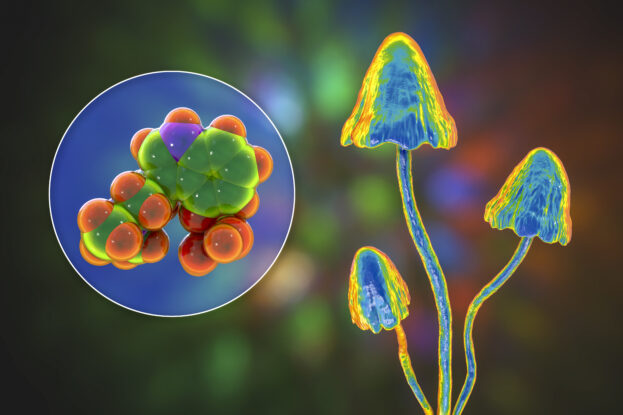
The psychedelic psilocybin molecule was originally derived from mushroom species. (Kateryna Kon/Science Photo Library/Getty Images)
How the Monash psilocybin study examined the brain
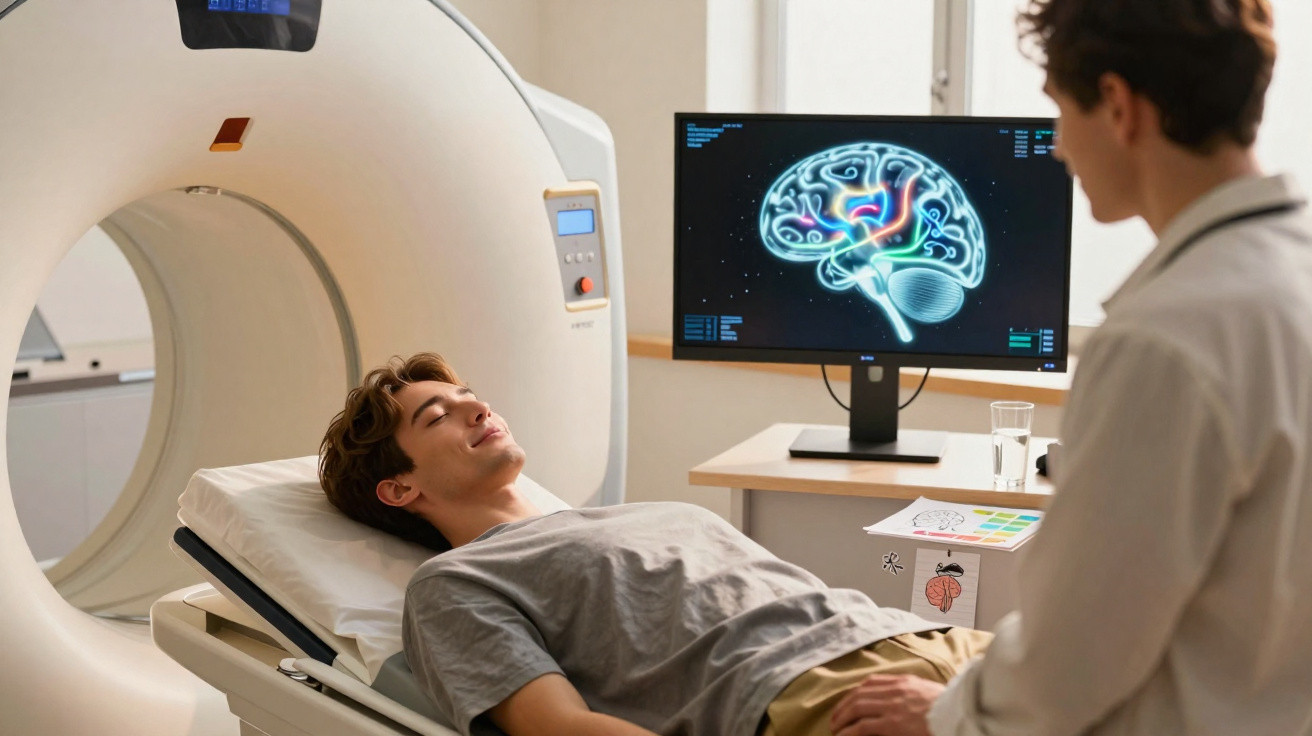
Across five years at Monash University, the team combined functional magnetic resonance imaging (fMRI), electroencephalography (EEG), machine learning models and questionnaires to investigate how the mind responds naturally following a dose of psilocybin.
The research included 62 healthy adults who had never previously used psychedelics. Their brains were scanned both before and after psilocybin treatment as they rested, meditated, listened to music or watched a silent film featuring moving clouds.
By charting blood-oxygen signals between brain regions, the scientists found reduced functional modularity: the normal separation of brain activity into distinct networks.
A key mediator seems to be the default mode network (DMN), a connected group of brain regions.
Like a neurological air-traffic controller, the DMN integrates information from areas that process abstract ideas such as space, time and identity. It is particularly active during introspection and daydreaming.
Psilocybin appears to loosen the boundaries between neural networks, enabling new neurological interactions.
Watch the study video on YouTube
The psychedelic may consequently change a brain gradient spanning the inward-looking DMN and the externally focused visual network, which processes what we see. This could support a shift between internal and external attention.
Of the experimental settings, listening to “ethereal” music appeared to produce the strongest global organisation of the brain.
When participants watched a film, the effects were weaker and neural networks were less disrupted than when they had their eyes shut while resting, meditating or listening to music.
Put simply, the extra visual stimulation influenced their psychedelic experience.
“This shows that context is not just background to the psychedelic experience. What a person is doing and focusing on shapes how their brain responds,” explains Adeel Razi, a computational neuroscientist at Monash University and the study’s senior author.
“For treatment, that reinforces why the environment and what a person does and experiences during the psychedelic session matter.”
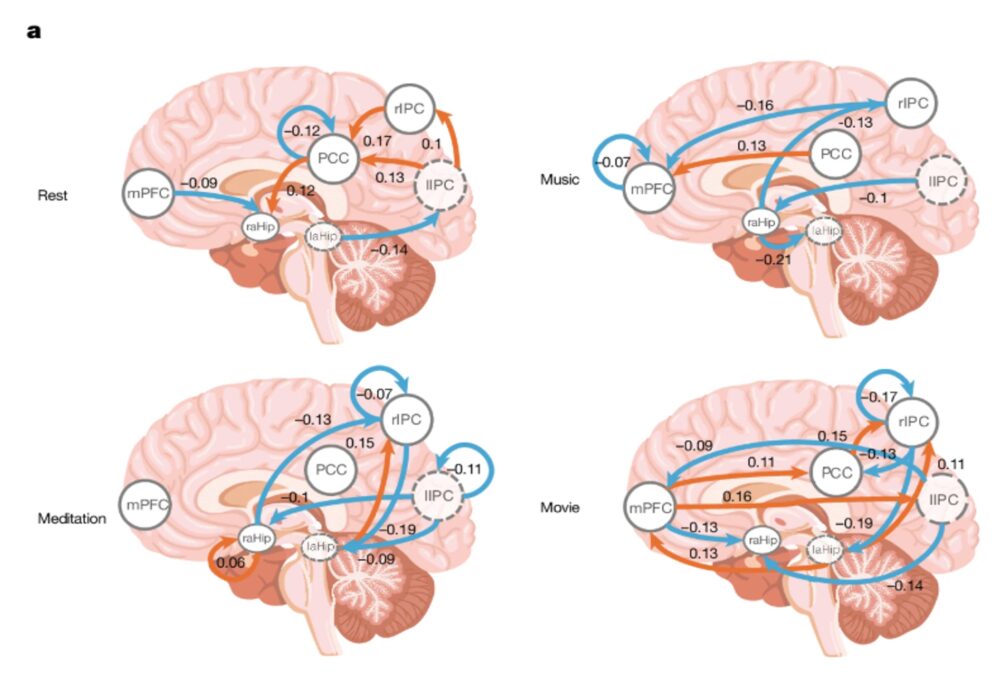
The researchers used machine learning to map changes in brain connectivity after psilocybin treatment. Different patterns emerged depending on what participants were doing at the time. (Stoliker et al., Nature, 2026)
Embeddedness and potential psychedelic therapy
The team emphasises the importance of what it calls embeddedness: “a perceptual and cognitive realization of being part of a unified whole.”
Psilocybin seems to foster a feeling of unity with the world and one’s environment. This may be an essential therapeutic feature, potentially helping to relieve existential distress associated with feeling separate, with no hallucinations required.
The researchers also propose that experiences including the dissolution of selfhood and the collapse of existential boundaries may be major drivers of psilocybin’s observed effects.
“People who showed strong reorganisation also reported greater positive psychological changes the following day,” Stoliker says, adding that this detail was not evident in earlier brain-imaging research, which may have measured average effects across groups.

It is important to note that the study enrolled healthy adults rather than patients. It was also open-label, so it had no placebo group.
Even so, its results could help refine psychedelic-based healthcare strategies.
Research has shown that one dose of psilocybin may relieve depression symptoms for months. Such findings prompted Australia to legalise prescription psilocybin therapy for treatment-resistant depression in 2023, alongside MDMA therapy for PTSD.
Other possible therapeutic applications also look encouraging. Animal models, for instance, indicate that psilocybin may provide a treatment option for anorexia nervosa, although studies in humans are still required.
As clinical trials have demonstrated, however, these much-promoted psychedelic therapies do not affect everyone in the same way.
Related: Huge Psilocybin Dose Has Incredible Effect on Elderly Dementia Patient
The new findings from the Monash research offer one possible reason why psychedelic-assisted therapy benefits some people more than others, as well as a potential way of measuring those differences.
“The finding that the organization of brain activity tracks [with] the transformative quality of subjective experience helps to elucidate how the psychedelic state translates into psychological change,” the researchers conclude.
If these brain-scan measures can be applied to patients, Razi adds, “this could eventually help clinicians understand how someone is responding and predict who is most likely to benefit.”
This research was published in Nature.
This article was fact-checked and edited by Clare Watson. Although we take pride in our process, we are only human. If you spot an error, please let us know.





Comments
No comments yet. Be the first to comment!
Leave a Comment