
The magnificent Step Pyramid, rising from the ancient Egyptian necropolis at Saqqara, is undeniably among the marvels of the ancient world.
Built roughly 4,500 years ago, the tomb of Pharaoh Djoser is Egypt’s earliest known colossal stone construction. It stands not only as a monument to the king, but also to the engineering brilliance of the people who lived in this land millennia ago.
How this architectural achievement was built – particularly because it differed so dramatically from every earlier structure – has long fascinated archaeologists and historians.
A team headed by Xavier Landreau, an Egyptologist at France’s Paleotechnic, now believes it may have identified an important piece of the puzzle.
Saqqara’s possible water-powered construction system
The team argues that a formerly unexplained structure at Saqqara was actually a check dam, lending support to the idea that a water-powered lift assisted in moving the materials used to construct the pyramid.
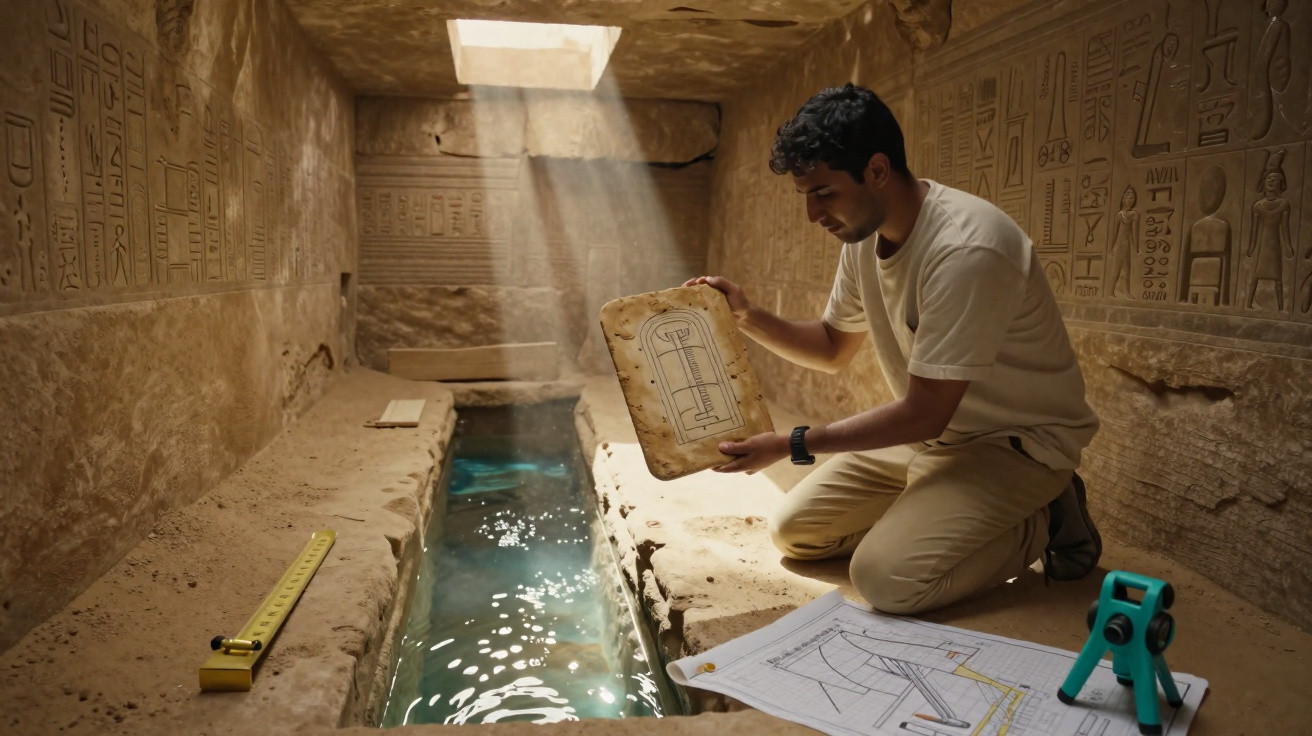
Their case is reinforced by several further features. The researchers interpret these as traces of an unusual hydraulic lift: a central shaft into which water, directed from beneath, could have surged like lava within a volcano. This flow could have raised a floating platform able to carry large stones to the pyramid’s summit.
This new reading of the structures could account not only for the pyramid’s construction, but also for several previously unidentified Saqqara features, bringing them together as parts of one coherent system.
“Based on a transdisciplinary analysis, this study provides for the first time an explanation of the function and building process of several colossal structures found at the Saqqara site,” the researchers write in their paper.
“The results show that the Gisr el-Mudir enclosure has the feature of a check dam intended to trap sediment and water, while the Deep Trench combines the technical requirements of a water treatment facility to remove sediments and turbidity. Together, these two structures form a unified hydraulic system that enhances water purity and regulates flow for practical uses and vital needs. Among the possible uses, our analysis shows that this sediment-free water could be used to build the pyramid by a hydraulic elevator system.”
The Step Pyramid and its enigmatic surroundings
Djoser’s pyramid is an extraordinary sight: an immense limestone structure above the surrounding necropolis, formed of six ‘steps’ that create its instantly recognisable silhouette against the sky.
Its construction represented a watershed in ancient Egyptian civilisation, signalling the emergence of the enormous tombs where kings and queens would be buried for their passage into the afterlife.
Yet several nearby structures have a far less certain purpose.
A few hundred metres from the pyramid stands the Gisr el-Mudir enclosure, a vast rectangular wall surrounding an area large enough to contain several football pitches. Outside the pyramid, a series of pits has also been cut into the ground within a deep trench encircling the monument.
The researchers suggest that these features could be connected. Their work indicates that the enclosure may have acted as a check dam, intended to collect water from the floodplain that once occupied the area. Directing this water through the trench could have removed sediment as it passed through each section.
Water cleared of sediment might then have crossed the dam, travelled through a trench and risen through the shafts of the pyramid while it was being built. In turn, it could have lifted a wooden platform, raising heavy building materials to the point where they were required.
Limits of the hydraulic lift theory
It is an original proposal, but one that requires evidence beyond models showing that it could have worked. For instance, it remains unknown how much water was available locally when the pyramid was built, or how the flow of water into and out of the pyramid shafts could have been managed.
Other transport methods were also probably necessary, at least to bring heavy materials to the lift and to raise them during periods when too little water was available for it to function. The potential use of hydraulic lift technology therefore does not overturn earlier research into the monument’s engineering. As in the present day, a combination of technologies suited to different requirements was likely to have been employed.
The findings instead underline the possibility that the ancient Egyptians’ ingenuity has been underestimated, and indicate that pyramid-building techniques deserve closer examination.
“The hydraulic lift mechanism seems to be revolutionary for building stone structures and finds no parallel in our civilization,” the researchers write.
“This technology showcases excellent energy management and efficient logistics, which may have provided significant construction opportunities while reducing the need for human labor. Furthermore, it raises the question of whether the other Old Kingdom pyramids, besides the Step Pyramid, were constructed using similar, potentially upgraded processes, a point deserving further investigation.”
The research was published in PLOS One.





Comments
No comments yet. Be the first to comment!
Leave a Comment