
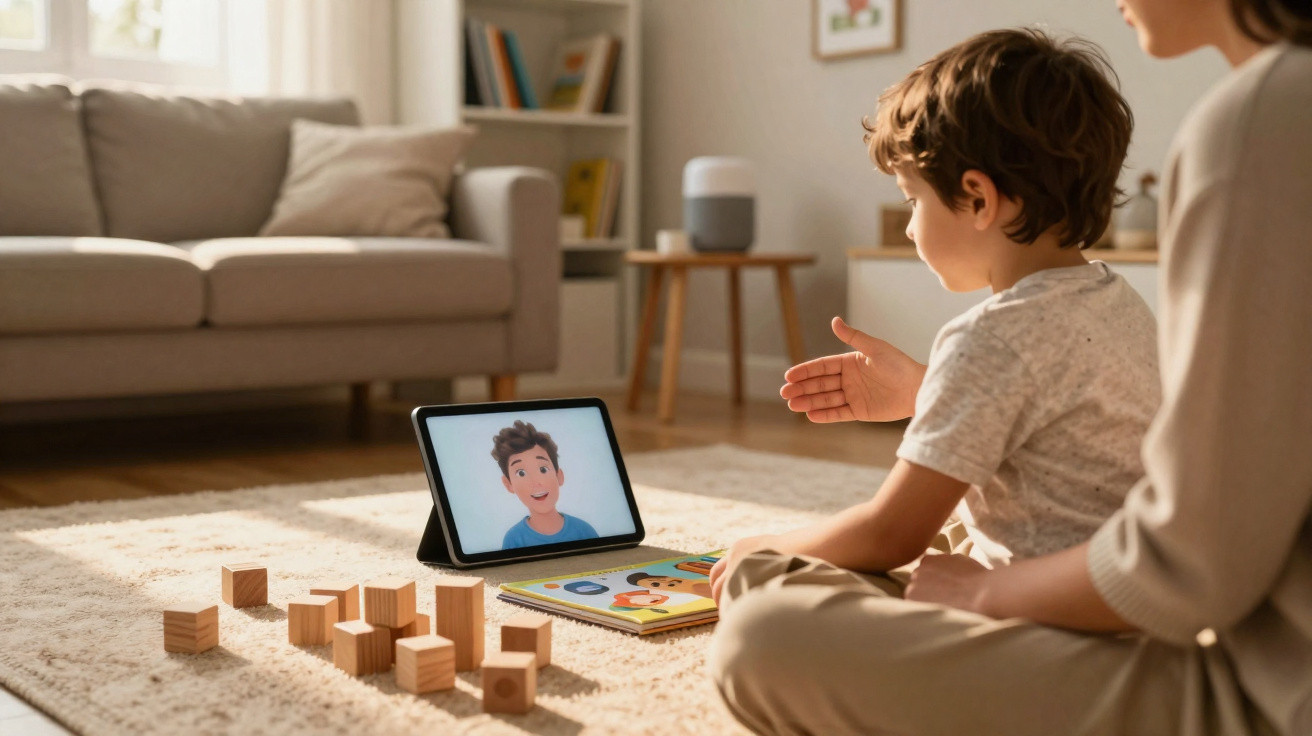
After spending years trying - sometimes desperately - to keep our young children away from screens, we now face an altogether different reality. Through AI, with its complex yet inherently compliant algorithms, they can form bonds with conversational partners that do not exist. Can this element truly be accommodated within their social and emotional development?
Four years after the shockwave created by ChatGPT, launched in late November 2022, AI has spread from the bottom up through every part of society, driven by users’ informal habits and the subject of extensive legitimisation efforts in many businesses. It has also crossed the school gates, forcing the education system to include training in this technology at secondary level, so that pupils can understand its limitations.
AI giants are already targeting our children; that is a fact. Talking soft toys powered by LLMs (Large Language Models) are already available on Amazon, as is the Miko companion robot, sold in Europe and powered in particular by GPT-4. The French Nyo soft toy is also expected to launch in France in summer 2026. The market remains small compared with the United States, but it is almost certain that this commercial push will succeed where passive screens failed: holding children’s attention through interactivity and simulated reciprocity.
Dana Suskind, a paediatric surgeon at the University of Chicago and author of the excellent guide Human Raised: Nurturing Connection, Curiosity & Lifelong Learning in the Age of AI, urges us to look at the issue differently. “All those academic skills we work so hard to develop in our children are now mastered by AI. Overnight, it absorbed everything: maths, logic, reasoning and even a semblance of empathy. It can simulate it all. But what it cannot do, what it is incapable of, is feeling care,” she explains. How much room can we give the machine without allowing it to take our place? Above all, how do we equip a child to resist a technology that imitates affection better than it will ever feel it?
Making mistakes and trying again: AI undermines the foundations of child development
Most of a child’s brain is built between birth and the age of five: nearly 85% of its physical structure develops during this brief period. Suskind likens this work to assembling a PC: “Those early years are the hard drive, the memory, the RAM; the rest of schooling consists of software updates.” She recognises the limits of the comparison: unlike a computer assembled from inert components, the brain only develops through contact with another human being.
“Every second, one million new neural connections are formed,” she says, but only under one non-negotiable condition. Psychologist Patricia Kuhl identified this filter, the “social gateway”: “only reciprocal human interaction allows this to happen”. A television screen may pour out pictures and speech, but it remains deaf to a child’s attempts to engage, leaving the gateway closed. “Television does not wire the brain because it is not reciprocal,” Suskind sums up. For a long time, this need for reciprocity was our strongest assurance that no machine could replace a parent.
AI and the social gateway
“But suddenly, these technologies can imitate human interaction and open the social gateway,” Suskind warns, referring to AI. What once protected very young children was devices’ inability to adapt to them: a cartoon unfolds in exactly the same way whether the child watches, laughs, cries or wanders off to play. By contrast, the social gateway requires a contingent response, prompted by the child’s behaviour.
AI crossed that technological threshold long ago: it can read a child’s expressions and respond personally, much as a parent responds to their baby’s babbling. For a developing brain that cannot yet tell the difference between consciousness and a program, the illusion is flawless - yet it is profoundly misleading, and potentially harmful.
This is where Suskind sees the risk, which she calls “artificial attachment”. It is undeniably an emotional bond, but its function is far deeper and more formative: “It is the biological system through which the brain learns to regulate emotions, trust others and feel safe enough to explore the world,” she explains. It is calibrated through contact with inevitably imperfect adults, who are sometimes available and sometimes distracted, at times calm or angry; it is the friction of real life that shapes character.
AI, by contrast, offers unfailing availability, and that is what worries the paediatrician. A child “partly raised by these perfectly reciprocal technologies” may learn that the entire world must instantly obey them. In her view, this is a developmental trap: rather than learning to live among beings who are “unpredictable, with their own thoughts and feelings”, the child comes to expect the impossible - the immediate submission of their surroundings. Put simply, because it responds too perfectly, AI may leave them ill-equipped for life.
What should you do to protect your child?
Suskind advises keeping all AI that interacts directly with a child, whatever its form, away from the first three to five years of life. This recommendation also applies to screens, as many studies have demonstrated their harmful effects on very young children’s brain development. “A resolutely human childhood remains the best way to prepare our children,” she argues, even if that means accepting a paradox: “A low-tech childhood is almost the best way to prepare for a future saturated with technology.”
For later on, the paediatrician has developed a method that encourages you to consider the purpose of an AI-enabled play object intended for children. Called DETECT (Design, Ethics, Trouble, Evidence, Confidentiality, Teaching), it is an assessment framework you can apply before buying anything.
Using the DETECT framework for AI toys
Design: what was the object created for - to educate, entertain or provide companionship - and is it aimed at the child, or does it support you as the parent? Ethics: was it trained on data representing diverse profiles, or on adult data later adapted for children? Trouble: have studies already identified harmful effects, and does the manufacturer provide guidance on good practice? Evidence: beyond its marketing packaging, does independent, peer-reviewed research substantiate its claimed benefits? Confidentiality: what happens to the data collected, where is it stored and for how long? Teaching: what does your child learn through interacting with it? These questions make it possible to immediately rule out toys that mimic affection, retaining only, potentially, those that enrich family dynamics without ever replacing human presence.
Although the DETECT framework can help, trust your parental instincts first. If you understand technology, AI and its excesses, you already know how wary you need to be. Without giving in to blind technophobia, simply follow one golden rule: AI must never come between you and your child. You do not have to reject it entirely, but even if you tried, the consumer technology market - with AI at the forefront - is clearly designed to enter your home whether you want it to or not. Still, “living with it” has never meant “relying on it”: precisely when a technology is everywhere, it becomes essential to retain control over what you allow it to do and what you forbid it from doing. Your “parental GPS”, to use Suskind’s phrase, is still intact, and there has never been a better time to trust it.



Comments
No comments yet. Be the first to comment!
Leave a Comment