
For all modern life’s difficulties and disappointments, there is at least one brilliant and deeply satisfying consolation.
Thanks to the efforts of thousands of scientists, humanity can now look farther into the Universe and deeper inside cells than ever before.
We can also investigate our shared past, including discovering what the world smelled like to our ancient forebears.
Reconstructing Pompeii’s ancient smellscapes
Through a field anthropologists call sensory archaeology, researchers can recreate ancient "smellscapes".
One example is the newly established scent of wealthy Pompeian homes: woody and earthy, with a touch of citrus.
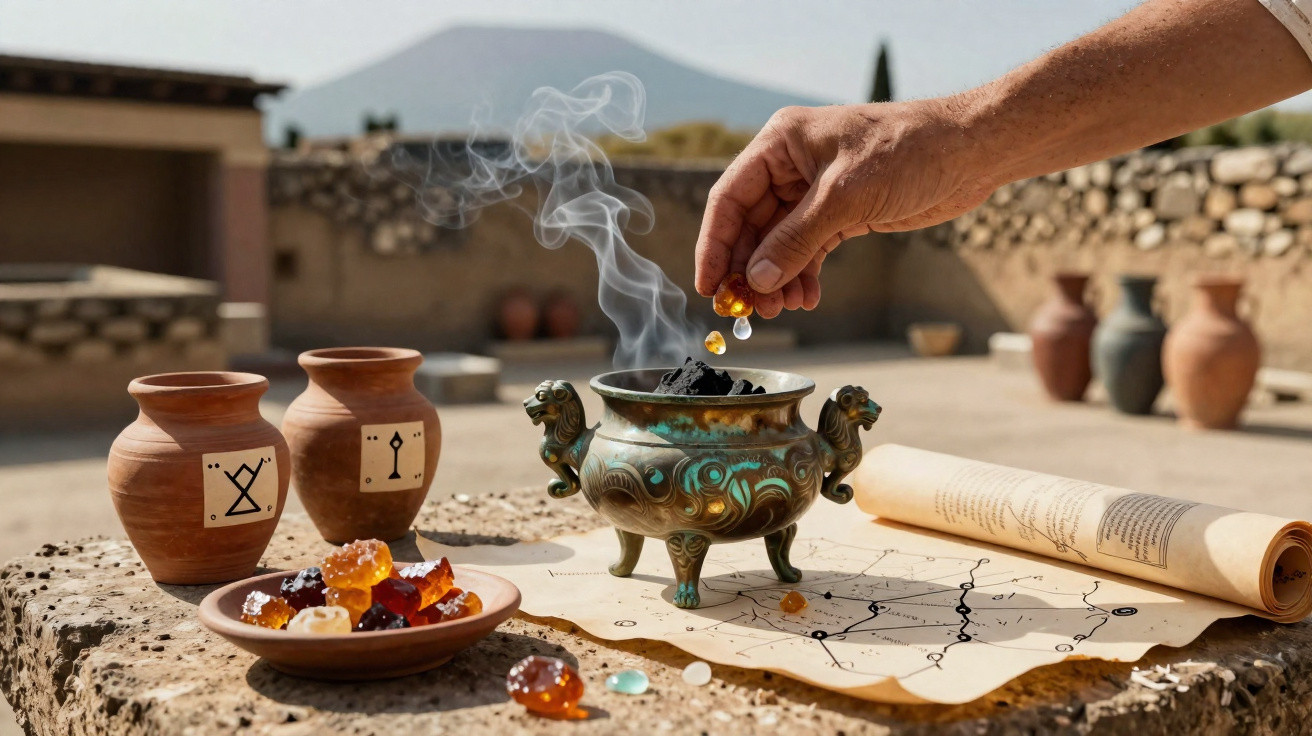
A European research team uncovered this unusually precise detail by examining ancient incense burners dating back 2,000 years.
Watch the related video on YouTube
The study examined two terracotta incense burners, also called censers, excavated decades earlier at Pompeii and the neighbouring settlement of Boscoreale.
One vessel was recovered from a building being turned into an inn when Mount Vesuvius erupted in AD 79. The other remained in a domestic shrine at a countryside villa, together with other ritual items.
Their form, ornamentation and archaeological setting all indicated one use: the burning of fragrant offerings in household religious rites.
Researchers already knew such rituals occurred because Roman writers recorded them. Incense, wine, flowers, fruit and grain were routinely presented to domestic deities called the Lares and Penates.
For instance, in Book Four of The Elegies, the Roman poet Propertius wrote: "Give me soft costmary, and offerings of lovely incense."
Costmary is a herb commonly valued for both its fragrance and medicinal applications.
Until now, however, archaeologists had found very little direct physical evidence of precisely what people burned.
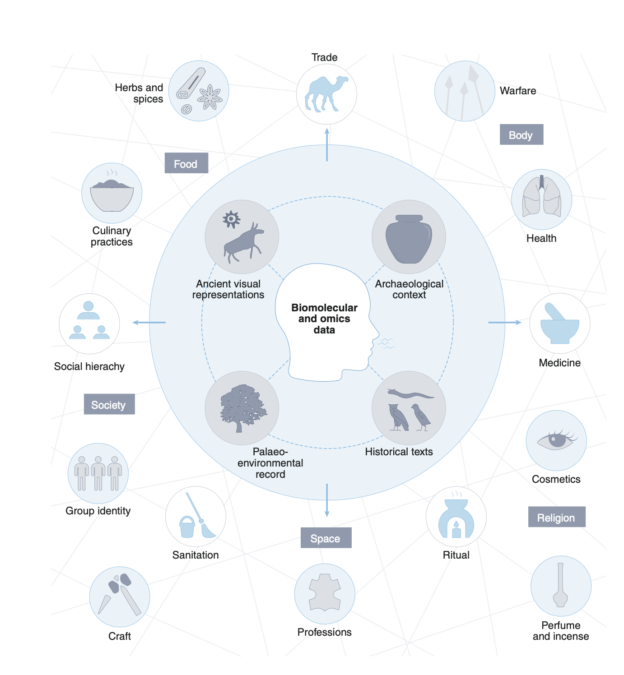
Diagram representing how biomolecular data can reconstruct ancient experience, behaviour and society. (Huber et al. *Nature Human Behavior, 2022.)*
How the ancient incense burners were analysed
To address this gap, the team used a sophisticated range of chemical methods. They took minute samples from the middle and outer edges of both censers, steering clear of the surface to limit present-day contamination, before conducting three complementary analyses.
One test sought microscopic mineral residues produced when plants burn. A second looked for phytoliths - minuscule silica structures formed by plants that remain long after the plants themselves are gone.
Lastly, gas chromatography and mass spectrometry were used to detect molecular signatures from ancient resins, oils and other organic materials.
The first unexpected result concerned what was absent. Neither incense burner showed signs that dried animal dung, a fuel widely used elsewhere in the ancient world, had been burned.
Both containers instead held abundant microscopic evidence of burned woody vegetation.
The phytolith evidence points to a blend of plants, likely including oak, laurel and stone-fruit-family species, as well as several grasses. They may have fuelled the incense, although some could also have constituted offerings themselves.
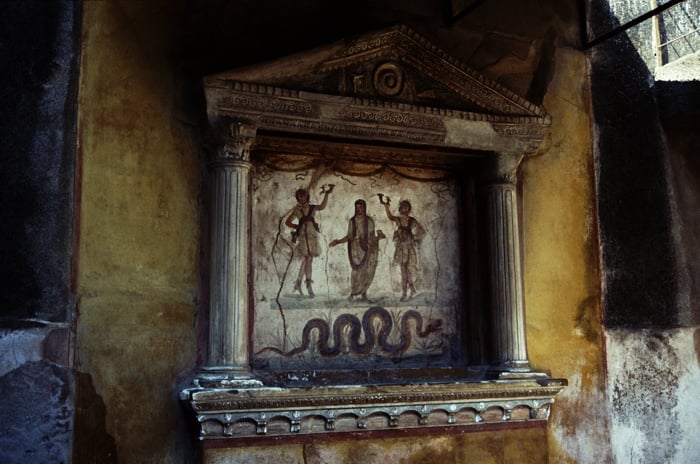
Altar of the Lares at House of the Vettii in Pompeii. Incense would have been burned as part of a daily practice to honour guardian spirits, in a bowl suited to that purpose that would have sat on the ledge of the altar. (Vanni Archive/The Image Bank Unreleased/Getty Images)
Many of these plants could be obtained locally near Pompeii. This accords with earlier finds of charred figs, pine nuts and other vegetal offerings in Pompeian shrines, supporting the view that ordinary plant life was central to household worship.
Imported resin and Pompeii’s trade networks
Only one censer retained chemical traces of a distinctive resin. This is significant not just because its scent remains known today, but also because it reveals the reach of ancient Rome’s trading connections.
The team found that the resin belonged to the same botanical family as frankincense, although it was probably elemi, acquired from the distant ends of the trade routes linked to the Roman empire.
This imported resin provides another indication of Pompeii’s role within an extensive ancient commerce network.
The authors propose that aromatic resins from Arabia, tropical Africa and Asia travelled north across the Red Sea, then through Alexandria and onwards to Italy, ultimately arriving in homes such as those at Pompeii.
Although written accounts document this practice well, the finding is the first direct archaeological evidence that imported aromatic resins were burned in Pompeian household worship. The effort made to obtain a particular fragrance demonstrates its importance.
The same censer also yielded possible chemical indicators of grape products, potentially wine or vinegar. The authors emphasise that these residues require cautious interpretation, since modern contamination cannot be ruled out; if authentic, though, they would correspond strikingly with Roman religious practice.
Ancient writings describe preliminary sacrifices in which worshippers poured wine while burning incense at the same time. The modest ash residues may therefore have retained the chemical remains of rituals performed nearly 2,000 years ago.
That a fleeting smoky smell mattered so much to Pompeii’s people - and that it can now be reconstructed - may be about as close as we can come to a real-world time machine.
The research was published in the journal Antiquity.
This article was fact-checked by Rachel Garner and edited by Peter Dockrill. Although we take pride in our process, we are only human. If you notice an error, please let us know.





Comments
No comments yet. Be the first to comment!
Leave a Comment