
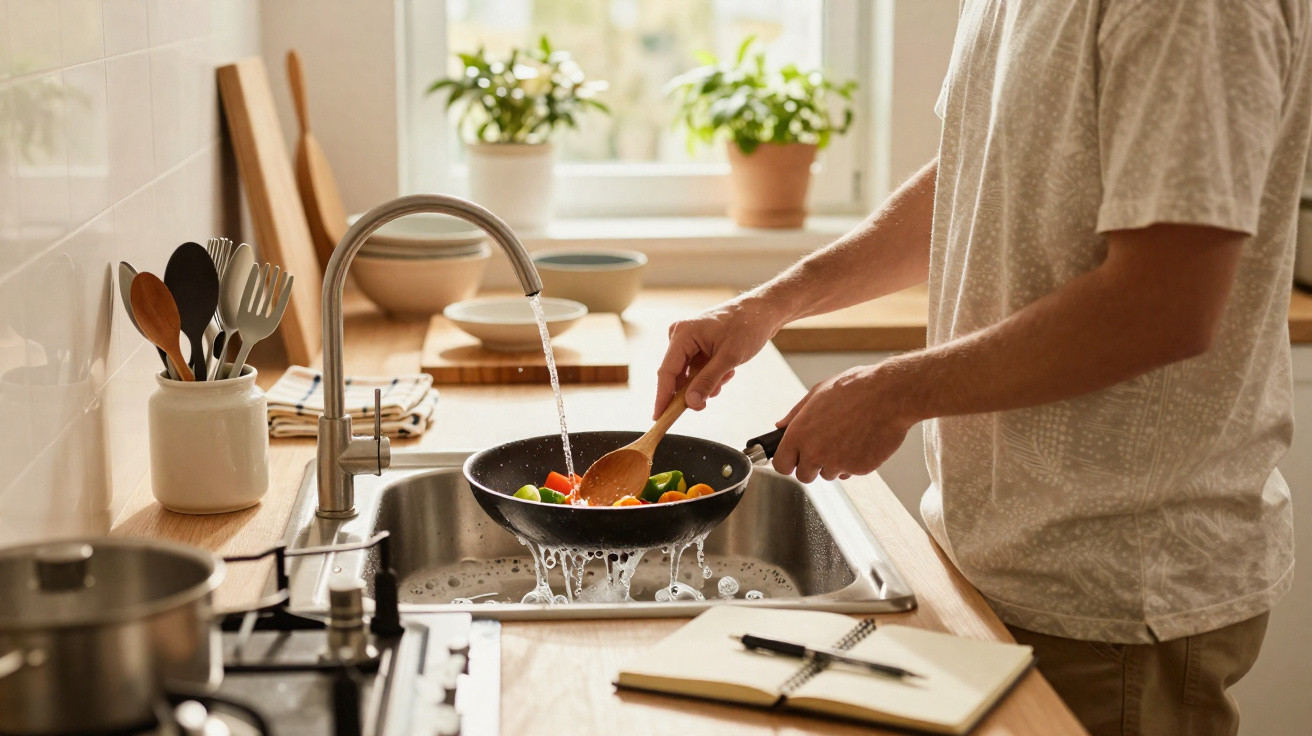
People who wash the dishes while cooking are not simply trying to keep the sink empty. This routine can work as a way to cut down on visual clutter, make use of natural pauses in the cooking process, and stop a tiring job being left until after the meal.
Why do some people clean utensils during cooking?
Those who follow this pattern usually act as soon as there is a chance, rather than waiting for plates, pans and cutlery to build into a stack. While food is in the oven or a pan is simmering on a low heat, they use those minutes to wash what will no longer be needed.
Handled this way, organisation turns one large job into smaller actions. Instead of confronting an entire dirty kitchen at the end, the effort is spread throughout cooking, so the meal finishes with fewer items left to wash.
What does the habit say about future comfort?
Washing up while cooking can show consideration for the so‑called “future self”. The person accepts a small effort now in exchange for a tidier kitchen later-when they will probably be more tired and less willing. The same logic can show up in other everyday behaviours:
- Putting each ingredient away straight after using it;
- Filling up the vehicle before the fuel runs out;
- Replying to an important message without putting it off;
- Laying out clothes and items for the next day;
- Sorting small loose ends before they pile up.
How does visual clutter affect attention during cooking?
Used pans, open packaging and utensils left around create multiple stimuli competing for attention. By clearing these objects from the worktop, the person lowers the environment’s cognitive load and can see the ingredients, the recipe steps and the available space more clearly.
That relief does not mean every kitchen has to stay spotless while it is being used. The advantage mainly appears when cleaning prevents an overload of items from getting in the way, causing forgetfulness, or making it hard to find the chopping board, spoon or the seasoning that is needed.
How can you make cleaning an automatic task?
One practical approach is to link washing up to moments that already belong to the recipe. This method-known as an anchor moment-reduces the need to decide when to start, because a familiar action becomes the cue for the next task:
- Wash the chopping board while the water comes to the boil;
- Wipe the worktop when the food goes into the oven;
- Put spices away during simmering;
- Rinse bowls before serving the dishes;
- Leave the sink clear before sitting down to eat.
Household organisation does not, by itself, define personality
The habit may connect to anticipation, planning and a preference for a less stressful routine, but it does not function as a psychological diagnosis. Some people clean during cooking because they like it, others because they have limited space, and many leave everything until afterwards without that implying a lack of discipline.
The key point is how each person manages effort and time. When cleaning during cooking reduces clutter and avoids a sink full of dishes after the meal, it turns short pauses into a practical way to protect one’s own comfort in the hours that follow.





Comments
No comments yet. Be the first to comment!
Leave a Comment