
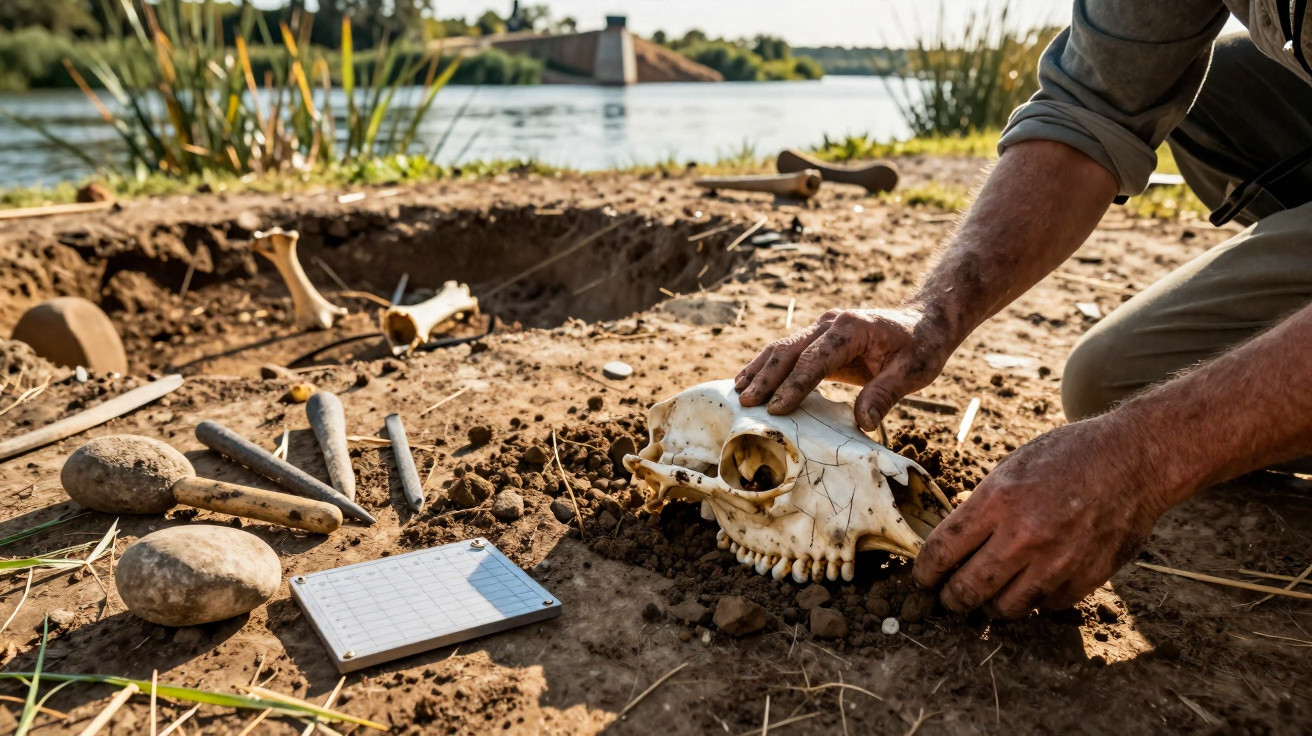
Around 400,000 years ago, long before the emergence of Homo sapiens, human groups living in central present-day Germany did not rely solely on huge animals for survival. Bones recovered at Bilzingsleben reveal an unexpectedly deliberate strategy: these hominins hunted young beavers, used their meat and fat, and probably removed their pelts as well.
What did archaeologists find at Bilzingsleben?
The archaeological site of Bilzingsleben, in Thuringia, has preserved a substantial collection of Middle Pleistocene animal remains. These included bones from at least 94 beavers. Researchers from the universities of Mainz and Leiden, together with the LEIZA centre, re-examined the material to establish how the animals died and how they were used.
Using magnifying lenses and digital microscopes, the team detected marks made by stone tools on several parts of the skeletons. The placement of these cuts showed that the carcasses were not merely encountered occasionally: they were processed systematically, including the removal of pelts and the division of body parts.
Why did humans choose young beavers?
One feature made the finding even more striking. A large proportion of the animals were young adults: individuals that had already reached a good size but were probably less experienced at escaping predators. According to the researchers, such a concentration is unlikely to have resulted from chance alone.
- The analysed remains came from at least 94 beavers found at the German site.
- Many were young adults, fully grown and comparatively rich in fat.
- Tool marks point to the processing of different areas of the carcasses.
- The pattern of cuts also suggests that beaver pelts may have been used.
Fat may help account for this preference. Very lean meat on its own does not provide a balanced diet, while energy-rich fatty resources would have been especially valuable to Pleistocene populations. Well-fed beavers may therefore have offered a concentrated source of energy in addition to meat from large herbivores.
Did beavers also provide pelts?
The marks identified on the bones occur not only in areas linked with removing meat. Some are consistent with movements made during skinning, leading the authors to consider that pelts may have been valued too. The exceptional preservation of the material made it possible to reconstruct these stages in unusual detail.
The researchers are more cautious when considering what these pelts may have been used for, as organic materials rarely survive for hundreds of thousands of years. Even so, the possibility broadens our understanding of these human groups, showing that a relatively small animal could provide several resources from a single hunt.
Why did we assume they hunted only large animals?
For a long time, the archaeological record appeared to indicate that early hominins strongly favoured large mammals. There is, however, a preservation bias: bones from large animals are more likely to survive and be discovered, whereas remains of small animals, and especially plant foods, disappear far more easily.
This imbalance may have distorted our picture of prehistoric diets. The repeated exploitation of beavers at Bilzingsleben shows that a more varied diet already existed around 400,000 years ago, long before broad food-gathering strategies were more commonly associated with later human populations.
How do beavers change human history?
The discovery helps dismantle the image of ancestors simply pursuing the biggest animals available. Selecting young adult beavers, processing their carcasses and repeatedly returning to this resource suggests careful prey selection and an understanding of the opportunities provided by the environment.
A collection of small bones has therefore managed to reshape a story built over decades. Whenever we picture human food 400,000 years ago as nothing more than a sequence of hunts for large mammals, it is worth remembering the beavers of Bilzingsleben. They show that looking at smaller evidence can reveal behaviour far more sophisticated than we expected.





Comments
No comments yet. Be the first to comment!
Leave a Comment