
Add Zona Militar to your Google feed
Why add us? Receive the latest from Zona Militar in your Google feed.
Join the WhatsApp channel
Join our official WhatsApp channel and receive the news instantly.
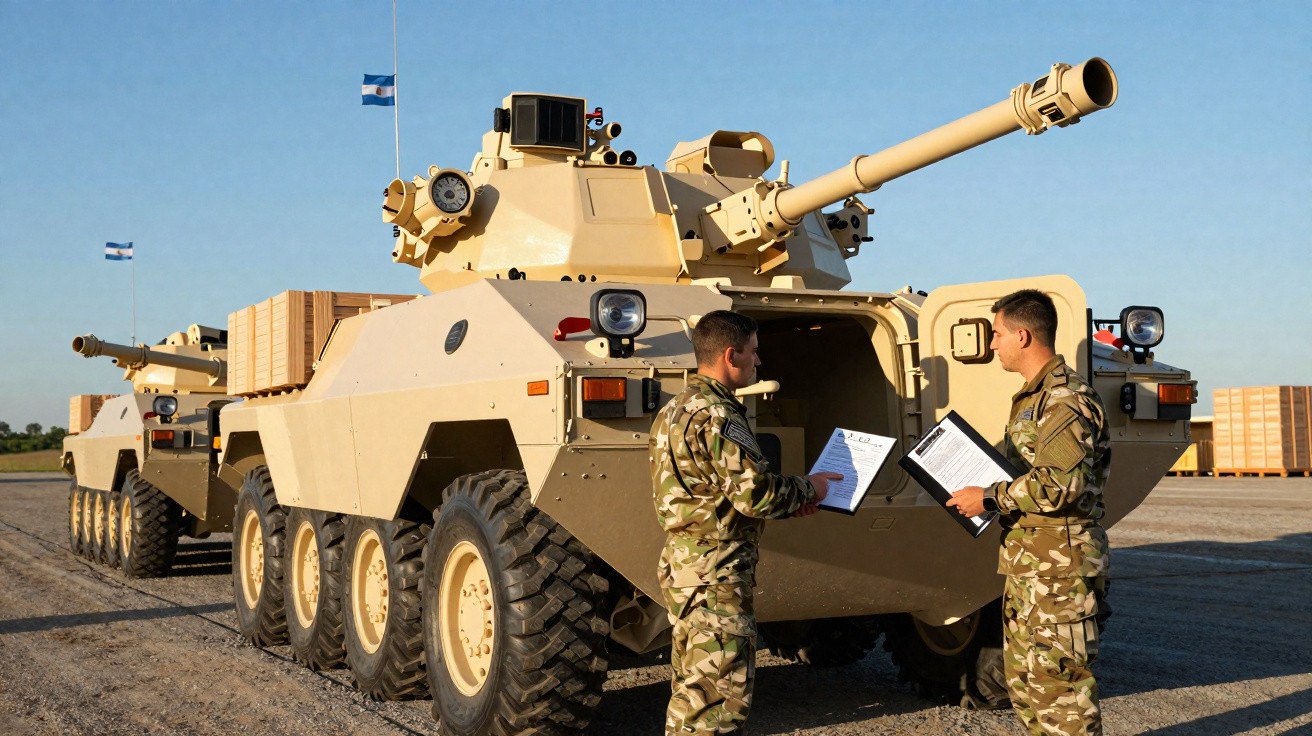
On the morning of Friday 21 August, at the Libertador Building, the Argentine Army signed the Letter of Offer and Acceptance (LOA) authorising it to acquire up to 235 Stryker-family wheeled armoured combat vehicles. The document had previously been approved by the United States Congress and is being implemented through the Excess Defense Articles (EDA) programme, the mechanism through which US Armed Forces equipment is transferred at reduced administrative costs. The transaction has a total all-inclusive value of US$83,733.
👉 Read also: Brazilian Navy deploys South America’s largest warship for the first time in the Rio Grande Elevation
Speaking to Zona Militar, a senior serving Army source put the significance of the deal into perspective: “The incorporation of these units represents a historic milestone and ranks among the three most important mechanisation processes in the Argentine Army. The first was the mechanisation of the 1950s and 1960s, the second involved the TAM family, and this one concerns the Stryker armoured vehicles.”
It is a weighty comparison. The first of those programmes gave the force its first modern post-war armoured capability. The second, launched in the early 1980s, led to domestic production of the Argentine Medium Tank and an entire family of vehicles sharing a common chassis, which still underpins the heavy mechanised component today. The third began to take shape on Friday, distinguished by the shift from tracked armoured combat to wheeled armoured combat.
📌 You may be interested in:
- Government reallocates more than US$140 million to the Ministry of Defence and the Armed Forces
- After 42 years of service, the Peruvian Navy retires the tank landing ship B.A.P. “Eten”
The Army frames the decision as a response to an operational need which the institution itself says has been deferred for more than two decades: the development of a medium combat capability, required both by the scale of the national territory and by the doctrinal requirements of the Rapid Deployment Force.
Four variants on a single chassis
Every vehicle covered by the agreement features the Double V-Hull (DVH) configuration, a structural redesign developed from combat experience gained over the past decade. Its shape redirects the blast wave from mines and improvised explosive devices outwards to the sides, rather than allowing it to reach the crew compartment - the key difference from the eight flat-bottomed M1126 vehicles already operated by the force.
The M1256 ICVV is the infantry combat variant and forms the numerical core of any wheeled mechanised unit. In addition to its crew, it carries a full infantry squad and is typically fitted with a remotely operated weapon station that can be controlled from inside the vehicle, avoiding exposure for the gunner. It combines protected transport to the dismount point with fire support for infantry once they have deployed.
The M1251A1 CVV exchanges transport capacity for electronics. It incorporates radios, terminals, and command-and-control systems that allow a unit commander to direct an operation while moving, without having to halt the force to establish a fixed command post. This is the variant that enables a mechanised brigade to operate with the agility required by its doctrine.
The M1131A1 FSVV serves as the link between manoeuvre forces and artillery. It carries a sensor package on a telescopic mast - thermal imaging equipment, a rangefinder and a laser designator - capable of establishing precise target coordinates and transmitting them directly to firing units, substantially shortening the cycle between detecting a target and striking it.
The M1133A1 MEVV is the family’s armoured ambulance, configured to carry stretcher cases and walking wounded, with onboard medical equipment for stabilisation during transport. Its operational value can be measured by one specific factor: the ability to evacuate casualties from the combat zone under ballistic protection within the timeframe that determines survival.
All four variants share a chassis, Caterpillar C7 engine, 8×8 running gear, central tyre inflation system and electrical architecture. This is the programme’s principal logistical argument: one spare-parts supply chain, one maintenance system and one mechanic-training programme for the entire family. The same engine also powers the Oshkosh FMTV lorries already in service, extending commonality beyond the armoured vehicle itself.
Delivery timetable and pre-delivery inspection
The equipment will arrive in stages. The first batch will comprise around fifty vehicles, scheduled for delivery in the coming months, and will begin the gradual fulfilment of the agreed total.
The step before signing was technical. In March, a specialist commission from the Directorate General of Materiel travelled to Fort Hood, Texas, to carry out a comprehensive inspection of the first batch of vehicles offered.
What the initial Stryker experience showed
The immediate precedent is the eight M1126 vehicles acquired through Foreign Military Sales at the end of 2025, at an approximate cost of nine million dollars, and delivered in Full Mission Capable condition, meaning they were technically ready for immediate operation.
That figure did not cover the equipment alone. It included spare-parts support for one year of intensive use, Level 1 and Level 2 technical maintenance support, complete consignments of major spares - officially presented in July at the 601 Arsenal Battalion in Boulogne - and a comprehensive technical-operational training programme for mechanics and drivers, delivered both in Argentina and abroad. According to the Army, the cost-benefit ratio of that transaction was significantly better than the standard market quotations for this equipment.
The Directorate General of Materiel described this arrangement as a “turnkey” delivery, under which a combat unit receives not merely the vehicle but an integrated system comprising trained crews, certified instructors and a functioning logistics chain. Without that prior framework, the arrival of another fifty vehicles would represent a logistical problem rather than an operational capability.
The eight Strykers were assigned to the tactical elements of the 10th Mechanised Brigade - specifically the 6th Mechanised Infantry Regiment “General Viamonte”, based in Toay - and made their operational debut during the KEKEN exercise in Patagonia, as well as taking part in ATLANTIC DAGGER. That cycle made it possible to assess the platform’s performance in the conditions in which it will actually operate and to adapt local logistical infrastructure.
Access to the EDA programme
One effect of the first purchase explains much of the second. Adoption of the system formally placed Argentina within the global community of platform users, which, according to the institution, promotes doctrinal interoperability with regional armed forces and those of allied countries and - crucially - secured priority access to the EDA programme.
In other words, the initial eight vehicles were not simply a training nucleus. They were the key that enabled the mechanism through which 235 units can now be agreed at minimal administrative cost.
With the first batch of fifty, the Army moves beyond a training nucleus towards the establishment of complete tactical elements. Ultimately, that is the difference between possessing the vehicle and possessing the capability.
Comments
No comments yet. Be the first to comment!
Leave a Comment