
Add Zona Militar to your Google feed
Why add us? Get the latest from Zona Militar in your Google feed.
JOIN THE WHATSAPP CHANNEL
Join our official WhatsApp channel and receive the news as it happens.
Dreadnought-class submarine construction progresses
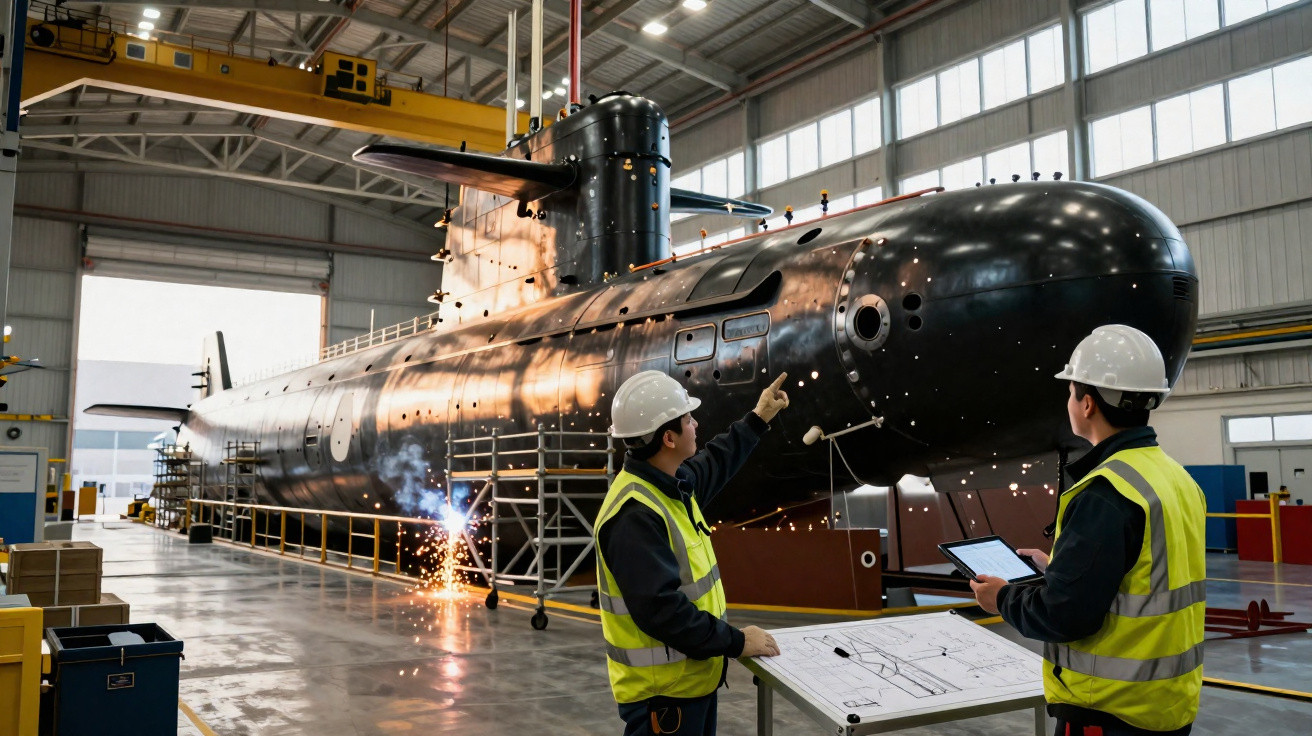
After the United Kingdom moved into the fourth stage of Dreadnought-class submarine construction, the Defence Nuclear Enterprise - the Ministry of Defence body responsible for projects involving nuclear technology - has reported further progress in a programme designed to safeguard the continuity of its nuclear deterrent capability for decades to come. The Royal Navy’s new generation of nuclear-powered ballistic missile submarines is continuing to take shape at BAE Systems’ Barrow-in-Furness facilities, where the various sections and modules for the future boats demonstrate the progress of an ambitious project that will replace the current Vanguard-class submarines. Those vessels have maintained the permanent at-sea presence of this capability for more than three decades.
👉 Read also: Navantia UK lays the keel of the first of the Royal Fleet Auxiliary’s new logistics ships
The programme covers the construction of four boats: HMS Dreadnought, HMS Valiant, HMS Warspite and HMS King George VI. One of the initiative’s most recent milestones occurred on 22 September 2025, when BAE Systems carried out the first steel cut for HMS King George VI at Barrow-in-Furness, formally beginning construction of the fourth and final submarine in the class. By that point, the other three submarines were already at different stages of manufacture, as the programme continued to progress simultaneously through the various construction phases for the Royal Navy’s future generation of strategic submarines.
📌 You may be interested in
- British aircraft carrier HMS Queen Elizabeth returns to service to lead a three-month deployment in Northern Europe
- Satellite imagery may reveal the Russian Navy’s first naval drone port near the Black Sea
Funding and service timeline for the Royal Navy submarines
The programme’s industrial and strategic importance was again underlined in July 2026, when the United Kingdom announced the allocation of £8.4 billion to complete construction of the Dreadnought submarines. Under the published schedule, HMS Dreadnought is expected to finish its sea trials and enter service at the start of the next decade, with HMS Valiant subsequently moving towards a comparable phase. HMS Warspite and HMS King George VI, meanwhile, will continue through construction, with their respective trials expected to begin during the second half of the decade.
Each of these nuclear-powered ballistic missile submarines will displace around 17,000 tonnes, measure approximately 152 metres in length and 13 metres in beam, and carry a crew of about 130 personnel. These dimensions will make the Dreadnought boats the largest and most advanced submarines ever operated by the Royal Navy. Their future entry into service will enable the gradual replacement of the Vanguard class and ensure the continuation of Continuous at Sea Deterrence (CASD), a central pillar of the United Kingdom’s defence strategy.
Nuclear deterrent and the Barrow-in-Furness supply chain
Operationally, the new submarines will serve as the future platform for Britain’s strategic nuclear deterrent, a capability based chiefly on the use of US-made Trident II D5 ballistic missiles. The construction of the four vessels therefore represents far more than a naval renewal programme: it is an initiative intended to preserve the country’s nuclear capability over the coming decades and maintain the permanent presence of a strategic submarine on patrol.
The Dreadnought programme is also further establishing Barrow-in-Furness as one of the United Kingdom’s leading submarine-building centres. The initiative includes more than 6,000 companies throughout its supply chain and forms part of a defence nuclear sector supporting tens of thousands of jobs. With construction underway on all four boats, the additional funding announced in July 2026, and the large modules of the future submarines moving through the Barrow facilities, the next generation of Britain’s nuclear deterrent is steadily taking tangible form.




Comments
No comments yet. Be the first to comment!
Leave a Comment