
Add Zona Militar to Google
Why add us? Get Zona Militar news on Google.
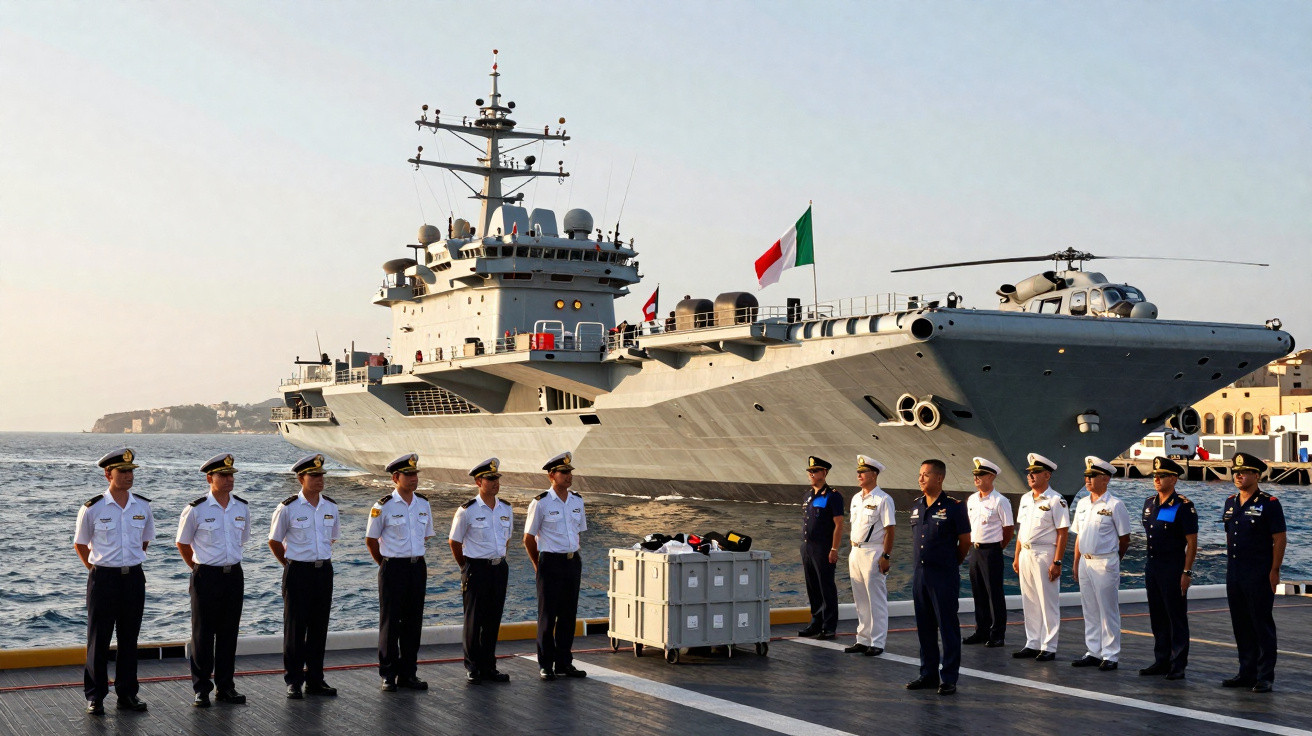
After more than four decades in service with the Italian Navy (Marina Militare), the aircraft carrier Giuseppe Garibaldi began its final voyage yesterday, 24 August, from Taranto to Indonesia, its new operator. Decommissioned at the end of 2024, the historic vessel is bringing a lengthy career as one of Italy’s foremost naval power-projection assets to a close. Its transfer also opens a new phase in the Indonesian Navy’s modernisation programme.
👉 Read more: US Air Force declares Initial Operational Capability for the new MH-139A Grey Wolf helicopter to strengthen the nuclear arsenal
Giuseppe Garibaldi and Italian naval aviation
Built by Fincantieri and commissioned on 30 September 1985, the Giuseppe Garibaldi represented a landmark for both Italy’s shipbuilding industry and the Italian Navy. Named after Giuseppe Garibaldi, one of the principal figures in Italian unification during the mid-19th century, the ship was designed and built domestically at a time when several European countries were investing in light aircraft carriers able to operate short take-off and vertical landing (STL) aircraft.
In the United Kingdom, the Royal Navy was bringing vessels such as HMS Invincible, HMS Illustrious and HMS Ark Royal into service, while Spain did the same with HMS Príncipe de Asturias, during an era defined by the growth of this type of platform and the employment of Harrier STL aircraft.
In Italian service, the Garibaldi operated AV-8B Harrier II Plus aircraft, which for decades formed the core of its embarked fixed-wing air group. Together with SH-3D and AW101 helicopters, these aircraft gave the ship an air-power projection capability at sea that Italy had not previously possessed in a vessel of this kind. The aircraft carrier consequently became one of the Italian Navy’s principal deployment assets, later retaining that role alongside the more modern aircraft carrier Cavour.
📌 You may also be interested in:
- South Korean Navy: KSS-III Dosan Ahn Chang-ho submarine completes historic Pacific mission
- US Air Force deploys B-52H bombers to Australia to strengthen the Indo-Pacific
Operational service and decommissioning
Throughout its operational career, the Giuseppe Garibaldi took part in several international missions. Among these was its involvement in the Kosovo War, during which Italian Harrier fighters flew 30 combat missions, totalling 63 flying hours. The vessel subsequently also contributed to operations connected with Operation Enduring Freedom in Afghanistan, and was involved in the 2011 intervention in Libya, when it led a Task Force that included the frigate Libeccio and the auxiliary ship Etna, among other units.
Its withdrawal from service formed part of the Italian Navy’s capability modernisation. The entry into service of the ITS Trieste amphibious assault ship made it possible to decommission the Garibaldi. Since 1985, it had been among the most recognisable units in the Italian fleet. Its retirement, however, did not bring its story to a final end, as Indonesia began considering its purchase and eventual integration into its naval force.
Indonesia’s first aircraft carrier platform
The transfer to Indonesia was completed during 2025 and 2026. Having assessed various options for acquiring and modernising the ship, Italy ultimately transferred the vessel as Indonesia moved forward with preparations to receive and operate its first aircraft carrier. The process involved sending Indonesian personnel to Italy for training, as well as readying the infrastructure required for its future commissioning, with an initial arrival date set for 20 September 2026.
The addition of the Giuseppe Garibaldi will mark a substantial advance in Indonesian Navy capabilities. In addition to the modernisation and refit the vessel will undergo, its arrival will enable the naval force, for the first time, to introduce an aircraft carrier platform and develop the capabilities, procedures and doctrine needed to operate this type of unit. The ship will also provide a platform with the potential to operate rotary-wing aircraft and other embarked air systems, expanding deployment options and power-projection capacity.
The departure from Taranto on the night of 24 August conclusively ended more than forty years of Italian history for the Giuseppe Garibaldi. For the Italian Navy, it marks the farewell to a vessel that accompanied the development of its naval aviation for decades and took part in some of the leading international operations of recent decades. For Indonesia, however, the historic aircraft carrier’s arrival will signal the start of a new era: the introduction of its first platform of this kind and the development of a capability that had not previously been part of its naval power.
Photographs used for illustrative purposes.



Comments
No comments yet. Be the first to comment!
Leave a Comment