
Add Zona Militar on Google
Why add us? Get Zona Militar news on your Google.
The Tomato Killer during Exercise Fraterno XXXIX
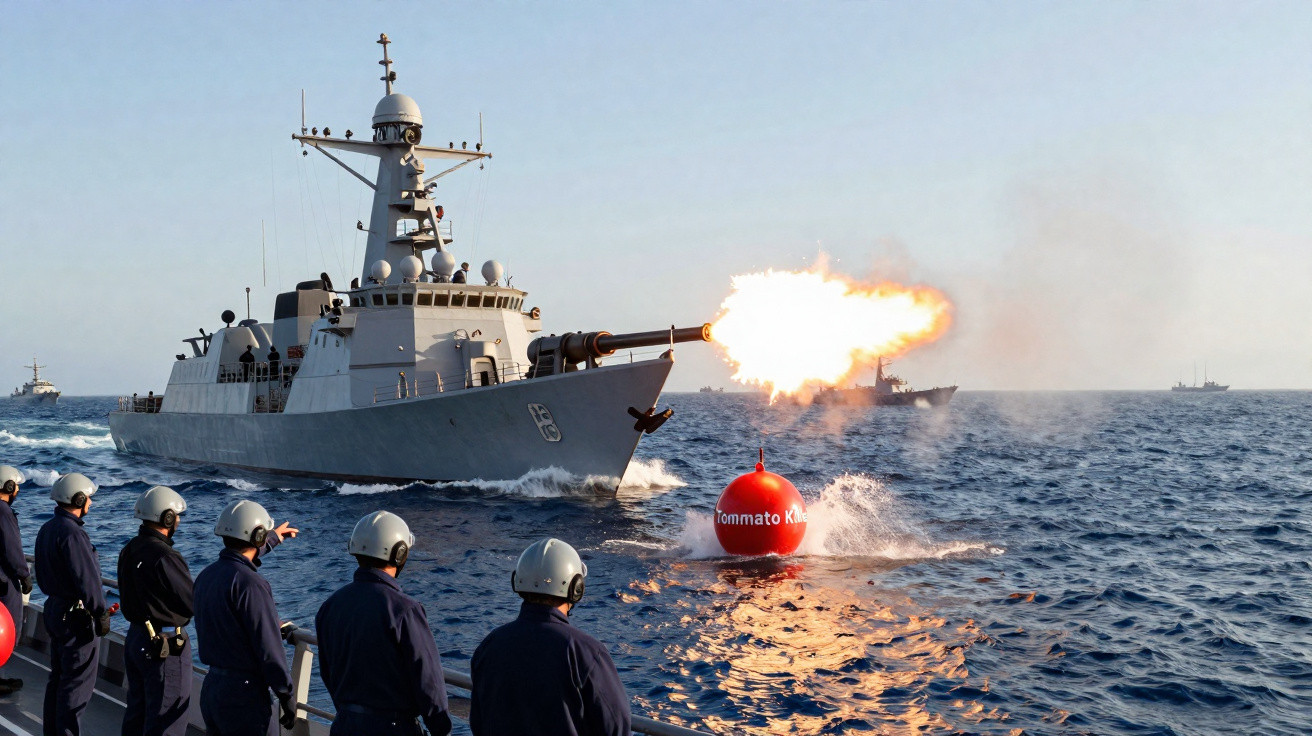
During the demanding maritime phase of Exercise Fraterno XXXIX in the South Atlantic, personnel from both navies took on one of surface gunnery’s most established and challenging tests: the “Tomato Killer”. To explore the doctrinal complexity, technological accuracy and human contribution behind every live-fire salvo, Zona Militar spoke exclusively with Lieutenant María Eugenia Navarro, who served in one of the exercise’s critical roles as Fire Control Officer aboard the destroyer ARA La Argentina (D-11).
👉 Read more: US Air Force declares Initial Operational Capability for the new MH-139A Grey Wolf helicopter to reinforce the nuclear arsenal
In the interview, Lieutenant Navarro explained that the well-known “Tomato Killer” is essentially a precision naval gunnery exercise conducted against a brightly coloured orange floating target launched at a designated location on the open sea. Rather than firing indiscriminately, the purpose is to practise detailed aiming and confirm weapons-system correction calculations in line with the Fleet’s rigorous doctrinal requirements.
A notable aspect of naval doctrine is that, in some combined training exercises, the operational order expressly directs crews not to fire directly at the target, but close to it. This preserves the buoyancy of the “Tomato” vessel and enables every unit on the firing line to complete its firing sequence. On this particular occasion, however, each ship in the fleet operated on the basis of concentrating its fire and testing the calibration of its integrated systems.
📌 You may also be interested in:
- After more than 20 years in service, the United Kingdom bids farewell to HMS Bulwark as its transfer to the Brazilian Navy progresses
- South Korean Navy: KSS-III Dosan Ahn Chang-ho submarine completes historic Pacific mission
Weapons and fire-control systems aboard ARA La Argentina
Detailing the weapons fit used, Lieutenant Navarro stated that primary surface fire normally relies on large-calibre weapons: the Argentine destroyer’s 127 mm gun and the 76 mm guns fitted to the Espora-class corvettes. The exercise may also be carried out using the 40 mm anti-aircraft guns found on both vessel types. Although these guns fire ammunition in continuous bursts, preventing individual impacts from being counted, they are an excellent operational tool for checking the overall performance of data-transmission links, gun alignment, and the introduction of dynamic corrections into the ship’s automatic fire-control systems.
Successfully conducting such a manoeuvre requires flawless coordination between several shipboard departments, covering the entire combat function. As the Argentine Navy officer described, the firing exercise brings together two teams working in complete harmony: personnel stationed directly at the gun and operators at consoles inside the Combat Information Centre (CIC).
The procedure begins at the gun mount itself, where local gun crews must carefully ensure that every physical and safety aspect of the weapon is in order before handing operational control from local to remote. Once the mount comes under the authority of the CIC (Command and Control Centre), the Lirot optronic radar takes over. Its high-resolution optical sensors and tracking cameras provide millimetric precision in acquiring and following the floating target. Lieutenant Navarro proudly noted that the destroyer ARA La Argentina operated with both of its Lirot sensors fully functional, carrying out the firing flawlessly through this advanced tracking system.
Salvos, corrections and the firing sequence
After the target position has been established, responsibility for directing the shot and commencing fire follows a very strict chain of command. The fire-control officer formally requests clearance to begin firing, while the ship’s commander is the sole authority able to issue the final “fire order”. Once firing is authorised, a direct communications link is established with a third crucial member of the command bridge team, known as the observer. Using high-powered binoculars, this specially trained gunner scans the horizon to visually identify the precise point at which the projectile strikes the water, technically termed the “peak”.
ARA La Argentina fired two salvos of 16 projectiles each. Once the first salvo had been fired, both the console operator and the fire-control officer checked the flight times estimated by the system computer on the display. From the observer’s visual report and the clear feed from the Lirot cameras, the team determined that the first salvo had fallen short of the target and slightly to the left. Using this initial deviation data, Lieutenant Navarro promptly entered a real-time correction into the fire-control computer, increasing elevation and moving the guns’ azimuth to the right and slightly higher. When the second and final prescribed salvo was fired, the correction proved wholly effective: the 40 mm projectiles bracketed and closed on the target, centring the floating target with extremely tight shooting accuracy.
The exercise ended with a valuable technical assessment, allowing the combined performance of the crews at sea to be compared. The Brazilian frigate MB Tamandaré (F-200) fired first, followed by the frigate MB União (F-45). The destroyer ARA La Argentina held third place in the firing line, before making way for the corvette ARA Espora (P-41). The corvette ARA Robinson (P-45) completed the formation in the planned firing order.
Pleased to have directed the destroyer’s guns to an exceptional standard, Lieutenant Navarro concluded by stressing the immense value of these live-fire exercises, which ensure that the Argentine Navy’s complex weapons systems respond with complete reliability and precision whenever the defence of national sovereignty demands it.
Special thanks: My sincere gratitude and admiration to Lieutenant María Eugenia Navarro and all personnel of the fire-control division aboard ARA “La Argentina”.
Photographs: Zona Militar
Comments
No comments yet. Be the first to comment!
Leave a Comment