
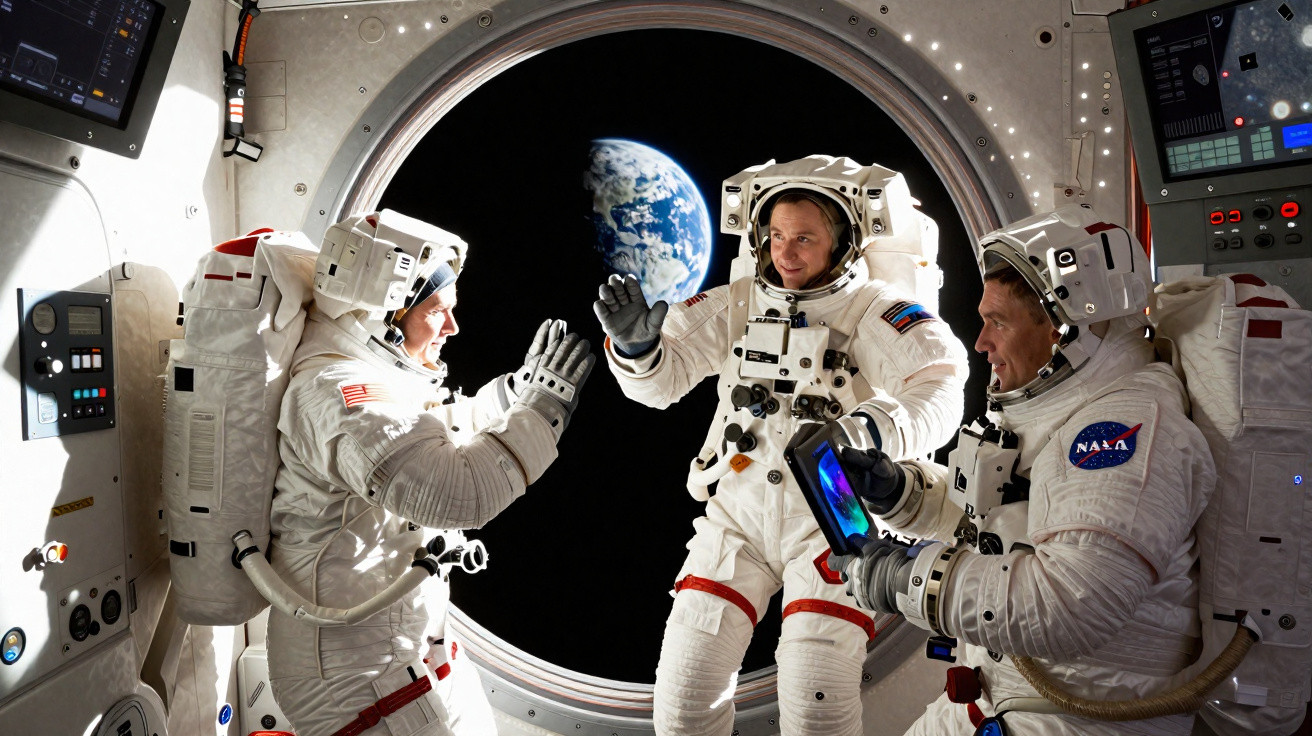
For over half a century, the Moon has seemed near enough to dominate the night sky, yet distant enough to remain beyond reach.
Artemis II altered that perception. NASA’s first crewed lunar mission since Apollo did not touch down, yet it achieved something equally vital: it demonstrated - visibly, publicly, and with four people aboard an entirely new spacecraft - that every link in the chain still functions.
This landmark mission encompassed launch, deep-space travel, a lunar flyby and a fierce, high-temperature plunge back through Earth’s atmosphere, culminating in a Pacific Ocean splashdown and a celebratory welcome in Houston.
The crew - commander Reid Wiseman, pilot Victor Glover, mission specialist Christina Koch and Canadian Space Agency astronaut Jeremy Hansen - made history in their own right.
The Artemis team brought the first woman, the first person of colour and the first non-US citizen to the Moon.
The lap that went beyond Apollo
Artemis II followed an ambitious yet practical flight plan: circle the Moon, put Orion through its paces in deep space, then return safely to Earth.
During the mission, the astronauts travelled farther into space than the lunar explorers of previous decades, achieving a new distance record beyond that set by Apollo 13.
At its most distant point from Earth, Orion was 252,756 miles (406,771 kilometres) away. That figure is significant because it represents both the mission trajectory and NASA’s trust in Orion’s navigation and onboard systems.
The flight generated the sort of powerful images that make human spaceflight feel immediate once more, including sights of the Moon’s far side “never witnessed before by human eyes.”
The astronauts also captured a remarkable “Earthset” image, with Earth descending beyond the Moon’s grey horizon - recalling Apollo 8’s iconic Earthrise photograph.
As an added piece of celestial spectacle, Artemis II witnessed a total solar eclipse during its journey.
A profoundly emotional experience
A mission may be technically perfect while still seeming impersonal. Artemis II did not feel that way. Its astronauts spoke candidly about both the extraordinary sights before them and the effort required to reach them.
“This was not easy,” Wiseman told the crowd in Houston. “Before you launch, it feels like it’s the greatest dream on Earth.”
“And when you’re out there, you just want to get back to your families and your friends. It’s a special thing to be a human, and it’s a special thing to be on planet Earth.”
“I have not processed what we just did and I’m afraid to even start trying,” Glover added.
A lifeboat suspended in the universe
Hansen shifted attention away from the four astronauts on stage, directing it instead towards those who made the mission possible and those following it from Earth.
“When you look up here, you’re not looking at us. We are a mirror reflecting you. And if you like what you see, then just look a little deeper. This is you,” he said.
Koch conveyed the scene in terms that sounded less like a formal media appearance and more like an attempt to describe an unanticipated feeling.
“Honestly, what struck me wasn’t necessarily just Earth, it was all the blackness around it. Earth was just this lifeboat hanging undisturbedly in the universe,” she said.
There was also a more ordinary complication: space toilets remain troublesome. Artemis II “had to contend with a more mundane problem – a malfunctioning space toilet,” and NASA has said it will correct the design before undertaking longer flights.
The show continues
The mission concluded in the traditional fashion: a blazing re-entry, parachute deployment and splashdown.
Afterwards, the crew returned to Houston, arriving at Ellington Field near Johnson Space Center to find a hangar packed with NASA staff and family members awaiting them.
NASA Administrator Jared Isaacman presented them to a standing ovation. The date added another layer of space-history significance: the astronauts came back to NASA’s Houston base on the 56th anniversary of Apollo 13’s launch, the flight indelibly associated with the words “Houston, we’ve had a problem.”
Isaacman embraced the moment’s symbolism. “The long wait is over. After a brief 53-year intermission, the show goes on,” he said.
Implications of the Artemis II mission
Artemis II was not designed as a mission to “touch the Moon”. Its purpose was to “prove we can get there and get back, repeatedly”.
It confirmed Orion’s capabilities with people aboard rather than only sensors and test dummies. It also demonstrated long-range operations, communications, navigation and recovery, as NASA seeks to move beyond isolated heroic expeditions towards a sustainable operational rhythm.
The mission established something beyond the technical achievements, too: a crew can travel into deep space in 2026 and still make the world feel the significance of it.
Many Apollo-era crews were publicly known for their strictly businesslike demeanour. Artemis II offered a contrast - more candid, more personal and, in Isaacman’s words, “wonderful communicators, almost poets.”
What happens next
The success of the mission has immediately focused attention on the flights that follow. NASA is already working towards Artemis III next year, planned as a docking-practice mission nearer Earth that will prepare for the subsequent attempt to land astronauts near the lunar south pole with Artemis IV in 2028.
NASA has also said that it will reveal the Artemis III crew shortly. Considerable uncertainty remains, including hardware schedules, funding, political factors and the unavoidable risks of space exploration.
NASA Associate Administrator Amit Kshatriya expressed that balance plainly: “You know what’s at stake,” he said, adding that exploration requires finding “the right line between being paralyzed by it and being able to manage it.”
Yet Artemis II reshaped the emotional equation. It did more than offer a promise of returning to the Moon: it carried out that return. Following 53 years of waiting, its accomplishment arrived with the compelling weight of evidence.
Image credit: NASA



Comments
No comments yet. Be the first to comment!
Leave a Comment