
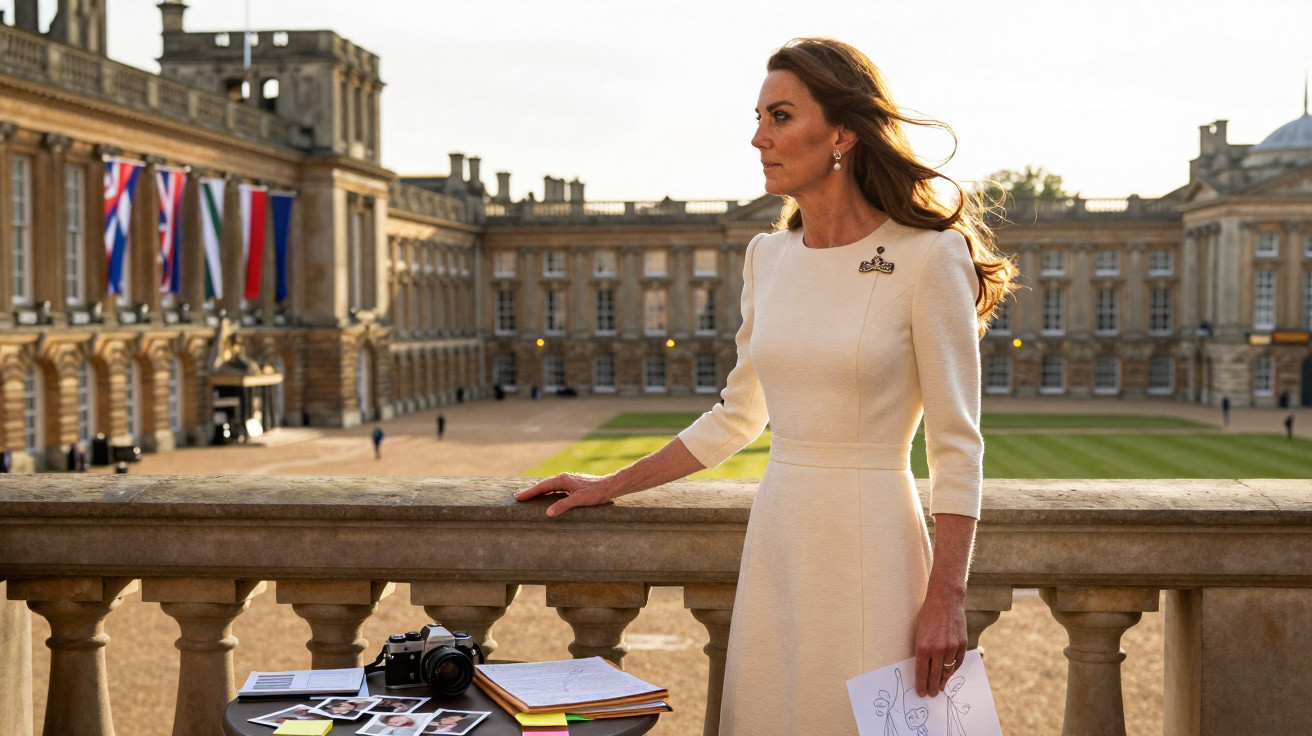
Long before she arrives, crowds begin to assemble: plastic Union Jacks flutter in the breeze, children sit high on their parents’ shoulders and phones are raised in expectant hope. Behind the palace walls, however, the woman they have come to see may be doing something decidedly less glittering: telling a child where to find their shoes, straightening a collar and taking one final calming breath. On her birthday, Catherine, Princess of Wales, occupies the meeting point between private family life and public destiny: a committed mother balancing school runs and hospital visits, and a future Queen gradually taking up a historic position while the monarchy changes before our eyes.
There is now a feeling that, whenever she steps into the spotlight, something has changed for good.
A birthday at the heart of the royal storm
Her birthday this year arrives at an unsettled moment for Britain. The late Queen’s chapter has closed, King Charles continues to shape his reign, and the royal family faces scrutiny on an unprecedented scale. Even so, one picture repeatedly appears across news alerts and social media feeds: the Princess of Wales, her head gently inclined, concentrating on a person whose name most of us will never hear.
She is the royal people seem naturally drawn to watch, not because of the shine of a tiara, but because her face reveals so much.
Look back through a decade of royal photographs and her life seems to unfold at speed. There is the reserved bride on that April day in 2011; the new mother leaving hospital with Prince George in a polka-dot dress that nodded to Diana without imitating her; the woman in jeans on the school run; and the assured figure at the late Queen’s funeral, standing firmly beside William while the world examined every movement.
Every image brings another dimension: greater duty, deeper resilience and slightly less apparent freedom. But the children still make faces on the balcony, and she still laughs with them.
Royal commentators often refer to “the Firm” as though it is a flawlessly functioning machine. In truth, it is more complicated and more human. The monarchy is undergoing a transition, with a new King on the throne, a future King moving nearer to his role and Diana’s memory never entirely absent. Catherine is positioned at the very heart of that sensitive adjustment.
She must represent both continuity and transformation. She is expected to be a modern working woman and a living emblem, while raising three children beneath the most intense spotlight in the world and carrying weighty titles with apparent ease. It is that very strain that makes so many people quietly support her.
The unseen effort behind the polished photograph
Watch her at a public engagement in slow motion and a clear routine emerges. She leaves the car, surveys the crowd, spots the children and heads towards those who are too shy to come forward. She crouches to meet their gaze, asks one uncomplicated question that brings their expression to life, then shares a brief laugh or smile. A photograph is taken, destined to remain on a family fridge for years.
That is her approach: reduce the scale of the occasion, person by person, until it feels almost ordinary.
It is easy to picture royal life as an endless succession of gowns and gala dinners. By most accounts, though, the reality involves diaries packed with briefings, report-reading, speech refinement and attention to detail on causes that could otherwise become little more than another headline. Early childhood development. Mental health. Addiction. The subjects Catherine has selected are not glamorous; they are complex, underfunded and frequently misunderstood.
Most of us recognise the moment of choosing the more difficult route, even when it may not bring the loudest applause. Her work reflects that experience on a national level.
In truth, no one can manage this every day without sometimes feeling overwhelmed. There is the demand to appear composed, the expectation of being a “perfect” royal woman and the close inspection of every outfit, word and gesture. Beneath those immaculate coatdresses sits a diary that would exhaust most of us.
She has spoken gently yet repeatedly about achievable everyday practices: listening without judgement, discussing mental health openly and getting down on the floor to play with your children rather than pursuing perfection. As she once put it:
“Simple, everyday moments with children – talking, playing, reading – build the foundations for their future. It’s not about getting it all right. It’s about being there.”
That message carries slightly greater force on her birthday.
- Her role as a mother - keeping three young children grounded while the world looks on - shows parents that everyday rituals matter more than royal surroundings.
- Her developing public voice - steady, thoughtful and ever more assured - demonstrates that it is possible to grow into a role without sacrificing warmth.
- Her causes - early years, mental health and families - direct attention to the things that shape society quietly, long before the cameras flash.
Catherine, Princess of Wales: a future Queen taking shape in real time
As the monarchy evolves around her, Catherine’s story feels unusually incomplete, like a book being written live across our screens. She is not yet Queen, no longer simply a duchess and not “Kate Middleton from Berkshire”. Her title may be lengthy, but her life has much further to go. Between tiara fittings and school assemblies, she is beginning to define what a 21st-century Queen could be.
Will fashion, policy, one particular speech or a thousand small acts be what she is remembered for? Nobody can yet know. There is something unexpectedly compelling about that uncertainty.
To some, she is a style icon who made headbands fashionable again. To others, she is the woman who asked direct questions about how new mothers and children under five are treated, well before doing so became politically safe. For many people with no interest in crowns whatsoever, she is simply a reliably steady presence within a chaotic news cycle.
Birthdays often make people stop and reflect. This one takes place while the royal family is redefining its own “normal”, and while people quietly ask what monarchy might mean in 2026 and beyond.
There is a subdued lesson in that outline on the palace balcony. We do not choose the stage, but we can choose how we stand upon it. We can hold tightly to the script or gradually reshape it for the world beyond the gates. On her birthday, the Princess of Wales offers a reminder that roles, royal or otherwise, are not statues carved from marble. They are living, changing and sometimes awkward efforts to carry out the task before us with grace.
Whether you support the monarchy, challenge it or merely scroll past it, her journey raises the same enduring question: in our own modest lives, what does it mean to bear responsibility while remaining human?
| Key point | Detail | Value for the reader |
|---|---|---|
| Devoted mother in the spotlight | Balancing school runs, family life and global attention | Provides a relatable perspective on managing responsibility and everyday parenting |
| Future Queen in a changing monarchy | Managing a historic transition from Elizabeth II to Charles III and beyond | Helps readers see how institutions and individuals develop alongside one another |
| Inspiration through steady, imperfect humanity | Focus on early years, mental health and small daily actions | Encourages readers to appreciate quiet consistency rather than polished perfection |
FAQ:
- Why is this birthday seen as especially symbolic for the Princess of Wales? It comes during a major royal transition, as King Charles establishes his reign and Catherine becomes more visible in her future position as Queen consort.
- How has her role changed since becoming Princess of Wales? Her diary, public profile and strategic duties have all expanded, particularly in relation to central issues such as early childhood and mental health.
- Is she really involved in the causes she supports, or is it just ceremonial? Accounts from charities and insiders consistently portray her as thoroughly briefed and actively involved, especially in the early years initiative she has supported for many years.
- Why do so many people relate to her despite her royal status? Her public image focuses on family, everyday moments and listening, rather than unrelenting glamour or grand speeches.
- What might her future as Queen look like? No one knows with certainty, but her emphasis on children, families and mental health indicates a reign focused on quiet social impact rather than ceremony alone.






Comments
No comments yet. Be the first to comment!
Leave a Comment