
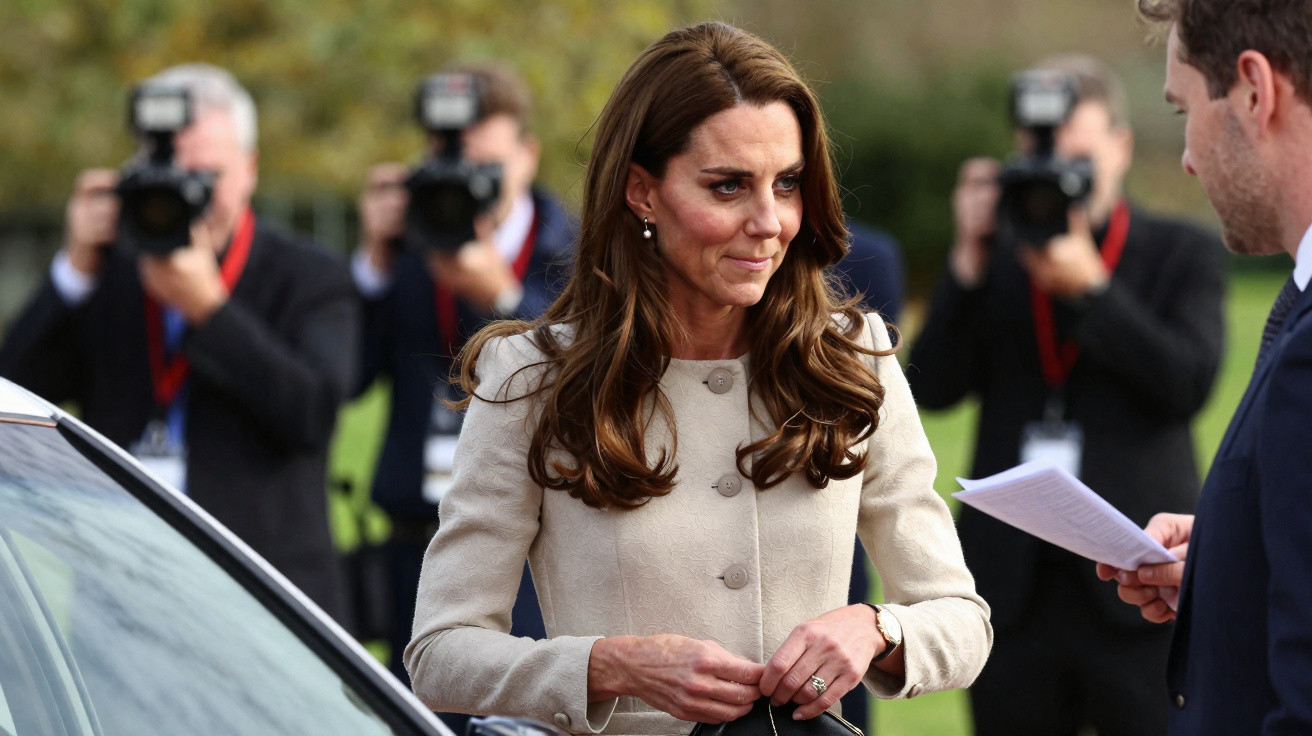
The crowd had already raised a barrier of phones by the time Kate Middleton left the car, with restrained British applause and frantic camera clicks mingling in the air. Windsor’s summer light was muted, almost grey, making the colours of her outfit appear more vivid than they normally would. Reporters had been told this was “just another engagement” - the sort of undramatic royal visit that correspondents can often draft halfway through before arriving.
Then the murmuring began. It was not about anything she had said, but about what she was wearing - or, more precisely, what she had decided to leave off. A missing bracelet, a reworked ring stack, a slight departure from the royal uniform that has gradually been constructed around her for more than a decade. Within minutes, users on X and Instagram were examining every detail with a level of forensic attention that would unsettle most people.
By the evening, one small choice by Kate had revived a much larger question: what sort of queen does she really want to become?
When a small royal detail becomes a national debate
The trigger was little more than a movement of her wrist. While Kate greeted volunteers and parents at a children’s charity event, long-lens photographers focused on her left hand. Regular royal-watchers spotted it first: the famous sapphire engagement ring remained, but it was accompanied by a narrow, understated band. Her customary collection of jewellery - sentimental bracelets and more formal items - had been reduced to the essentials.
Taken alone, it might simply have been practical. She was meeting children, bending down to speak at their height and shaking countless hands. Yet a photograph taken by a photographer seated on the pavement showed a close-up of her hand placed on a child’s shoulder. In the image, the sapphire’s shine appeared almost severe. There were no distracting diamonds, no elaborate cuff: only the emblem of her marriage and the plainest gold.
Within a few hours, tabloids were publishing side-by-side images from earlier years. Commentators described it as a deliberate “reset” from familiar royal glamour. Was she indicating a more contemporary, pared-back monarchy? Was it an understated acknowledgement of the cost-of-living crisis? Or was it merely the choice of a woman who did not want to sound like a jewellery box while playing with toddlers? The very modest scale of the change seemed to convince people that it must signify something greater.
Her decisions have prompted national discussion before. After she wore a high-street dress again for a formal engagement last year, fashion editors welcomed the “relatable duchess” approach, while some columnists argued that she was “dressing down the crown.” When she stood a little apart from William at a Remembrance event, body-language specialists appeared on breakfast television to interpret the space between them as though it contained a hidden message.
A clear pattern has developed. Kate seldom speaks publicly at length, and her remarks are closely managed when she does. As a result, her visual presentation - her clothing, hairstyle, posture and hand movements - forms the most prominent part of her public communication. Whenever she alters something, however slightly, people hurry to interpret it. Is she seeking to become a reassuring link between traditional monarchy and a restless, distrustful generation? Or does she remain confined to the part of flawless royal wallpaper?
The new argument over this jewellery decision arrived directly within that tension. Monarchists saw a future queen deliberately reducing the sparkle to place herself alongside “ordinary” families. Critics read it differently: they saw a woman whose most insignificant accessory could dominate a news cycle, highlighting just how unlike almost everybody else her life is. A ring is never just a ring when the entire institution is balanced on top of it.
The planned choreography of a “spontaneous” Kate Middleton appearance
Away from public view, royal dressing resembles a military campaign far more than a casual morning decision. For the Windsor charity visit, palace staff reportedly spent days discussing the appropriate mood: gentle without becoming sugary, respectful without appearing rigid. Her clothes had to photograph well beside plastic toys and bright primary colours. Her jewellery needed to be restrained enough that it would not catch on small hands. The engagement ring remains, always - it is virtually part of the role itself.
According to a stylist familiar with royal protocol, removing the extra bracelets and luxury watch would have communicated a quiet but unmistakable point: this day was for listening rather than shining. That is the contradiction at the heart of Kate’s public life. Every effort to seem “less visible” attracts attention. She understands that arriving covered in diamonds produces predictable headlines. But appearing almost bare makes the contrast newsworthy too.
Most people recognise the moment when one small clothing decision affects how others respond to them. Now imagine that experience magnified by worldwide media and centuries of royal expectation. Kate walks a line where a cardigan may be interpreted as rebellion and a nude shade of nail polish as political positioning. Removing a bracelet quietly becomes a test: is she making the monarchy gentler, or merely managing its presentation more effectively?
For close observers, a straightforward approach seems to be emerging. When Kate wants attention to remain on a cause rather than her image, she reduces visual distraction. A simple coat, familiar shoes, smaller earrings and the same handbag carried at several earlier engagements all serve that purpose. She may repeat clothing from a previous visit - signalling continuity - while centring the look on one recognisable item, such as the sapphire ring.
On occasions when the institution requires more impact, she adjusts in the opposite direction. She wears statement hats for major royal ceremonies, vivid colours for balcony appearances and sharply tailored outfits when the Firm needs to project stability during a fragile period. The Windsor visit belonged firmly in the “soft focus” category. Several people attending that day called her “less formal than usual”, noting her frequent direct eye contact and her tendency to crouch to a child’s level and remain there longer than the timetable permitted.
In truth, nobody manages this every day. Most people choose whatever is clean, still fits and allows them to feel broadly like themselves. Kate does not have that freedom. Therefore, when she deliberately removes an item that has become part of her visual uniform, it has significance. The more she turns to understatement, the more that understatement becomes a statement in itself.
This is where disagreement about her position becomes more pointed. Some royal supporters love the minimal jewellery, taking it as evidence that she understands the national mood. As food costs climb and public services come under pressure, they regard a future queen who can sometimes look as though she might blend into the school run as a sign of progress. Others believe this is precisely the wrong time for restraint. To them, the monarchy is theatre: a living costume drama paid for by taxpayers that should, at the very least, look spectacular while it endures.
For republicans, the discussion itself supports their argument. They see a day of political talk shows dominated by a woman’s choice to wear, or not wear, a gold bracelet as a symptom of democratic exhaustion. Why, they ask, should people project ethics and policy on to a fashion decision when elected representatives are the people actually making laws? The irritation is not necessarily directed at Kate personally, but she becomes the lightning rod for it.
Between these competing forces, Kate’s quieter style has prompted a broader question: is she attempting to change the monarchy internally by modifying its visual language, or is she simply its most accomplished messenger? A stripped-back outfit at a community event encourages people to view her as approachable, almost within reach. Yet the sapphire on her finger still suggests the reality of her standing: however plain everything else may be, she will always be presented as more than human.
One royal commentator put it this way at the close of a lengthy radio discussion about the Windsor visit:
“Kate knows that clothes are now her loudest speech. Every time she tones it down, she’s really asking the country: do you want your queen to look like you, or to look like a queen?”
For those observing from a distance, several points are worth considering quietly:
- How rapidly we assess women in public life by their appearance before their words
- How much emotional effort we devote to interpreting symbols we never chose
- How readily modest gestures are enlarged into sweeping narratives
- How often power is concealed in the smallest, most polished details
This does not mean Kate’s clothing should be ignored, or that it is unimportant. Clothes have always been a language, particularly within palaces. The simple reality is that a billion eyes cannot help transforming one bracelet - or its absence - into a referendum on the future they are prepared to accept.
A question that will outlast the next outfit change
The dispute over Kate’s understated Windsor appearance will soon leave the headlines. Another royal photograph, another politician’s mistake or another viral controversy will take its place in people’s feeds. Images of her unadorned wrist and solitary sapphire will enter the immense archive of royal photographs that digital history appears to forget, but never fully removes.
What remains is the underlying discomfort. When a single styling choice can inspire long reflections on national identity, it reveals how fragile the monarchy’s social contract has become. People want signs that their institutions understand the pressure of the present moment, and clothing is among the few signals they can interpret immediately. Whether by instinct or intention, Kate is communicating more loudly by displaying less.
Whether this represents sincere humility, careful public relations or a combination of both will probably reveal more about your own faith in power than it does about her wrist. The next time she appears in full regalia, wearing tiaras and orders, some people will breathe a sigh of relief while others will recoil. The next time she discreetly removes an item, the same cycle will begin again. In the space between excess and restraint, fairy tale and ordinary life, a different version of the monarchy is being tested quietly - one absent bracelet at a time.
| Key point | Detail | Value for the reader |
|---|---|---|
| Symbolic power of small choices | Kate’s minimal jewellery at a children’s event prompted national debate about her role | Helps readers understand how small visual signals can influence major public narratives |
| Managed “relatability” strategy | Repeated outfits, toned-down looks and softer styling for community visits | Gives insight into how modern royals shape their image in a media-saturated age |
| Tension around the future monarchy | Responses to her style expose deeper divisions over what a queen ought to represent | Encourages readers to consider their own expectations of power and symbolism |
FAQ:
- Question 1 Did Kate Middleton really mean her jewellery choice to convey a message?
Answer 1 Her private intention cannot be known, but every visible element is considered in royal circles, so even slight changes are seldom accidental.
- Question 2 Why does the media concentrate so heavily on what Kate wears?
Answer 2 As she speaks comparatively little in public, her clothing provides the most accessible “story” for photographs, headlines and rapid social-media responses.
- Question 3 Is Kate attempting to modernise the monarchy through her style?
Answer 3 Her repeated outfits and reduced luxury point towards a more understated, relatable image, even though she continues to occupy a deeply traditional role.
- Question 4 Does this sort of symbolism genuinely matter to ordinary people?
Answer 4 It affects daily life less directly than bills or housing, but it subtly influences how people feel about the institution above their elected government.
- Question 5 Could Kate’s choices genuinely alter the monarchy over time?
Answer 5 Style by itself will not change the system, but repeated visual signals may gradually reshape expectations of what a queen should look like, and that can often precede more substantial change.






Comments
No comments yet. Be the first to comment!
Leave a Comment