
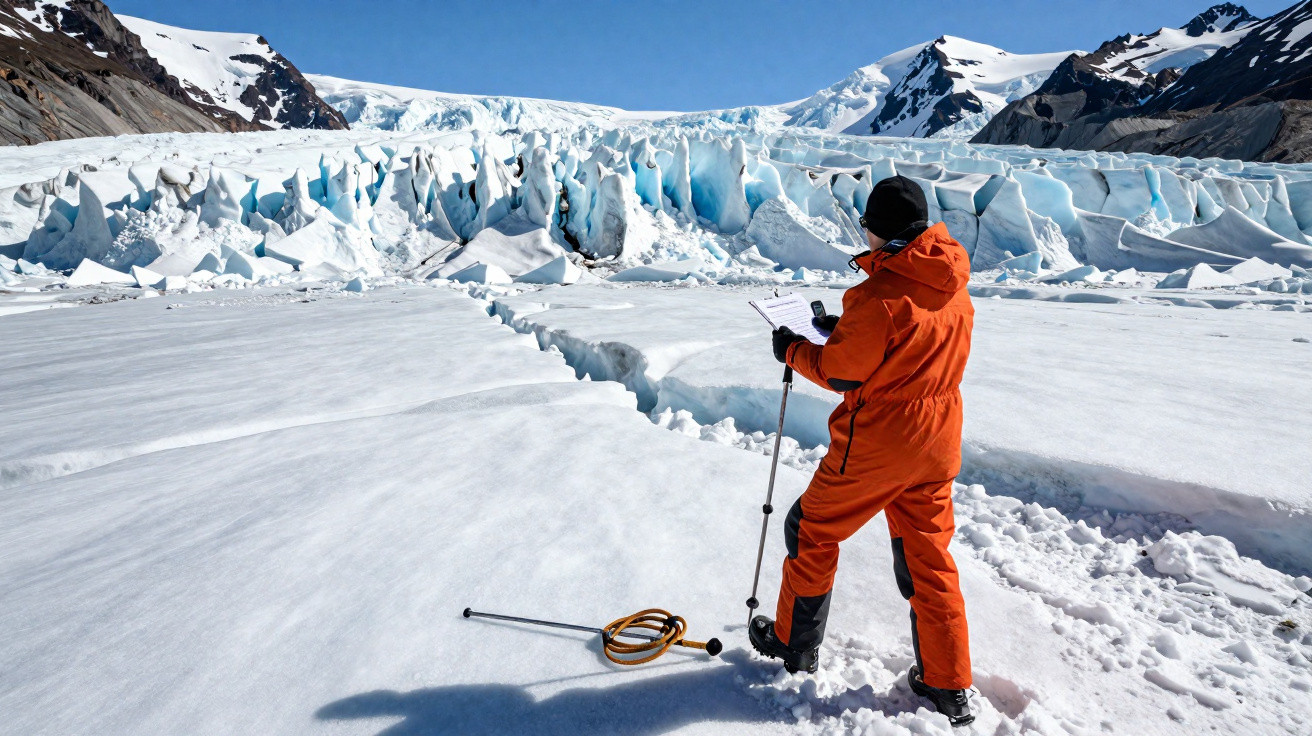
Standing before a glacier advancing towards you is an experience that is hard to forget: immense towers of ice crack continuously as they creep onwards. You cannot perceive the movement as it happens, yet its progress is unmistakable from one day to the following day.
One of us (Harold) witnessed this while undertaking fieldwork at Nathorstbreen, on the Arctic archipelago of Svalbard, in 2012. At the time, the glacier was advancing by more than 10 metres each day.
Such experiences are unusual. As the climate warms, most of the world’s glaciers are retreating quickly, with thousands expected to vanish completely over the coming decades.
Yet a small proportion behave differently, repeatedly accelerating and advancing for months or years following lengthy periods of little movement and retreat. This phenomenon is called glacier surging, and scientists have struggled to explain it for many years.
It may seem that advancing ice offers a counterpoint to the bleak outlook of disappearing glaciers, but the reverse is true. Surges can hasten ice loss, leave glaciers more exposed to climate change and pose major dangers to communities downstream.
We have recently published a worldwide study examining more than 3,000 surging glaciers to investigate why they move in this way. It also provides the first summary of the hazards associated with these glaciers and the ways climate change is influencing surging.
Why some glaciers surge
In a surge, a glacier can accelerate from a gradual crawl to tens of metres per day, at times within only a few weeks. Its most rapid stage, during which ice may travel at more than 60 metres a day, usually continues for a year or longer, although certain glaciers have surged for as long as 20 years. The glacier may then return to slow movement, or even stagnation, suddenly within days or gradually over several years.
During the surge that started in 2008, Nathorstbreen advanced by more than 15 kilometres over approximately a decade, reshaping the whole landscape within a few years.
Scientists think that changes below the glacier control the beginning of a surge. In surge-type glaciers, meltwater is not drained away immediately. Instead, it accumulates beneath the ice, lowering friction between the glacier and the ground and allowing the ice to slide more rapidly.
Once this water finally drains away, the glacier slows down again. Certain glaciers undergo recurring surges, with years or decades of weak ice flow between them, but determining precisely when a surge will occur remains difficult.
Global hotspots of surging ice
Our research indicates that at least 3,000 glaciers have surged at one time or another. Although this represents only around 1% of the world’s glaciers, these tend to be large glaciers and account for roughly 16% of the global glacier area.
They occur especially in concentrated geographical clusters across the Arctic, the Himalayas and other high mountain areas of Asia, and the Andes, while being mostly absent from other places. Climate is the main reason: surges generally do not occur in areas that are now too warm, including the European Alps and mainland Scandinavia, or too cold and dry, such as Antarctica.
Factors including glacier size and the geology beneath the ice also help determine which glaciers within a region surge and which do not.
Several hotspots lie in inhabited areas, where surging glaciers can pose risks. Advancing ice may engulf farmland and infrastructure, while also blocking rivers and creating hazardous lakes that can unleash destructive floods when the ice dam fails.
A surge of Shisper Glacier in the Karakoram mountain range created an unstable lake that drained repeatedly between 2019 and 2022. This caused widespread damage to the Karakoram Highway, an important route linking Pakistan and China.
Rapidly flowing ice can open deep cracks, known as crevasses, making travel more difficult in places such as Svalbard, where glaciers serve as routes between remote settlements. It can also interrupt tourism and leisure pursuits, including situations where climbers cross glaciers to reach mountain peaks. When surging glaciers enter the sea, they can release large numbers of icebergs over a brief period, potentially threatening shipping and tourism.
Surging is changing as the climate warms
Rising temperatures are already altering both the timing and pattern of glacier surging. Surges are occurring more often in some regions, whereas they are becoming less common elsewhere as glaciers thin and no longer retain enough mass to build towards a surge.
Periods of heavy rain, intense melting and other extreme weather events have also been found to prompt surges sooner than anticipated. These influences could become increasingly significant in a warming climate.
Overall, the evidence points to growing uncertainty around glacier surges. As the planet warms, surging may decline in certain regions but increase in others. Glaciers that have not previously surged could potentially begin doing so, including in locations with no historical record of surges, such as the rapidly warming Antarctic Peninsula.
Surging glaciers demonstrate that ice does not invariably react to warming in straightforward, predictable ways. In a rapidly changing world, understanding these exceptions and addressing the hazards they generate is essential.
Harold Lovell, Senior Lecturer, Glaciology, University of Portsmouth and Chris Stokes, Professor in the Department of Geography, Durham University
This article is republished from The Conversation under a Creative Commons licence. Read the original article.



Comments
No comments yet. Be the first to comment!
Leave a Comment