
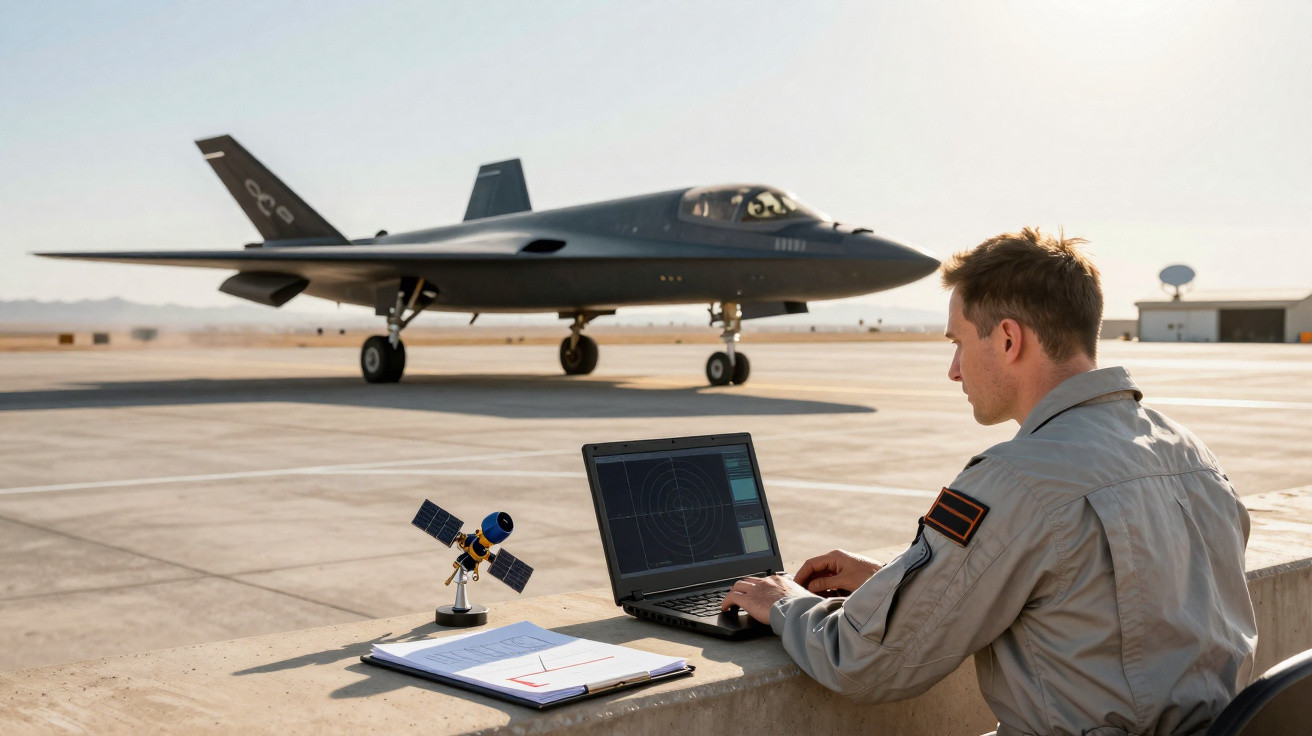
The Pentagon has now confirmed flight trials of a new stealth aircraft-one that insiders describe as almost impossible for radar, and even satellites, to detect. That term, “invisible”, is doing a great deal of work. So is the hype surrounding it.
I stood beside a silent desert runway, where the horizon seemed sewn into the tarmac, as the tower lights dimmed and a form emerged from the darkness. There was no thunderous roar, only air being drawn in and a drifting outline that appeared to wipe itself away as it travelled. A crew chief watched the stars as closely as the runway, as though the sky were observing in return. It seemed to be nothing in the sky, but it was there. The ground radios remained at a subdued murmur. Then the object climbed once more, and the darkness swallowed it. Something had taken flight. Something deliberate.
What “invisible” means in 2025
The Pentagon has confirmed flight testing for a next-generation stealth aircraft. Its description is deliberately striking: an aircraft designed to evade modern radar and avoid satellite detection windows. Yet the truth is technical rather than fantastical. In defence terminology, “invisible” means substantially more difficult to detect across several types of sensor-not literally hidden by a cloak.
There is ample precedent. The B-21 Raider’s initial flights took place amid strict emissions control and night operations, while open-source assessments have long likened the F-22’s radar signature to that of a marble. NGAD-related programmes have reportedly flown demonstrators since 2020. Pilots describe “signature budgets” much as accountants count watts and degrees. This is not magic; it is mathematics, materials and rigour.
Picture every control being turned down. Radar cross-section is reduced through shaping and radar-absorbent coatings. Infrared output is lowered by cooler exhaust routes and plume masking. Radio-frequency emissions are limited through tightly controlled LPI/LPD communications. Contrails, too, are managed through altitude choices and adjustments to fuel chemistry. Satellites are avoided by timing, orbital forecasting and terrain masking. The aircraft does not disappear; it simply becomes an extremely poor target.
Reading the Pentagon’s guarded wording
Begin with the language used. When officials refer to “survivable” platforms and being “low observable across domains”, they are not suggesting science fiction. They mean the aircraft is intended to disrupt the kill chains used to detect, fix and track a target. Match every assertion to a sensor type: radar, infrared, electro-optical, passive RF and space-based SAR. Then consider which countermeasure is reducing that sensor’s effectiveness.
Everyone has seen a headline that sounds like science fiction and prompted an instinctive: really? Stop and unpack it. Headlines trade in wonder; test pilots work in margins. Satellite “invisibility” will often mean planning routes beneath cloud cover, launching between known satellite overpasses and restricting emissions. In truth, nobody does that every day. During a classified test window, however, they absolutely might.
Genuine invisibility-from radar or satellites-does not exist. What does exist is the management of probability and relentless attention to detail.
“If you can’t kill the sensor, outrun its timeline. If you can’t outrun its timeline, starve it of energy.” - flight test engineer, Edwards AFB
Here is a straightforward guide to briefing-room terminology:
- “Low observable” = a reduced signature, rather than no signature.
- “Multi-spectral” = radar, IR, visual and RF emissions have all been addressed.
- “Adaptive mission systems” = software can alter tactics or payloads while airborne.
- “Open architecture” = updates can be introduced rapidly without stripping out the aircraft’s internals.
- “Operationally relevant” = it functioned outside the laboratory, at least once.
Pentagon stealth aircraft test flights, myths and implications
First, the flights themselves. Officials have confirmed that a new stealth platform has flown, drawing on NGAD technology and lessons from the B-21 programme. Its range and operating altitude remain deliberately vague. What has emerged is an outline: a cranked-kite planform, blended edges and smooth apertures. The clues are less dramatic than the rumours-maintenance patterns moving to dusk, runway closures resembling weather delays and telemetry traffic that never rises sharply.
Then come the myths. Satellites are not all-seeing gods in the sky. Their orbits are predictable, and they have blind spots, swaths and revisit intervals. Space-based SAR can penetrate cloud, but it struggles with time constraints and terrain clutter. Infrared sensors favour a hot plume; reduce that plume and they must search coastlines and deserts for contrast. In that untidy environment, an aircraft designed to be unremarkable can prevail.
The strategic stakes follow. China is deploying dense radar networks, over-the-horizon arrays and proliferated LEO sensors. Russia combines legacy VHF systems with more recent digital techniques. The Pentagon’s response is not a single aircraft but a system-of-systems: a stealth airframe, loyal-wingman drones, decoys, electronic attack and data links that operate quietly. The important story is not a miraculous cloak, but a system-of-systems discreetly reshaping air power.
There is a complication that the hype tends to overlook. Satellites observe in infrared. Sky temperatures vary, and contrails reveal their source. The crew chief at the runway perimeter understands all of this. That is why the aircraft departs as winds ease and the upper atmosphere cools. It follows a gap between commercial air corridors. The radios scarcely whisper. After it returns, the apron resembles any ordinary Tuesday in the Mojave.
The change ahead is not limited to the jet itself; it extends to mission planning. Consider operations teams using orbital-mechanics applications, contrail forecasts and AI-produced maps of satellite passes. Pilots could be briefed using “sensor exposure budgets” and receive real-time cockpit prompts: climb 500 feet, turn slightly left, set the throttle to a specified temperature. A pilot’s task becomes one of navigating probabilities, rather than simply outrunning missiles in a straight line.
Industry speculation points to materials that absorb radar energy at unusual angles, “digital skins” that detect incoming frequencies and respond, and exhaust routes cooled through boundary-layer effects. Some of these ideas will not survive testing. Others will endure. The most effective approach may be a traditional one: fly where the adversary is not watching, when the sensor cannot see, in an aircraft that refuses to shine.
Military programmes pass through familiar stages: possibility, secrecy, unveiling, disappointment, revision and, sometimes, surprise. This programme appears to have moved beyond possibility. It is flying. The cautious language reflects the certainty that countermeasures will follow. Somewhere, an engineer is already creating a stronger net. Elsewhere, a planner is teaching the fish how to avoid it.
There is a cultural change as well. The F-117 was a cathedral-few airframes and highly protected missions. The coming generation is intended to provide scale and interoperability: drones that accompany aircraft, sensors that combine data, and information that matters only when required. The “invisible jet” headline may command attention, certainly. But the quiet network behind it is where the advantage lies.
And then there is cost. Stealth depends as much on the supply chain as on scientific progress. It requires coatings that cure correctly in midnight humidity, fasteners that do not create a radar spike and sealants that do not turn chalky under desert sunlight. Every hour of maintenance involves a compromise. If this aircraft genuinely succeeds, it will do so because sustainment became more capable.
There is a human rhythm to it, too. Pilots sleep during the day before stepping onto a flight line humming at its edges. Ground crews remove panels that nobody is permitted to photograph. Schedulers regard satellite tracks as they would tides. The object in the darkness is a machine. What gives it significance is the people who rehearse until what seemed improbable becomes routine.
Separating signal from noise in the next “invisible” story
Apply a three-part test. First, convert claims into sensors. If the sensor and its countermeasure can be identified, there is substance in the assertion. Second, seek evidence of tactics: night operations, EMCON, contrail management and timing around LEO satellite passes. Third, look for signs of the wider ecosystem, including drones, decoys and electronic-warfare packages. Modern jets no longer operate alone.
The common errors are treating a demonstration as doctrine and a prototype as procurement. A flight test does not mean production at scale. A briefing slide does not guarantee sustainment. Treat curiosity generously: it is possible to be impressed and sceptical at the same time. Excitement encourages further reading; scepticism helps keep the assessment accurate.
When a press briefing invokes “multi-domain survivability”, ask how it is achieved.
“We don’t chase invisibility-we chase doubt in the enemy’s decision loop.” - retired squadron commander
Then use this short checklist:
- Ask which signatures were reduced, and by what amount.
- Record any reference to EMCON or LPI/LPD links.
- Look for indications of contrail and thermal management.
- Follow satellite-pass timing through NOTAMs and closures.
- Check for co-operation with drones or EW escorts.
Where this leaves us
So, the Pentagon says a new stealth aircraft is flying, built to evade more than radar alone. The satellite aspect is meaningful in practical terms, not magical ones. It is easy to imagine the mission-planning displays: orbital maps pulsing, wind layers moving and a route threading through the openings.
The myth is attractive because it is uncomplicated. The reality is compelling because it functions. Somewhere between them is the aircraft I watched vanish into the night before returning like a rumour marked by landing lights. This new era will not be determined by one airframe. It will depend on a thousand small advantages arranged in the correct sequence, at precisely the right moment. That is the competition worth watching.
| Key point | Detail | Why it matters to the reader |
|---|---|---|
| “Invisible” means low observable | Signatures are reduced across radar, IR, visual and RF sensing-not literal disappearance | Helps interpret breathless headlines without overlooking real advances |
| Space runs to a timetable | Flights are scheduled around satellite passes, weather and terrain masking | Explains how “satellite-proof” operations rely on timing and tactics |
| A system-of-systems outperforms a lone jet | Stealth is combined with drones, decoys and EW to disrupt kill chains | Clarifies why the ecosystem matters more than the airframe |
FAQ:
- Is the Pentagon really testing a new stealth aircraft? Yes. Officials acknowledge flight tests of a next-generation platform, likely tied to NGAD-era technologies.
- Is it truly invisible to radar and satellites? No. It’s designed to be very hard to detect across multiple sensors, but not literally invisible.
- How can an aircraft avoid satellites? By flying during gaps in coverage, using weather and terrain, controlling emissions, and managing thermal and contrail signatures.
- What makes this different from the B‑21 or F‑22? New materials, tighter emission control, better thermal management, and deeper integration with drones and electronic warfare.
- When will it be operational? Testing comes first. Timelines depend on funding, sustainment, and whether the design scales beyond prototypes.






Comments
No comments yet. Be the first to comment!
Leave a Comment