
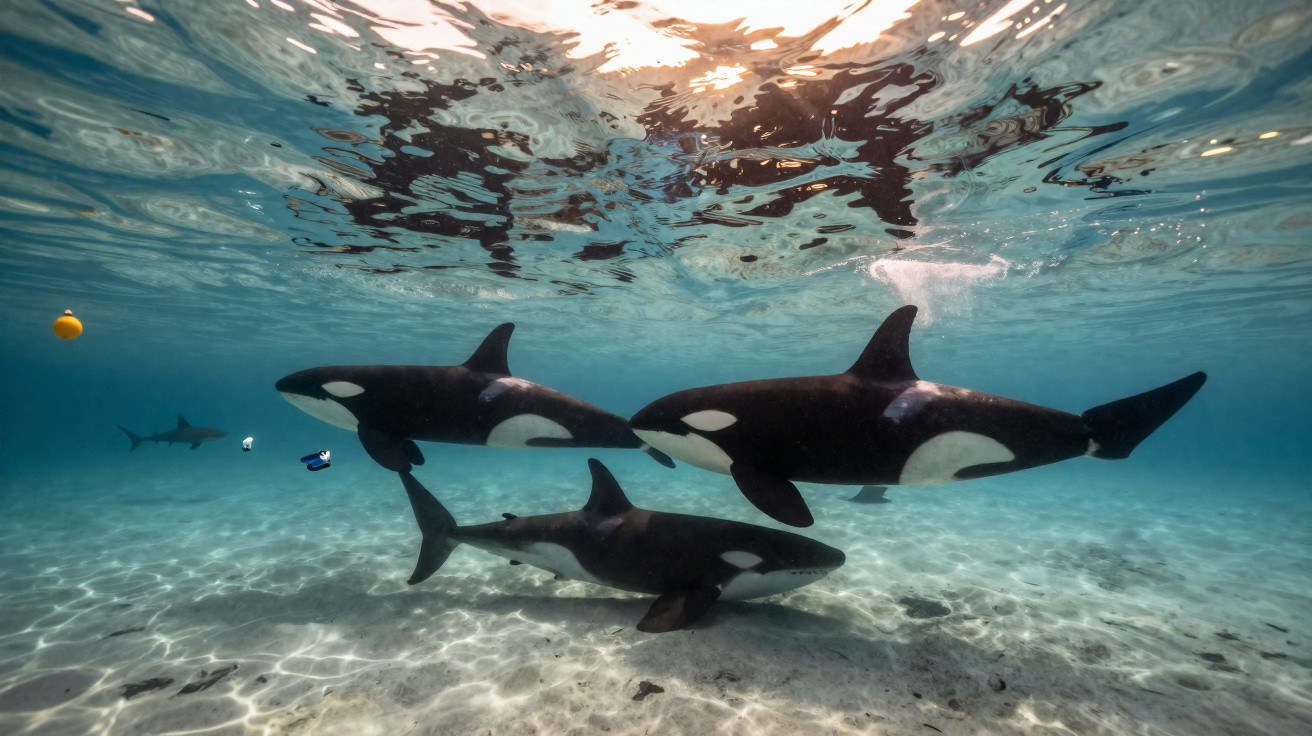
Port and Starboard: orcas hunting great white sharks
Near Gansbaai, a fishing town on South Africa’s coast, two orcas have become known around the world.
Called Port and Starboard, the pair have repeatedly been seen pursuing and killing one of the ocean’s most formidable predators: the great white shark, Carcharodon carcharias.
These killer whales (Orcinus orca) are such accomplished hunters that some scientists have linked them to the shrinking numbers of sharks in a habitat that was once densely populated.
A new paper, however, identifies a different problem. The orcas may not be the primary cause at all. Instead, the sharks could be being forced from their home by an even more effective predator: humans.
In recent years, evidence has increasingly shown that killer whales are exceptionally capable shark hunters, including of large species such as whale sharks and great whites.
Using echolocation, orcas can effectively scan a shark’s body like an ultrasound. They then focus on the liver, which is rich in the lipids sharks rely on during long migrations, removing it with almost surgical accuracy.
From 2017 to 2025 - roughly eight years - 11 cases of orcas preying on white sharks were documented. Most involved carcasses washing ashore and were believed to be the work of Port and Starboard. In 2017, scientists also witnessed the pair kill and disembowel 17 smaller sevengill sharks in one day, although this was an unusual event.
It is not possible to establish the average number of sharks Port and Starboard kill annually, as human observers may not record every hunt.
Human mortality of South African white sharks
Yet a paper led by Enrico Gennari, a marine biologist at South Africa’s Oceans Research Institute, suggests that human activity far exceeds the killer whales’ toll.
Gennari and his co-authors used several lines of evidence to calculate the human-caused death rate among South Africa’s white sharks. Their figures are substantially higher than the known number of orca killings.
They estimate that humans remove 44 white sharks each year from coastal South Africa, through the KwaZulu-Natal shark control programme and bycatch in longline shark fisheries.
Investigating this question has long been difficult. South Africa became the first country to introduce legal protection for the great white shark in 1991. It subsequently had to track shark populations and implement measures intended to safeguard them.
Precisely how those white shark populations are faring, however, remains disputed. A 2023 study proposed that the sharks had not declined but had moved their range eastwards. In 2024, the same research group clarified that the absence of population growth since the 1991 protections was still worrying.
Researchers cautioned that presenting the population as stable could reduce the urgency with which governments pursue additional conservation action.
In their opinion article, Gennari and his colleagues contend that the wider body of evidence points to a more troubling picture. They argue that the white shark population is declining rather than stable, with more serious consequences for the species worldwide.
"If the worrying declines observed in what were once considered the largest aggregation sites of white sharks in the world, in just less than a 15 yr period, were representative of the entire population of white sharks in southern Africa, as we believe they are," the researchers write, "the situation would be extremely alarming, and the possible extinction risk could happen much earlier than modelled."
The latest estimate of white shark abundance, based on data collected up to 2011, put the population at about 908 individuals. Later assessments using genetic data, published in 2016, indicated that a single interbreeding population along South Africa’s coast contained only 333 mature individuals.
No population census has been conducted since, while sightings have dropped sharply in certain areas.
In False Bay near Cape Town, white sharks were recorded at approximately 1.64 per hour between 2000 and 2015. That figure fell to 0.3 sharks per hour from 2016 to 2020. By 2018, boat-based surveys were finding virtually none.
Fisheries and shark control programmes
Gennari’s team is similarly concerned that the white shark population is falling. It calculates that the 44 white sharks killed annually through the government-regulated demersal shark longline (DSL) fishery and the KZNSB shark control programme represent around 5 to 10 percent of the estimated population each year.
That level is unsustainable even by itself, and the calculation does not include other human-related causes of death.
Humans cannot, of course, dictate the actions of Port and Starboard. But the researchers say this makes it all the more essential to restrict human activities that place this shark population at risk.
"Predation by orcas is a natural phenomenon that, no matter the level, does not fall under management control of the government of South Africa, similarly to other sources of mortality occurring in international waters," the researchers write.
"However, the ongoing mortality of white sharks from the DSL and KZNSB, which do fall under government regulation, [is] alone at levels sufficient to prevent white shark recovery, and likely to drive its decline."
"While South Africa was the first nation to protect white sharks," the team concludes, "we fear that it may soon also hold the title as the first nation to lose this species."
The report was published in Endangered Species Research.






Comments
No comments yet. Be the first to comment!
Leave a Comment