
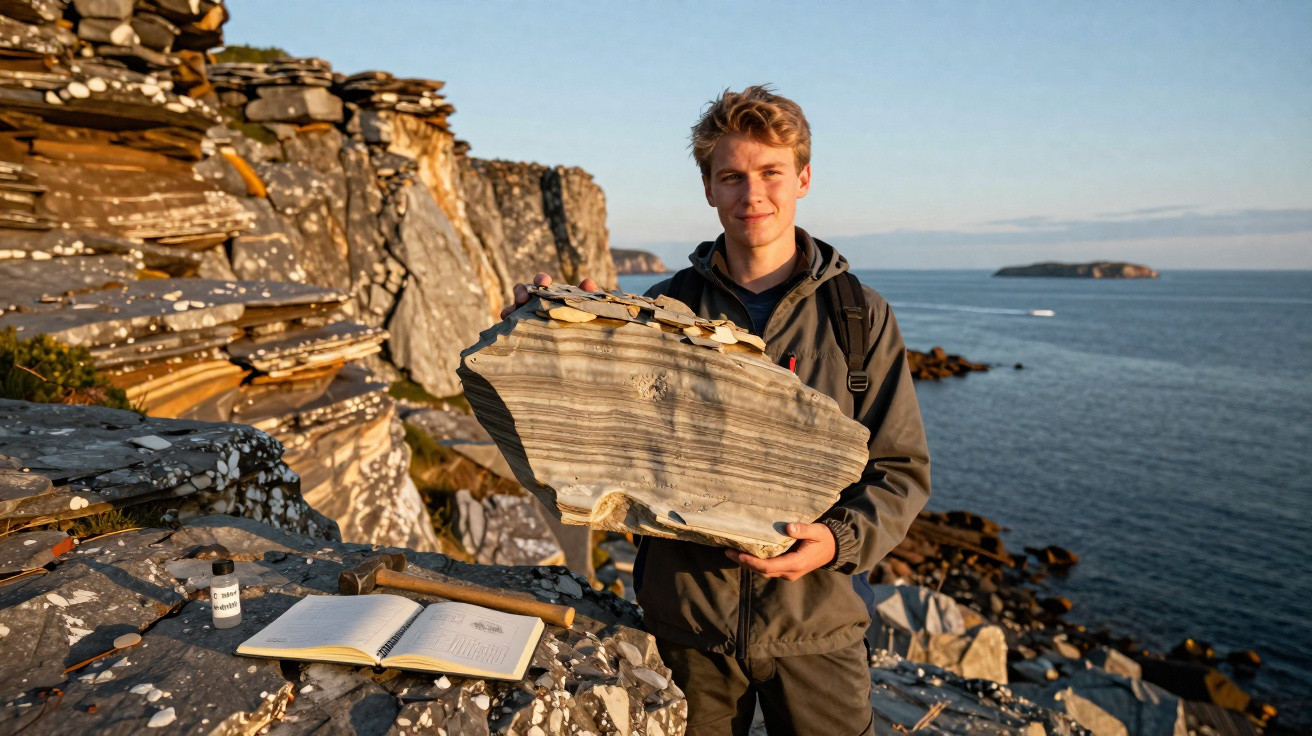
A stretch of seafloor dating back half a billion years is providing scientists with something long absent from studies of the Cambrian: a dependable clock.
New research finds that layered rocks in southern Sweden retain a precise chronology of a major climate disturbance, enabling fossils and chemical signals from far-flung regions to be aligned in time at last.
This advance may transform scientists’ understanding of one of life’s most significant historical eras.
Rocks that recorded time
A continuous succession of ancient seafloor sediments in southern Sweden contains thin layers preserving fossil material alongside changing chemical signals over millions of years.
Damien Pas and his colleagues at the University of Lausanne (UNIL) followed these patterns to link the layered archive directly with the timing of the climate disruption.
As the sequence formed without substantial interruptions, it retains the event’s complete development and decline in their original sequence.
This uninterrupted record provides firm boundaries for the start and finish of the disruption, making wider comparisons throughout the Cambrian world possible.
Why timing changed everything
Marine animals diversified quickly during the Cambrian, roughly 539 to 487 million years ago, but the environmental chronology of that period has remained unclear.
This uncertainty largely stemmed from sedimentary rocks, which preserve clues about climate and life but seldom contain minerals that can be dated easily and directly.
In the absence of a reliable clock, a carbon spike or extinction in one basin could be matched only broadly-or perhaps not matched at all-with records elsewhere.
While this limitation remained, researchers debated the order of events rather than their causes, and global correlations were less robust than they ought to have been.
Reading Earth’s orbital rhythm
Earth’s orbit is never entirely stable, and its subtle variations can govern climate through recurring, predictable patterns over long periods.
Geologists describe the study of this timing in rock layers as cyclostratigraphy: the interpretation of climate rhythms preserved in layered rocks.
Within the Swedish core, the researchers identified recurring chemical highs and lows that corresponded to the rhythm expected from orbital cycles.
Once this pattern was consistent through the section, rock depth became more than simple thickness: it began to measure elapsed time directly.
Carbon leaves a clear mark
Carbon isotopes-slightly different versions of carbon that travel differently through water and air-were among the features examined using the new chronology.
When the global carbon cycle shifts, the relative proportions of these isotopes change, creating a chemical signature that may be preserved in rocks around the world.
In this case, the signal was the Drumian Carbon Isotope Excursion (DICE), a pronounced decline in marine carbon signatures.
Precisely dating DICE gives geologists an uncommon fixed reference point for correlating rock records deposited in oceans far apart.
Sweden’s unique rock record
Southern Sweden provided an exceptional resource: a lengthy, fossil-rich seafloor archive that accumulated steadily rather than being interrupted by repeated gaps.
Previous research on the Alum Shale Formation had already demonstrated that southern Scandinavia holds a continuous carbon record valuable for global correlation.
Its continuity ensured that fossils, sedimentary changes and chemical signals stayed in their original physical order, rather than being rearranged by erosion.
Because this section is so complete, it can act as a benchmark when less complete records from elsewhere appear to conflict.
Matching Cambrian rocks across continents
Armed with the Swedish chronology, researchers can compare rock layers on different continents without depending solely on fossils.
Although the DICE signal had been recognised in widely separated basins, its precise age had remained frustratingly uncertain.
A more exact date allows these dispersed sections to be aligned by the event itself, revealing whether biological changes happened simultaneously or were regional.
From this perspective, local geology becomes part of a global account of climate, timing and early ecosystems.
Climate was always moving
The new clock further indicates that climate in this warm ancient world responded in pulses to orbital variation, rather than changing at random.
As Earth’s axial tilt and orbital shape shifted, sea level and dust supply also changed because wind and water transported sediment differently.
Earlier UNIL work had identified comparable middle Cambrian patterns in Utah, indicating that orbital pacing was not restricted to a single basin.
Observed in more than one basin, this wider pattern strengthens the argument that early Palaeozoic climates were capable of responding rapidly.
Fossils finally make sense
Fossils are more revealing when the rocks around them have precise ages, since their sequence can begin to indicate cause rather than mere coincidence.
When a climate disruption precedes an ecological turnover, that order suggests the environment may have helped bring about the change.
This clearer sequence matters for Cambrian seas because many major animal groups emerged as ocean conditions and chemistry changed rapidly.
Improved dates will not answer every evolutionary question, but they reduce the range in which the true causes might be concealed.
Next steps for the timeline
No single core can represent every shoreline, ocean depth or local disturbance from a world spanning tens of millions of years.
Local chemical conditions can obscure a global signature, while even a robust clock is most useful when it is supported by other sections.
Future research will compare the new chronology with additional cores, as UNIL and partner teams seek equivalent dates in other locations. Should these records agree, the Cambrian could acquire the sort of shared timetable that later periods already possess.
Nevertheless, confirmation from other archives is still vital, since the history of early animals cannot depend on one surviving record.
For the moment, though, this half-billion-year-old seafloor archive already acts as a “rock clock,” bringing fossils, chemistry and climate rhythms onto common terms.






Comments
No comments yet. Be the first to comment!
Leave a Comment