
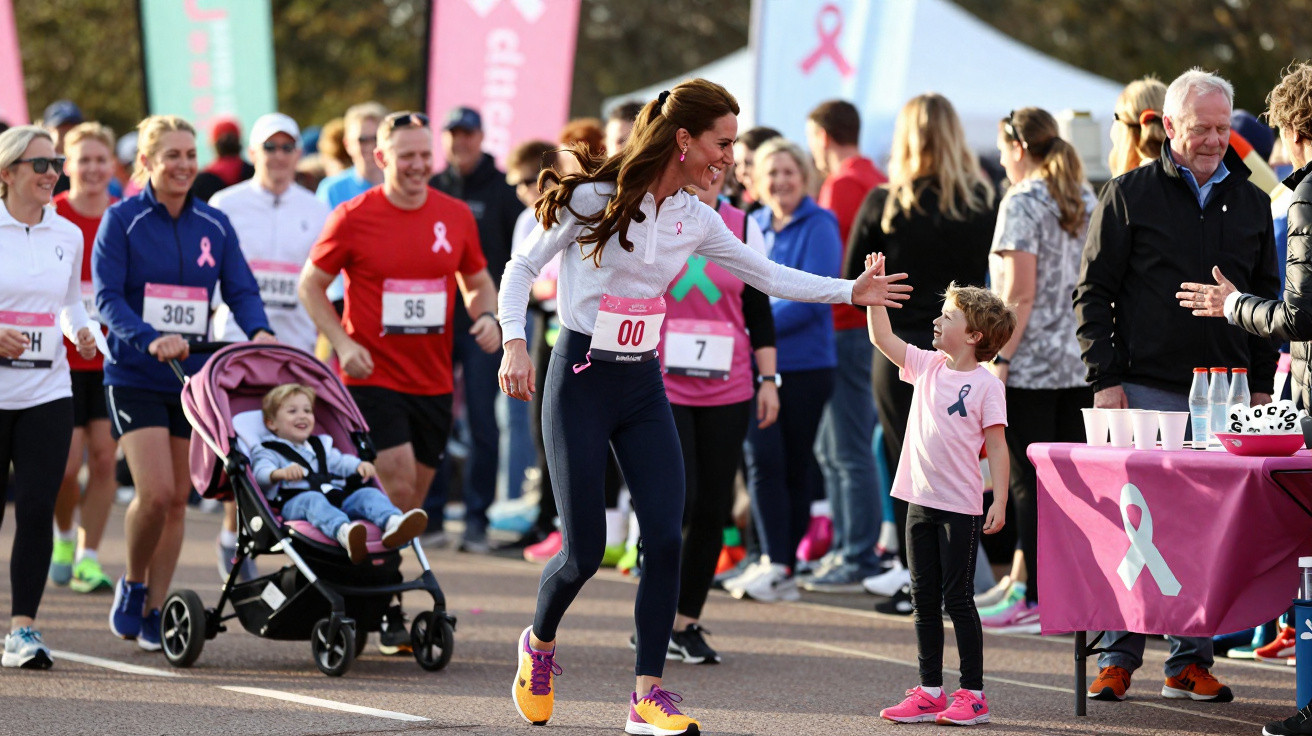
The atmosphere along The Long Walk in Windsor felt altered that morning. It was less formal, less carefully staged, as though a window had been opened in the royal world and everyday life had swept through. Runners in pink vests fastened their race numbers, tied back their hair, double-knotted their laces and readied their phones. Then a ripple of chatter passed through the crowd, quiet at first before becoming as sharp as camera clicks. Princess Catherine had arrived to run, rather than glide, in the Rose Delights charity run supporting cancer causes.
There was no sash or tiara: only running kit, a determined smile and cheeks pink from the crisp air.
It was the sort of scene that made people pause their scrolling and simply look.
When a Princess Trades Heels for Running Shoes
From afar, Catherine nearly disappeared into the mass of runners. She wore navy leggings and a light-coloured top, moving with those recognisable long strides. The security presence at the perimeter gave her away, along with the way every phone suddenly tipped upwards, like sunflowers turning towards unexpected light.
Parents raised children on to their shoulders. Volunteers exchanged nudges and whispers, their eyes wide. Normally a heartfelt local gathering for cancer awareness and support, the Rose Delights run had become an international moment in an instant.
As she began to jog, an unusual hush fell over the gathering, as if people needed time to adjust the story they had expected.
Close to the start line, a woman in her forties clutched a laminated photograph to her chest. It showed a girl with a shaved head and an unwavering grin. Quietly, the woman explained that her daughter had adored “Kate” since childhood, and that she had come to run in her daughter’s place.
When Catherine went by, the woman neither shouted nor tried to move closer. She simply lifted the picture slightly, her eyes glistening. The princess noticed, slowed for a moment and offered a small, intentional nod. There was no dramatic gesture or sweeping speech: only one person acknowledging another.
That brief interaction soon appeared in hundreds of tightly cropped screenshots, posted with captions that read more like personal journal entries than royal commentary.
Royal engagements are generally arranged with the precision of a ballet: planned angles, set timings, orderly lines and controlled exits. This run instead resembled a school fundraising event, where everyone is a little anxious and has not quite had enough coffee. Princess Catherine’s impact did not come from appearing as the Princess of Wales. It came from seeming like another person doing something practical, sweaty and mildly uncomfortable for those confronting something much harder.
Cancer remains in the lives of countless families like an unwanted visitor. When a royal enters that space without the familiar sense of separation, people recognise it at once. That is why this “Run for Rose Delights” moment spread so quickly online.
It was not glossy; it felt unmistakably human.
The Small Gestures That Won Over the Crowd
Before the official countdown began, Catherine did something that could easily have gone unseen from further away. She moved away from the cameras towards a small group of children in vivid headbands, each with “Running for Mum” written across their backs.
Rather than offering a distant royal wave, she crouched to their height. She joked that her own children make fun of her running technique, asked whose laces needed an urgent re-tie, and admired one boy’s wristband, which he held out like a prize, as though it were a diamond bracelet.
These occasions have their power in the small details that never appear in an official itinerary.
For many attending, the event was not about catching sight of a princess. It was a way to remember someone they loved, someone they had lost or someone still receiving treatment. Their race bibs carried their stories: “For Dad”, “For Nanna Rose”, “For my best friend”.
Seeing Catherine run among them, a little breathless like everyone else, changed the mood. Twice, she paused to fix her ponytail, laughed when her race number almost came loose, and stretched out her legs like any apprehensive runner waiting at the start.
We all know that feeling: partly prepared and partly frightened, yet turning up regardless.
The social-media comments shared most widely were not focused on clothes or etiquette, but on how relatable she appeared. One user wrote that seeing Catherine run with cancer survivors “felt like watching a sister, not a duchess.” Another said they had never been interested in royal news, yet the footage “hit close to home” because their own mum was having chemotherapy.
There is a restrained lesson in this. On days like these, public figures need not raise their voices to make an impact. They need to attend, accept that perspiration is not always flattering on camera, and allow their body language to speak. It is strangely reassuring when someone watched so closely permits themselves to appear a little unpolished before millions.
That is the point at which a charity event becomes more than an entry in a diary and turns into a memory people carry with them.
What Princess Catherine’s Royal Run Reveals About Us
A closer look at Catherine’s pace showed that she was not attempting to lead the field. She remained just behind some of the more practised runners, alongside people who appeared less certain. Rather than imposing her own rhythm, she matched theirs. It was a straightforward act, almost impossible to spot on television, but meaningful at ground level.
You need not be royal to take that approach. At your next charity walk or run, consider keeping pace for a while with someone who seems alone or uneasy. Ask who they are running for, and whether they would rather talk or walk in silence.
Showing up in person is one thing; showing up emotionally is something else entirely.
These events can bring a quiet expectation to be “strong”, smile and keep tears hidden so as not to lower the atmosphere. People recount their stories briefly before swallowing the most difficult parts. Catherine’s attendance, in light of her widely known recent health difficulties, disrupted that expectation a little.
If illness has ever left you feeling guilty for not being unfailingly courageous, you are not alone. You can support cancer causes while also feeling untidy, exhausted or even angry about what is happening. Honestly, no one manages every day with flawless grace.
The Rose Delights run appeared to make room for both realities: hope and fatigue, laughter and grief, sharing the same track.
“Seeing Princess Catherine run with us didn’t magically fix anything,” one participant said afterwards. “But for an hour, it felt like the distance between palace and hospital ward shrank to almost nothing.”
- Pay attention to small acts – A nod, a mutual glance or a hand on the shoulder can remain with someone much longer than a speech.
- Allow room for imperfection – An awkward stride, an unsteady voice or a crooked race number are signs of genuine presence, not failure.
- Speak about the person you are running for – Saying their name aloud, even softly, can make an ordinary jog a ritual of remembrance.
- Tell your own version of the story – A photograph, post or message to a friend can keep these causes present long after the event.
- Keep one commitment – Whether you donate, check in on a friend or arrange that medical appointment, turn the day’s emotion into one practical action.
A Royal Run That Belongs to Everyone
What remains after Princess Catherine’s Rose Delights run is not the precise distance she ran or her finishing time. It is the sense that, for one short section of road, the royal narrative and ordinary life moved together. Children wearing paper crowns ran beside adults with hospital wristbands tucked beneath their sleeves. Volunteers passed out cups of water with the same attentiveness they might show when handing a neighbour a mug of tea.
Such scenes show that public figures can offer more than balcony waves. They can share the same cold morning light as everyone else and communicate, without speaking, “I see what you’re carrying.”
Perhaps that explains why so many viewers clicked, watched again and quietly sent the videos on with private captions of their own. They were not merely watching a princess. They saw resilience in movement, with fear and hope existing side by side, and a cause made visible by the rhythm of trainers on the pavement.
The enduring question is simple, if slightly unsettling: once the banners are packed away and the photographs no longer trend, how much of that courage do we carry into daily life?
| Key point | Detail | Value for the reader |
|---|---|---|
| Royal presence can feel human | Catherine ran alongside participants, spoke with families and matched their pace | Encourages readers to view public figures – and themselves – as able to form genuine connections |
| Small gestures matter | Nods, brief chats and noticing a photograph or wristband | Demonstrates how small actions at charity events can bring others profound comfort |
| Emotion and action can mix | Grief, hope and exhaustion shared along the same running track | Helps readers embrace imperfect responses while continuing to support cancer causes |
FAQ:
- Question 1 Was Princess Catherine’s Rose Delights run an official royal engagement?
- Question 2 Why did this specific event attract so much public and online interest?
- Question 3 In what ways does taking part in a charity run help cancer patients and their families?
- Question 4 Must I be fit or an experienced runner to join similar local events?
- Question 5 What is one easy way to honour someone affected by cancer if I cannot take part in a run?






Comments
No comments yet. Be the first to comment!
Leave a Comment