
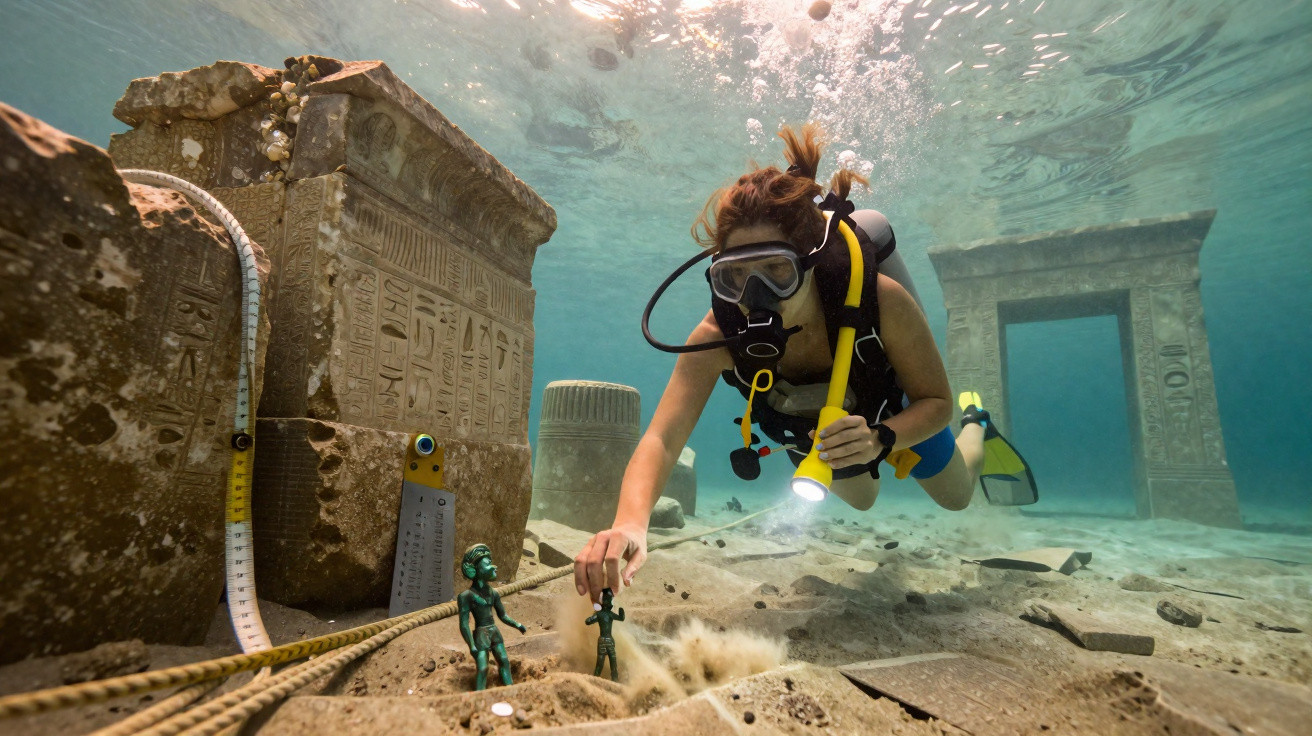
For two millennia, scholars have wondered where Egypt’s final queen was laid to rest. Now, suspicion is mounting that the trail to Cleopatra’s legendary tomb may begin underwater, near a long-underestimated temple west of Alexandria.
A sunken harbour reshapes the search
On 18 September 2025, Egypt’s Ministry of Tourism and Antiquities announced a discovery that initially sounded like a conventional case of underwater archaeology: an ancient harbour had been identified near the Mediterranean coast, now buried several metres beneath sea level.
Such announcements are far from unusual in Egypt, a country whose history is ever-present. Yet the location immediately caught experts’ attention. The harbour remains lie only a few kilometres from Taposiris Magna, a temple complex around 50 kilometres west of Alexandria. For years, an international team has been pursuing a bold possibility at precisely this site: that Taposiris Magna could be where Cleopatra VII and her lover Mark Antony were buried.
A newly discovered harbour off the coast places Taposiris Magna at the heart of what may be the most spectacular tomb search of our time.
The leading advocate of this theory is Dominican researcher Kathleen Martinez, formerly a criminal defence lawyer and now an archaeologist with long-standing links to National Geographic. She sees the harbour discovery as another piece in a wider picture formed by inscriptions, religious architecture, pottery and coins.
Why Taposiris Magna could be Cleopatra’s final resting place
Cleopatra is regarded as the most celebrated ruler of Ptolemaic Egypt. She ruled from 51 to 30 BC, considered herself a reincarnation of the goddess Isis, and presented herself as a divine queen in both domestic and foreign affairs. After her defeat by Octavian at the naval Battle of Actium, she took her own life, probably in Alexandria. No confirmed trace of her tomb has been found since.
The Roman victor had a clear objective: to display Cleopatra in Rome as a trophy of his power. The fact that this never happened turned her into a legend even in antiquity. Later sources refer to a burial, but leave its location and form unclear. Alexandria was long seen as the obvious candidate. Part of the ancient metropolis now lies underwater, having sunk into the sea as a result of earthquakes and ground subsidence.
Martinez deliberately began from a different premise. She considered which location would have made theological, political and military sense in the late Ptolemaic kingdom. Her answer was Taposiris Magna, a temple complex devoted to Osiris and Isis - the very deities with whom Cleopatra identified herself.
Evidence supporting Taposiris Magna
- Religious significance: The temple was an important centre of worship for Osiris and Isis, who were central to Cleopatra’s public self-presentation.
- Archaeological finds: Coins bearing her portrait, along with pottery and offerings from her reign, have been uncovered.
- Burial structures: Researchers have revealed several burial chambers in and beneath the temple, thought to have been intended for high-ranking individuals.
- Military position: At the time of Cleopatra’s death, Taposiris Magna apparently had not yet fallen into Roman hands - a strategic advantage.
It is this particular combination that leads Martinez to believe Cleopatra may have chosen burial in a place rich in symbolism yet comparatively secure from a military perspective. The newly reported harbour fits this scenario strikingly well: it may have provided the route through which processions, priests and valuable funerary goods reached the temple.
How the sunken harbour could become a game changer
For now, the newly identified harbour is chiefly made up of wall lines, mooring structures and scattered building remains. Satellite imagery, dives and underwater scanning techniques such as sonar indicate that the installation may have been substantially larger than first believed.
For the search for the tomb, this means researchers must reconsider the surroundings of Taposiris Magna. If the temple had its own harbour, it was evidently more closely integrated into Mediterranean trade than previously assumed. That makes it more likely that the complex held greater political and religious importance than older textbooks suggested.
The more significant Taposiris Magna was, the more plausible it becomes that Cleopatra chose this very place for a tomb of maximum symbolic power.
Martinez and her team plan to intensify their underwater work in the coming months. Systematic dives, sediment sampling, underwater photogrammetry and 3D reconstructions are planned. Their aim is to establish whether the harbour was directly connected to the temple’s ceremonial areas, or even contained its own, as-yet unknown ritual zones.
Documentary follows the demanding mission
National Geographic is documenting the work on film. The documentary Cleopatra’s Final Secret is intended to show the combination of traditional fieldwork, advanced technology and personal obsession involved. Even now, it is clear that the search for Cleopatra is less a romantic treasure hunt than a painstaking struggle with clues, hypotheses and measurement data.
The film also highlights the risks involved. Underwater work is dangerous, and access to some areas is severely restricted. Currents, poor visibility and the potential danger of collapsing ruins make every minute spent diving more difficult.
What finding Cleopatra’s tomb would mean
If the Taposiris Magna theory proves correct, archaeology would be facing a discovery of the century. Cleopatra’s tomb would rival that of Tutankhamun in significance, perhaps even surpass it. Whereas Tutankhamun became an icon largely by chance, Cleopatra represents an entire era between the pharaonic kingdom and Roman world power.
An undisturbed tomb - if one still exists at all - could answer questions that have occupied scholars for decades:
- How did Cleopatra really die, beyond the literary accounts?
- What role did Roman envoys play during her final days?
- What did funerary worship look like at the end of the Ptolemaic dynasty?
- What political messages did the tomb’s furnishings convey?
At the same time, Egypt would face a delicate balancing act. Such a discovery would attract millions of tourists from around the world. The pressure to open the site to visitors would be immense, while conservation concerns would favour a more restrained approach. For years, the country has been working to ease the burden on celebrated sites including Luxor, the Valley of the Kings and Abu Simbel.
How underwater archaeology works in Egypt
The report of the sunken harbour forms part of a wider series of maritime discoveries. In the waters off Alexandria, teams have located parts of the ancient lighthouse, statues, columns and entire harbour installations over recent decades. The once-submerged cities of Heracleion and Canopus also demonstrate how dramatically the coastal zone has subsided over time.
A typical investigation usually follows these stages:
- Preliminary research using historical maps, texts and geological data.
- Survey voyages using sonar and magnetometers to identify structures below the seabed.
- Targeted dives at notable locations, with photographic documentation.
- Collection of samples, dating and material analysis on land.
- Gradual excavation of particularly relevant areas.
Every stage requires time, funding and permits. Politics also plays a major role in Egyptian archaeology: archaeology is part of the country’s image-making. Discoveries generate headlines, while new museums and prestige projects are intended to reinforce Egypt’s reputation as the cradle of civilisation.
Why myths surrounding Cleopatra endure
Cleopatra captivates not only historians, but also popular culture, literature and film. One reason is that she stands at a historical dividing line. Her death ended Ptolemaic rule, and Egypt became a province of the Roman Empire. At the same time, a wave of propaganda about her was unleashed. Roman authors commonly depicted her as a seductive schemer - an image that has persisted to this day.
Modern research seeks to correct that stereotype. Evidence points to a politically highly educated, multilingual ruler who skilfully navigated between Hellenistic and Egyptian traditions. A tomb containing original inscriptions, statues and symbols could greatly sharpen - or revise - that picture.
There is also the power of titles such as “female pharaoh”, “divine queen” and “ruler of the Nile and the sea”. For many people, they instantly evoke lavish cinema, shadowy palaces, golden treasures and dramatic love stories. This blend of archaeology and emotion is exactly what makes the hunt for her tomb so compelling.
Why the case matters to German-speaking readers
For German-speaking audiences, the question is often: what does this have to do with us, beyond being an exciting story? More than might first appear. German and Austrian institutes have been active in Egypt for decades, including in the Valley of the Kings, at Saqqara and at Nubian temple sites. Many methods of modern analysis - from 3D scanning to ancient DNA analysis - were also developed with the involvement of European laboratories.
If Cleopatra’s tomb is genuinely found, collaboration with research institutions in German-speaking countries would be very likely. Radiological analysis, materials science and conservation all require international cooperation. For museums in Berlin, Munich, Vienna or Basel, such a discovery would be a major draw for large special exhibitions.
Until then, the matter remains a wager on the future. Kathleen Martinez confidently says it is “only a matter of time” before the veil is lifted. The sunken harbour off Taposiris Magna at least reinforces the sense that the search is leaving its dead end behind and entering a phase in which every new excavation season could produce real answers - or raise entirely new questions.





Comments
No comments yet. Be the first to comment!
Leave a Comment