
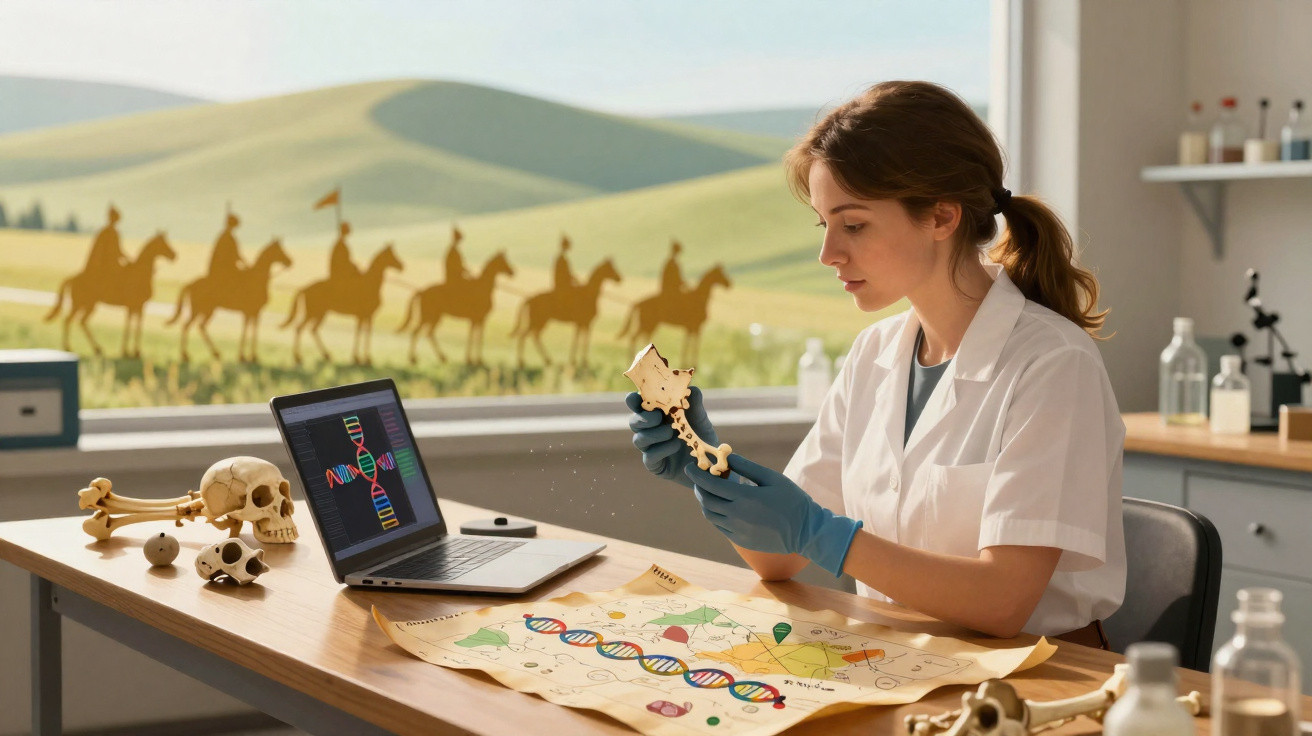
For centuries, our understanding of earlier societies has relied chiefly on pottery fragments, burial grounds and ancient written records. But ancient DNA research is transforming both what we know about the human past and the scope of what can be discovered.
In a recent study, we examined the genetic material of hundreds of people who lived in the Carpathian Basin, in south-eastern central Europe, over 1,000 years ago. The findings reveal detailed family trees, offer a view of a complex society and trace stories of change across several centuries.
Who were the Avars?
The Avars were nomadic people whose origins lay in eastern central Asia. Between the 6th and 9th centuries CE, they held power across much of eastern central Europe.
Archaeologists know the Avars particularly for their distinctive belt fittings, although their wider legacy has been eclipsed by earlier peoples such as the Huns. Even so, Avar burial grounds provide exceptionally valuable evidence of their customs and ways of life. Archaeologists have so far excavated more than 100,000 Avar graves.
Through the perspective of "archaeogenetics", we can now investigate far more deeply the complex network of relationships connecting people who lived more than a millennium ago.
Kinship patterns, social practices and population dynamics
A large share of our knowledge of Avar society is based on accounts produced by their adversaries, including the Byzantines and Franks. This research therefore marks an important advance in our understanding.
We brought together ancient DNA evidence with archaeological, anthropological and historical context. This enabled us to reconstruct large family pedigrees and provided insight into the kinship patterns, social practices and population dynamics of this enigmatic era.
We collected samples from every available set of human remains from four completely excavated Avar-period cemeteries, including sites at Rákóczifalva and Hajdúnánás in present-day Hungary. In total, 424 individuals underwent detailed analysis.
Nearly 300 of these people had close relatives buried within the same cemetery. We were consequently able to reconstruct several large pedigrees extending across as many as nine generations and 250 years.
Avar communities were structured around paternal lines
The research identified a complex social structure. Our findings indicate that Avar society operated through a strict paternal system of descent, known as patrilineal descent.
After marrying, men generally stayed in their father's community, helping to maintain continuity in the lineage. Women, by comparison, were central to building social connections because they married beyond their own family community. This custom, known as female exogamy, highlights women's crucial role in sustaining social cohesion.
The study also found cases in which closely related men, including brothers or a father and son, had children with the same female partner. These relationships are termed "levirate unions".
Despite these customs, we found no indication of partnerships involving genetically related individuals. This implies that Avar communities carefully maintained knowledge of their ancestry.
The findings are consistent with historical and anthropological evidence from societies on the Eurasian steppe.
Our work also found that the principal descent line at Rákóczifalva changed, with one pedigree replacing another. This shift coincided with changes in archaeology and diet that were probably associated with political developments in the region.
Although this transition was substantial, it cannot be identified by genetic research conducted at a broader level. Our results demonstrate that apparent genetic continuity can conceal the replacement of whole communities. This observation could have wide-ranging consequences for future archaeological and genetic investigations.
Future directions for Avar research
Conducted with researchers at the Max Planck Institute for Evolutionary Anthropology in Leipzig, Germany, and Eötvös Loránd University in Budapest, Hungary, our study forms part of the wider HistoGenes project, funded by the European Research Council.
The project demonstrates that ancient DNA can be used to study whole communities rather than isolated individuals. We believe there remains much more to uncover.
Our next objective is to build a fuller picture of ancestral Avar society by extending the research across a broader geographical area of the Avar realm. This wider approach will let us explore the origins of women who married into the communities we studied. We also hope it will clarify connections among communities in greater depth.
We additionally intend to examine evidence of pathogens and disease in the people included in this research, improving our understanding of their health and daily lives.
A further research direction involves refining the dating of Avar sites. We are currently assessing several radiocarbon dates from individual graves to establish a more precise chronology for Avar society. This detailed timeline will enable us to identify major cultural shifts and interactions with neighbouring societies.
The authors wish to acknowledge the contributions of Zsófia Rácz, Tivadar Vida, Johannes Krause and Zuzana Hofmanová to this work.
Magdalena M.E. Bunbury, Postdoctoral Researcher, James Cook University and Guido Alberto Gnecchi-Ruscone, Postdoctoral Researcher, Department of Archaeogenetics, Max Planck Institute for Evolutionary Anthropology
This article is republished from The Conversation under a Creative Commons licence. Read the original article.




Comments
No comments yet. Be the first to comment!
Leave a Comment