
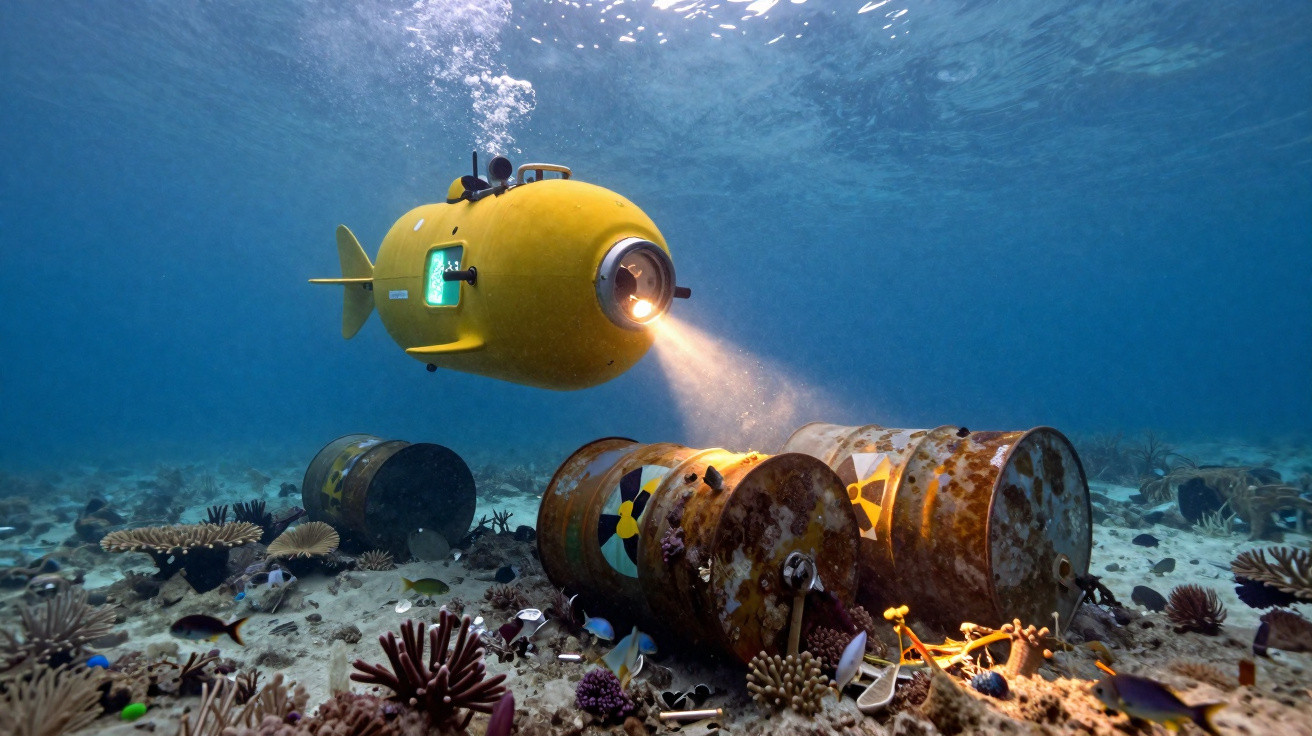
The latter half of the 20th century was, in many respects, a golden era for nuclear technology.
After the atomic destruction of the Second World War, radioactive decay was put to new and more peaceful uses. Nuclear power stations, medical therapies, scientific work and industrial applications all expanded beneath what seemed to be a beneficial nuclear glow.
Yet the nuclear age also produced a substantial challenge: deciding how to deal with the thousands of tonnes of radioactive waste created during this period.
Atlantic radioactive waste dumping
For Europe, the answer appeared comparatively straightforward.
At the bottom of the Atlantic Ocean lay a seemingly suitable stretch of seabed which, in the view of the authorities, was not being used by anyone who mattered.
Between 1949 and 1982, more than 200,000 barrels of low-level radioactive waste were sent there. Together, they held over 150,000 tonnes of waste and were largely discarded at depths of 3,000 to 5,000 metres.
For many decades, their eventual fate was largely unknown.
Scientists have now travelled down to the dumped barrels in a crewed submersible to examine them. They found that numerous containers had corroded and deteriorated, allowing their contents to leak across the seabed.
Remarkably, this may not represent a failure of the original strategy.
Low-level radioactive waste, or LLW, is not without danger. Derived from activities including medical and industrial work, it generally contains smaller quantities of long-lived radionuclides.
The International Atomic Energy Agency now advises placing LLW in secure containment and isolating it for at least several hundred years. During the mid-20th century, however, the guidance was somewhat different.
The rules at the time stated that the containers only had to survive their descent to the seabed and remain sealed long enough for short-lived radionuclides to decay.
Once that had happened, the leftover waste was intended to seep out gradually and disperse into the nearby ocean.
Still, not every substance inside the barrels would simply decay away. Their contents were a radioactive mixture that included cesium-137, plutonium isotopes and tritium, with some materials able to remain for thousands of years.
After sea dumping ended in the 1980s, the matter was effectively abandoned. For decades afterwards, little was known about either the barrels' exact locations or their condition.
NODSSUM maps the radioactive waste barrels
A few years ago, French National Center for Scientific Research nuclear engineer Patrick Chardon and marine geologist Javier Escartín began asking what had happened to the discarded waste.
Their question ultimately led to NODSSUM - Nuclear Ocean Dump Site Survey Monitoring - a cross-disciplinary project combining nuclear physics, geology, oceanography, biology and marine chemistry. Its aim is to locate the barrels and establish whether they are affecting the environment around them.
The project's first voyage began in June 2025 aboard the research vessel L'Atalante. During this initial survey, the researchers deployed an autonomous underwater vehicle, UlyX, across the seabed to map and photograph barrels, while also gathering water, sediment, fish and crustaceans from nearby.
Within a single month, the team had found and mapped 3,355 barrels.
That first expedition served as reconnaissance, providing the scientists with something they had previously lacked: specific targets.
They returned in May 2026.
On this occasion, the team travelled aboard the Pourquoi Pas? with Nautile, a three-person submersible able to descend to 6,000 metres. During 20 dives, it took scientists to depths of more than 4,700 metres, where they inspected barrels at close range and took samples from the areas immediately surrounding them.
The state of certain barrels was disturbing at first sight.
Many were severely corroded and degraded, with material visibly seeping on to the surrounding sand.
Deep-sea life and escaped radioactivity
However, the expedition also produced a puzzling discovery: the barrels seemed to act as small oases on an otherwise thinly populated sandy seabed.
Anemones had fastened themselves to the containers. Sponges, sea cucumbers, fish and crustaceans inhabited the surrounding area, while crabs appeared especially attracted to these artificial shelters.
This gave the researchers an unforeseen complication. Rather than merely being vessels gradually releasing radioactive material into a vacant abyss, the barrels had become integrated into the ecosystem.
That raised a far more complex issue: was radioactive material entering the bodies of the animals themselves?
There was no doubt that some radioactive substances had escaped their containers. Equipment on the ship recorded substantial signals of cobalt-60 and niobium-94, which the researchers could directly connect to the dumped waste.
Cesium-137 and americium-241 also occurred at concentrations far above the background levels expected from atmospheric nuclear tests and accidents.
Whether this radioactivity is building up in animals living on or near the barrels remains a separate question.
At five locations, Nautile gathered sediment, water, organisms and microbial communities from directly beside - and even touching - the barrels. The scientists additionally sampled nearby rocky habitats so they could compare those communities with the ones associated with the containers.
The samples are currently being examined to establish what impact, if any, these unusual habitats are having on the creatures that inhabit them.
There is, though, previous evidence indicating that even pronounced radioactivity close to a source may not travel far.
A recent investigation of the sunken Soviet submarine Komsomolets recorded radionuclide concentrations hundreds of thousands of times higher than background levels immediately around its leaking reactor. Yet the concentrations fell steeply just metres away as the substances dispersed through seawater.
Likewise, the NODSSUM researchers found that, although radioactive signals around the barrels were substantial, activity was not high enough to create serious radiation-protection concerns for scientists handling the samples.
Neither Nautile nor the instruments it carried displayed evidence of contamination.
This does not mean the waste is harmless, nor does it suggest that radioactive crabs are about to overwhelm us.
For the first time, however, researchers possess both a detailed map of thousands of barrels and samples capable of showing what is taking place around them.
This article was fact-checked and edited by Peter Dockrill. Although we take pride in our process, we are only human. If you notice an error, please let us know.





Comments
No comments yet. Be the first to comment!
Leave a Comment