
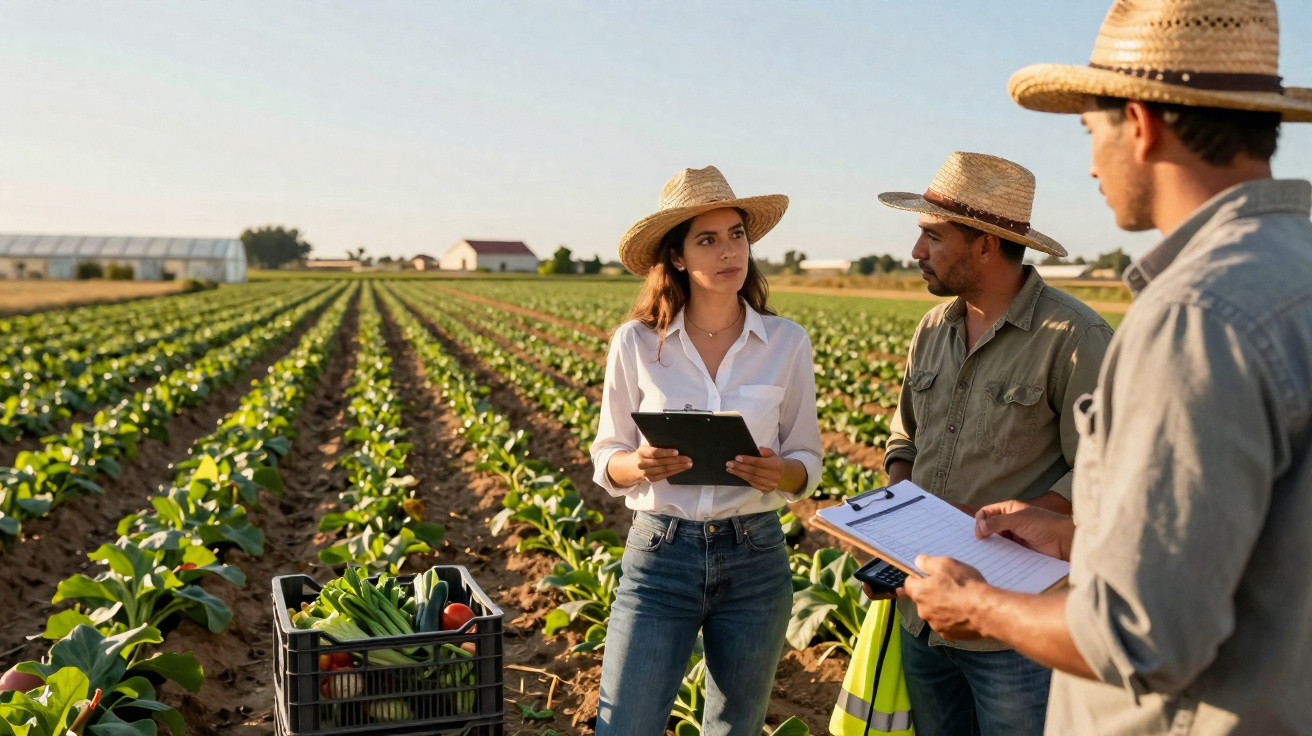
In Spain, a farmer has reignited the debate over agricultural pay by showing poorly completed planting work on her holding.
Laura Moreno, a Spanish farmer and content creator, posted a TikTok video that prompted a large number of responses. The online source text describes what she found after a day of planting: a significant proportion of the plants had reportedly not been placed in the ground properly. In her view, the standard of the work and pay levels cannot be considered separately.
Incomplete crop rows at the centre of the dispute
In the video, Laura Moreno walks through a recently planted field. She points out empty gaps in the rows where plants should have been positioned. Her criticism concerns work she considers inadequate, which, she says, means that part of the job must be inspected and redone.
“It turns out that half of the plants have not been put in place,” Laura Moreno laments.
The farmer highlights missing plants in several areas of the field. She first mentions a row with one or two plants absent, then notes similar gaps in the neighbouring rows. The footage illustrates her argument: for an agricultural employer, incomplete or poorly carried-out work can create additional costs.
The issue goes beyond the time needed to put the plants back into the soil. Uneven planting may also make crop management more difficult. Irrigation work, machinery access and row maintenance frequently depend on a carefully planned layout. If some plants are missing, the farmer must choose whether to replant them, leave the gaps empty or alter how the field is managed.
Laura Moreno’s response to calls for higher agricultural pay
The video is a direct reply to the frequent criticism of agricultural pay levels. Laura Moreno does not deny that this debate exists, but she believes pay must also reflect the work delivered.
“People say that agriculture is badly paid, but how can I pay more if they do not do their job properly?” Laura Moreno asks.
She addresses the people responsible for the planting, challenging them over the consequences of these mistakes. “How am I going to be able to pay you well, my darlings? How am I going to be able to call you?” she says in the video. Her final question is also directed at her followers: “If work was done like this for you, would you give more money as you are being asked to do?”
Online responses reflect a broader reality: agricultural jobs are shaped by seasonal work, physical hardship, weather-related uncertainty and the economic constraints faced by farms. The debate can sometimes set employees against employers in an overly simplistic way. Yet a farm must simultaneously pay its teams, purchase plants and inputs, maintain equipment and manage the risk of poor harvests.
What work quality means on a farm
When planting is carried out, quality is not simply a matter of completing the task quickly. It includes putting each plant in the correct position, observing the planned spacing and checking that every location has been filled. These actions determine how uniform the field will be.
- A missed plant can lower the number of plants being grown.
- An uneven row can make certain tasks harder to carry out.
- Replanting requires additional labour.
- Delays to operations can affect the crop timetable.
Laura Moreno’s case does not support conclusions about agricultural workers as a whole. It presents the perspective of a farmer dealing with planting she considers defective. Above all, the video demonstrates the tension that can emerge when an employer feels that the result does not match the paid working time.
Pay rules for agricultural day labourers in Spain
In Spain, agricultural day labourers are covered by pay rules that may differ according to the region, crop type and relevant provincial collective agreement. The source text states a minimum of €57.82 gross per working day, compared with an average of close to €61 in the sector concerned.
For someone working a full month, this would amount to between €1,200 and €1,500 gross per month, based on the data cited by the source. These figures include the portion relating to additional bonuses and holiday pay. Conditions are not the same everywhere: olive harvesting in the province of Jaén and strawberry harvesting in the province of Huelva may fall under different local frameworks.
Piecework is also used. Under this arrangement, an employee is paid according to the quantity harvested or processed, such as kilos or crates. It can enable experienced workers to increase their earnings, while also raising questions about pace, safety and the required standard of work.
The source text also states that an employer may make a deduction of up to 10% when accommodation is provided. However, trade unions and agricultural organisations report cases of fraud in some vulnerable areas, including irregular pay of €5 to €6 per hour, below the applicable rules.
What is the position of agricultural employees in France?
In France, agricultural employees are covered by employment law and collective agreements applicable to their work. Their pay cannot be lower than the statutory minimum wage where it applies, or than the minimum set by a collective agreement when that amount is more favourable. Rules may also vary according to the type of holding, the employee’s qualifications and the area.
The Mutualité sociale agricole is the main social protection body for the agricultural sector. Among other responsibilities, it manages social protection for both farm operators and employees in the sector. The labour inspectorate may intervene where there are breaches involving contracts, working hours, health or pay.
As in Spain, seasonal jobs in France raise practical recruitment issues. Farmers need people who are available for periods that can be short, while employees expect working conditions and pay that reflect the physically demanding nature of the tasks. Training for the role and supervision in the field have a direct part to play in reducing errors.
Economic vulnerability often highlighted by farmers
The source text also refers to the experience of Paula Nuévalos, another young farmer. She describes self-employment as an activity in which earnings have no ceiling, but losses are equally uncapped. This uncertainty is part of everyday life for many small farms.
“There is no ceiling on what you can earn, but there is none on what you can lose either,” Paula Nuévalos says about self-employment in agriculture.
Another business owner, Ángel Pérez, points out that some self-employed people sometimes forgo paying themselves in order to pay their employees. “Very often, the self-employed go without pay so that the employee does not miss out on their wages,” he says.
These accounts do not settle the debate about low pay and working conditions in the fields. They do, however, underline that a farm’s profitability relies on many factors: crop selling prices, labour costs, weather conditions and losses caused by work that needs to be redone. In Laura Moreno’s video, the forgotten plants therefore become a symbol of a wider disagreement involving quality expectations, pay and the economic survival of farms.





Comments
No comments yet. Be the first to comment!
Leave a Comment