
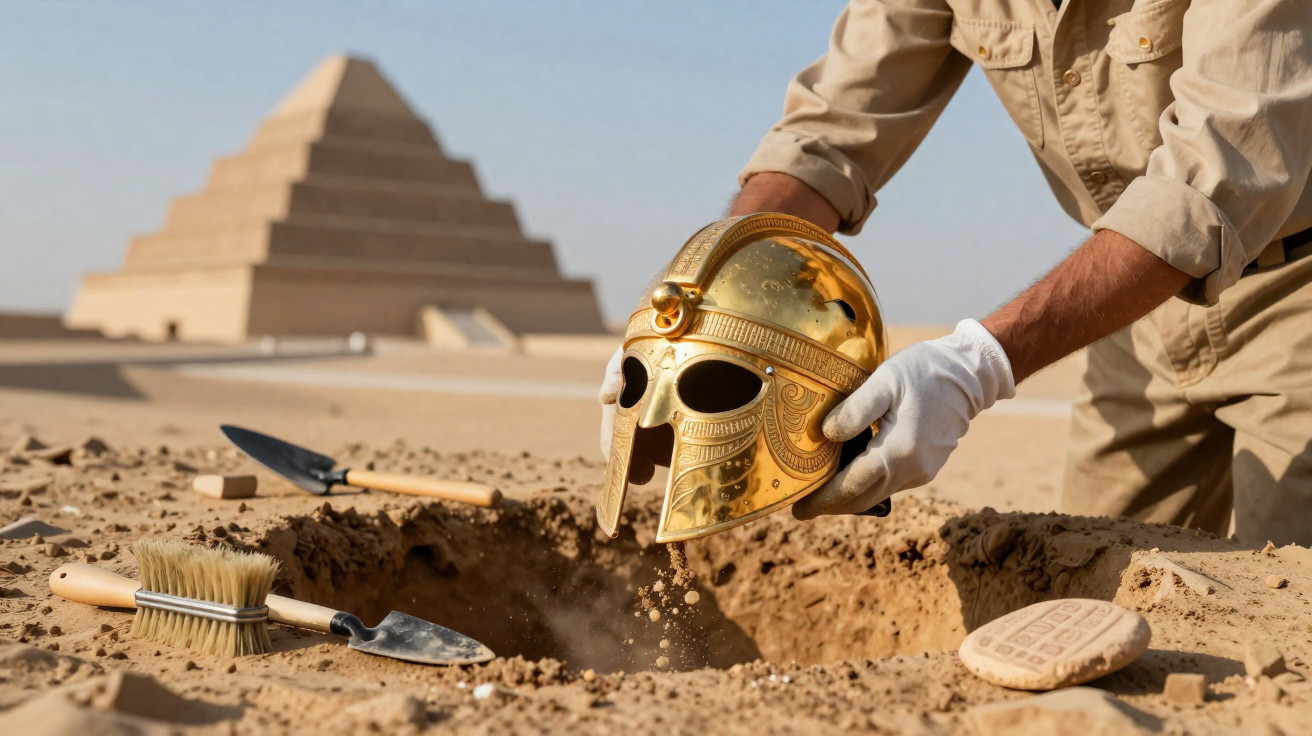
Under the yellow light of a museum display case, a gold helmet can appear almost familiar: a weighty, gleaming prestige object made to be admired. Yet the example unearthed at Ur, in southern Iraq, did not come from a living palace, but from a tomb that had been silent for nearly 4,500 years. It lay beside a man named Meskalamdug, whose name still sounds like a whisper from the world’s earliest cities. Beneath its finely engraved golden curls, this helmet evokes an age when wearing precious metal on one’s head already proclaimed status, strength and perhaps closeness to the gods. One object can make an entire civilisation seem alive again. Its most unsettling detail is still to come.
A gold helmet in the heart of Ur
Ur was no small settlement lost in the sand. Around 2600 BCE, this Sumerian city ranked among Mesopotamia’s major urban centres. Amid its temples, workshops and markets, people managed harvests, traded with distant lands and buried their elites with a wealth that continues to impress archaeologists. The helmet associated with Meskalamdug, made from gold estimated at about 15 carats, emerged from this crowded, noisy and deeply stratified society. Its surface reproduces carefully styled hair, with locks swept up around the ears. Every feature was deliberate.
The discovery dates from excavations at the Royal Cemetery of Ur led by British archaeologist Leonard Woolley during the 1920s. The helmet was found in a grave that did not contain the site’s most extravagant treasures, yet held sufficient evidence to indicate someone of high rank: jewellery, weapons, valuable objects and inscriptions. Depending on the translation, Meskalamdug probably means “hero of the good land” or “hero of the fertile land”. The name does not belong to a ruler who has been conclusively identified, which makes the artefact all the more compelling. It confronts us with a real man while withholding many of the answers.
A combat helmet would ordinarily shield the skull. This one appears instead to defend an image: that of a leader who was invulnerable, controlled and almost superhuman. Gold is too soft to provide effective protection on a battlefield, although the object may have been worn in ceremonies. Its importance lay elsewhere, in what observers understood the moment they saw it. At a time when precious metal belonged to very few people, displaying such a piece would have imposed silence on those around its wearer. Power had to be visible before it was ever spoken of.
Why the Meskalamdug helmet still challenges researchers
To understand an ancient helmet, it is necessary to resist a very modern instinct: looking only at its beauty. A straightforward approach is to place the object within three precise contexts: where it was found, the items buried with it and the techniques required to make it. In this case, the tomb at Ur discloses a world in which social standing extended beyond death. The deceased did not depart alone, but took the markers of identity with them. Set in the darkness of the grave, the helmet may have served as one final assertion of authority.
A common mistake is to assume that the gold must have come from the area around Ur. Lower Mesopotamia, however, had no major workable gold mines nearby. The metal must have arrived through complex trading networks, probably from Iran, Anatolia or regions farther away still. To be honest, nobody really does this every day: tracing the path of metal that is four and a half millennia old. Yet that trail demonstrates something tangible: the first cities were already connected to a far wider world than is often imagined.
The helmet’s delicacy also reveals the skill of Sumerian craftspeople. A sheet of gold was hammered, shaped and ornamented with a precision that implies tools, repeated practised movements and a long tradition of passing on expertise.
“The helmet tells us not only who wore it: it also reveals the hands capable of making it.”
- It replicates an elaborate hairstyle, probably indicating social distinction.
- Its gold points to long-distance trade routes.
- Its presence in a tomb links prestige, remembrance and political power.
It is therefore not an isolated treasure, but a small map of the Sumerian world.
The fragile fate of a symbol of power
Meskalamdug’s helmet is also a reminder that archaeological treasures are never entirely safe. Kept for many years at the Iraq National Museum in Baghdad, it is believed to have vanished during the looting that struck the institution in 2003, amid the chaos following the US invasion. Copies and photographs still make study possible, but the possible loss of the original leaves a very real absence. We all know the strange feeling of looking at an old photograph: the thing is visible, yet cannot be touched. Here, that absence concerns a unique piece of human history.
Its potential disappearance does not diminish the object’s force; instead, it makes that force more palpable. Ancient civilisations can seem remote, fixed behind glass and dates that are difficult to remember. But the story of this helmet connects with a very current concern: what happens to a country’s memory when its museums are under threat? Heritage is never abstract. It consists of fragile materials, guarded rooms, catalogues, conservators and people determined not to let stories disappear.
It is also important to be cautious about dramatic labels. Calling this helmet “one of the oldest symbols of power” does not mean it was the first object of authority ever made; sceptres, ceremonial maces and insignia had already existed in other forms. Its distinctiveness lies in the meeting of gold, the human face it suggests and the funerary context of Ur. It embodies a very old but still recognisable idea: those who rule often seek to make their position visible. Sometimes, they place it quite literally above their heads.
| Key point | Detail | Added value for the reader |
|---|---|---|
| A discovery at Ur | The helmet is connected with Meskalamdug’s tomb, around 2600 BCE. | Understanding its age and Sumerian context. |
| Gold from afar | Mesopotamia probably imported this metal through extensive trade. | Seeing Ur as a city open to the world. |
| Power on display | The helmet suggests exceptional status rather than military protection. | Reading the object as a political and social message. |




Comments
No comments yet. Be the first to comment!
Leave a Comment