
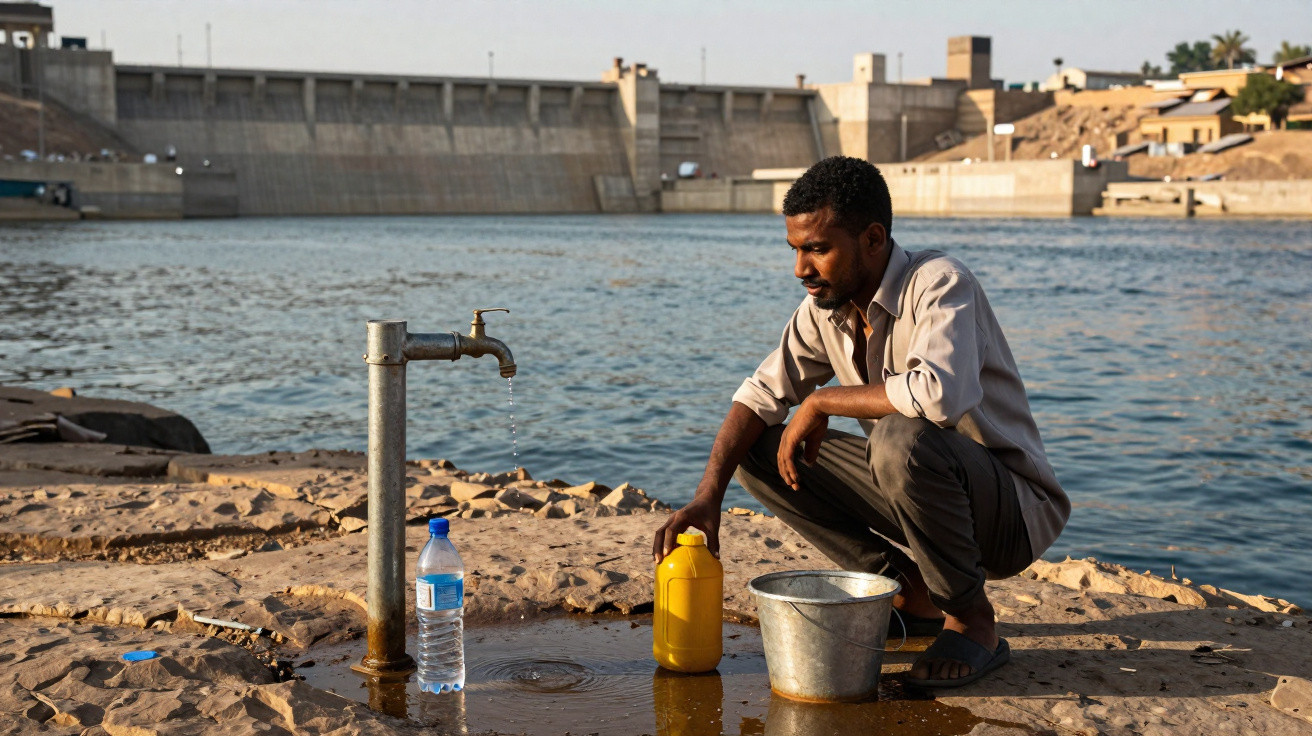
On the banks of the Nile near Aswan, the water can seem almost motionless on certain mornings. It stretches towards the horizon, dense and blue, as though the river has forgotten how to move. In 1970, Egypt sought to harness that power: to stop enduring floods, prevent water from flowing away to the sea, and secure harvests and electricity for a rapidly growing country. The Aswan High Dam was conceived as a promise of security. Yet holding back water is never a neutral act. A vast lake breathes, warms up, evaporates and alters everything living around it. We all know the urge to keep every drop, every possession and every possibility, for fear of lacking something tomorrow. The Nile shows that preserving too much can also come at a high price. And the bill is enormous.
The day Egypt set out to tame its river
Before the dam, the Nile reached Egypt with a changing temperament. In some years, flooding enriched the land with black mud full of silt; at other times, it swept away homes, ruined crops and left lasting anxiety behind it. For centuries, people had lived with this pattern, balancing gratitude with fear. Completed in 1970, the Aswan High Dam transformed that relationship: the river would no longer decide everything on its own. Water became a reserve, almost a national vault. At first glance, the reasoning appeared straightforward. In a largely arid country dependent on one great river, allowing water to escape seemed like an unaffordable luxury.
Created behind the structure, Lake Nasser can hold around 132 billion cubic metres of water. It is a staggering amount, far exceeding the average annual flow of many European rivers. Depending on the year, Egypt receives around 55.5 billion cubic metres from the Nile, as allocated under water-sharing agreements with Sudan. Yet evaporation across this huge surface, exposed to the desert sun, is substantial. Estimates differ, but they frequently suggest that between 10 and 16 billion cubic metres disappear into the air each year. Depending on the method used, that volume is comparable to a large share of the water carried by the Seine over a year. A river vanishing silently into the sky.
This contradiction illustrates a simple truth: storing water does not invariably mean saving it. The dam has certainly shielded Egypt from extreme floods and, especially in its early years, enabled hydroelectricity generation. It has also made irrigation more consistent, which matters greatly for both towns and farmland. However, a giant reservoir produces a new vulnerability: water remains for a long time in an area of intense heat. It evaporates before reaching canals, taps or crops. Total control carries a physical cost. The sun does not negotiate with human plans. It takes its share every day.
When saving every drop ends up wasting water
The lesson is not that Egyptians should be blamed for building the dam. At the time, the decision addressed very real emergencies: feeding a growing population, reducing the risk of famine and stopping floods from governing the lives of millions. Today, the practical response is instead to consider storage at several scales. A large reserve can be valuable, but it works best alongside smaller basins, recharged groundwater reserves and better-maintained canals. Putting some water underground or retaining it in soils reduces its exposure to sunlight. It is less spectacular than a concrete wall, but often more sensible.
One common mistake is to focus only on what has been retained, without calculating what escapes while it is being kept. In everyday life, this resembles a fridge full of food bought “just in case”, then forgotten at the back of a drawer. We tried to avoid shortage and instead created waste. Let us be honest: nobody manages this perfectly every day. The same instinct applies to water at national level. Leaking networks, overly generous irrigation or highly water-intensive crops can undo part of the effort made to build reserves. Keeping something also requires maintaining it.
The dam caused another loss, one less apparent from Lake Nasser’s shores: the Nile’s silt is trapped behind the structure. For centuries, these sediments naturally enriched soils in the valley and delta. Farmers have had to rely more heavily on fertilisers, while the delta, deprived of part of its sediment supply, has become more vulnerable to erosion and rising sea levels. Herodotus had already written:
“Egypt is a gift of the Nile.”
- The river brings water, but it also carries nutrients and sediment.
- A dam guards against excesses while blocking part of that wealth.
- Effective management means accounting for both benefits and hidden losses.
The Nile, a reflection of our most ordinary habits
Egypt’s experience is neither an outstanding success nor an absolute failure. It demonstrates that a decision may be right for its time, only to reveal side effects over subsequent decades. The Aswan High Dam gave Egypt valuable capacity to manage dangerous floods and years of drought. It also shifted the problems elsewhere: major evaporation, greater reliance on fertilisers, tensions over sharing the river, and concerns linked to new dams built upstream, particularly in Ethiopia. Nothing is ever lost without being transformed elsewhere. That applies to water, but equally to how we live, consume and seek to make everything secure.
There is something deeply human in this story. We stockpile files, savings, clothes, food supplies, appointments and sometimes even regrets, believing they will protect us. Then comes the point when accumulation takes up space, demands energy and eventually slips beyond our control. Lake Nasser does not suggest that every resource should simply be allowed to flow away. It suggests that we should decide what to keep, anticipate its cost and accept that no dam can make the world entirely predictable. A useful reserve remains alive: it circulates, nourishes and serves a purpose. Otherwise, it becomes a burden beneath the sun.
Egypt’s choices also echo current climate debates. In a world where droughts are becoming harsher and rainfall more irregular, large dams retain a strategic role. But experts now give greater attention to combined solutions: modernising irrigation, fixing leaks, recycling wastewater, protecting groundwater reserves, adapting crops and sharing data between countries along the river. This approach may seem less heroic than a dam stretching for several kilometres. It may also be closer to reality. The Nile crosses eleven countries: no single one can own it alone. Water retained in one place always becomes somebody else’s concern.
| Key point | Detail | Value for the reader |
|---|---|---|
| Giant-scale storage can lose water | Lake Nasser experiences substantial evaporation in a desert climate. | Understand that keeping water does not automatically mean conserving it. |
| The dam also delivered benefits | Flood protection, regulated irrigation and electricity generation. | Avoid an overly simplistic interpretation of this historic decision. |
| Losses are not only visible | Silt is held back, affecting soils and the delta. | Consider the indirect consequences of a practical choice. |
FAQ:
- Why did Egypt build the Aswan High Dam? To control Nile flooding, store water during dry years, expand irrigation and generate electricity. The project met essential needs in a country that is largely desert.
- How much water evaporates from Lake Nasser each year? Figures vary according to the period and calculation method, but commonly cited estimates range from 10 to 16 billion cubic metres annually.
- Was the dam a mistake? No, presenting it that way would be too simplistic. It prevented flood-related disasters and strengthened water security, while also creating lasting ecological and agricultural effects.
- Why was Nile silt so important? It naturally fertilised farmland in the valley and delta. Its retention requires more fertiliser use and weakens the natural balance in downstream areas.
- What lesson can be drawn from this story? Before holding on to a resource, its storage costs must be measured. The best reserve is often one that remains accessible, well maintained and genuinely used.





Comments
No comments yet. Be the first to comment!
Leave a Comment