
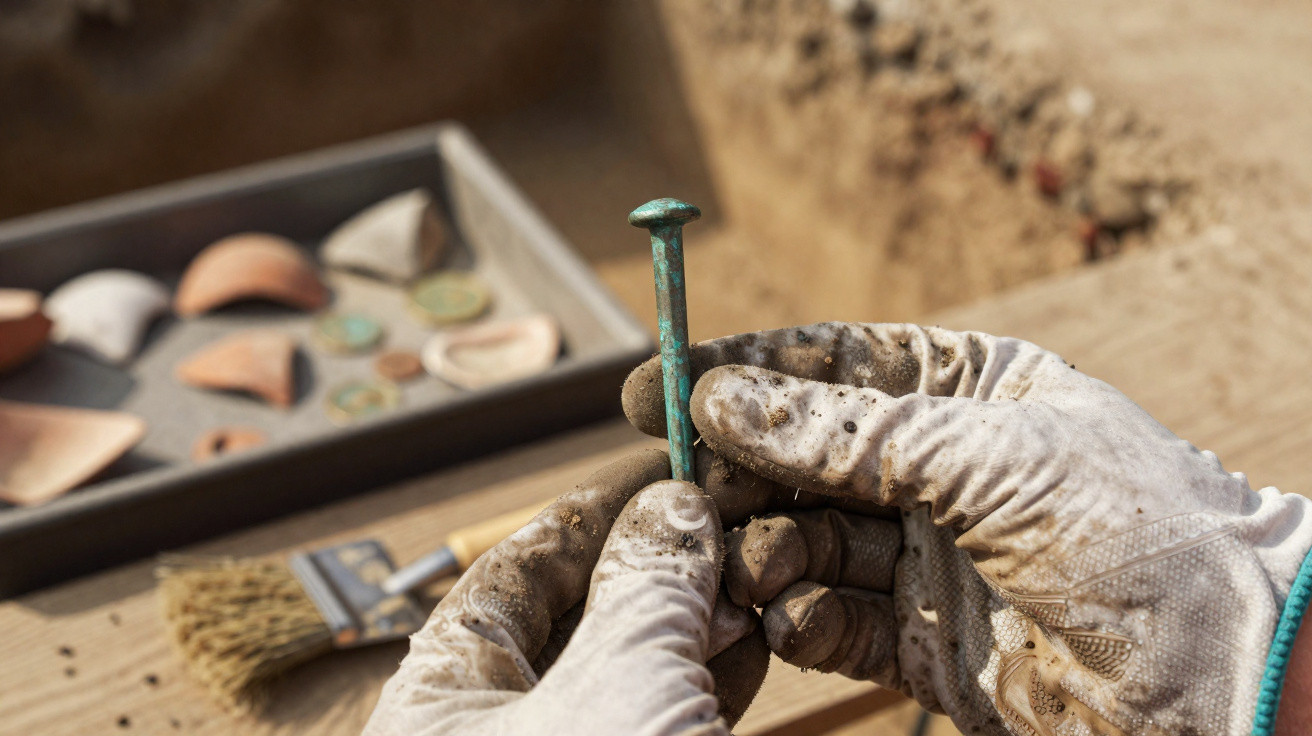
Road-improvement work near Cheltenham, England, has uncovered an object that brought together two very different concerns for ancient Romans: keeping their nails clean and warding off bad luck. Among the artefacts recovered from the ground was a small copper nail cleaner with a handle deliberately fashioned as a phallus.
The find was made during archaeological excavations carried out ahead of planned improvements to Junction 10 of the M5 near Cheltenham. Archaeological Research Services was commissioned to examine the land before the Gloucestershire County Council scheme began.
The investigation exposed evidence from several periods of occupation, including coins, a copper-alloy buckle and a fourth-century burial. Among these discoveries was the small Roman tool, probably dating from between AD 300 and 400, whose unusual shape immediately drew the archaeologists’ attention.
What was this small object used for?
At its lower end, the object has a slender blade split into two prongs, a shape designed to remove dirt from beneath fingernails. Comparable items are known from Roman Britain archaeology, while the British Museum holds other copper-alloy nail cleaners connected with everyday personal grooming.
The example found near Cheltenham also includes a small loop, probably intended to attach it to a strap or cord so it could be worn on the body. The Archaeological Research Services team believes it may rank among the best-preserved examples of its kind yet identified.
Why was the Roman nail cleaner given a penis-shaped handle?
To modern eyes, its form may look like little more than an obscene joke. In the Roman world, however, phallic images also carried meanings linked with luck, fertility and protection. Rob Collins, an archaeologist at Newcastle University, has explained that such representations were used to avert misfortune and occur in both written sources and the archaeological record.
Phalluses could feature on amulets, buildings, personal possessions and inscriptions, and were also associated with defence against the evil eye. This combination helps explain why someone might have carried a grooming tool in such an apparently extravagant form:
- The tool’s forked tip was intended to clean the area beneath the nails.
- Its phallic handle turned an everyday implement into an object with symbolic meaning.
- Romans connected phallic representations with good fortune and fertility.
- Phallic amulets and images were also used as protection against the evil eye.
What does the object reveal about hygiene and superstition?
The discovery illustrates that practical routines and beliefs did not have to belong to separate worlds. A Roman could have used the same item to tend to their nails while also carrying a symbol thought to offer protection. Its loop further supports the possibility that the implement served as a personal accessory, kept close at hand.
This interpretation has parallels in other finds from Roman Britain. The British Museum describes the phallus as a symbol widely associated with good fortune, while English Heritage records amulets in which phallic motifs are linked to protection from the evil eye.
Why does a nail cleaner deserve so much attention?
Monumental temples and fortresses help historians reconstruct empires, but small objects reveal how people actually lived. A nail cleaner offers insight into concerns about appearance, hygiene, convenience and personal beliefs at a time when symbols now regarded as explicit could form an ordinary part of daily life.
The tool unearthed beneath the route of future roadworks turns an apparently amusing scene into something far more revealing. It is worth looking beyond the shape of the handle: hygiene and superstition sit side by side in this object, preserving a surprisingly intimate detail of Roman life for around 1,600 years.






Comments
No comments yet. Be the first to comment!
Leave a Comment