
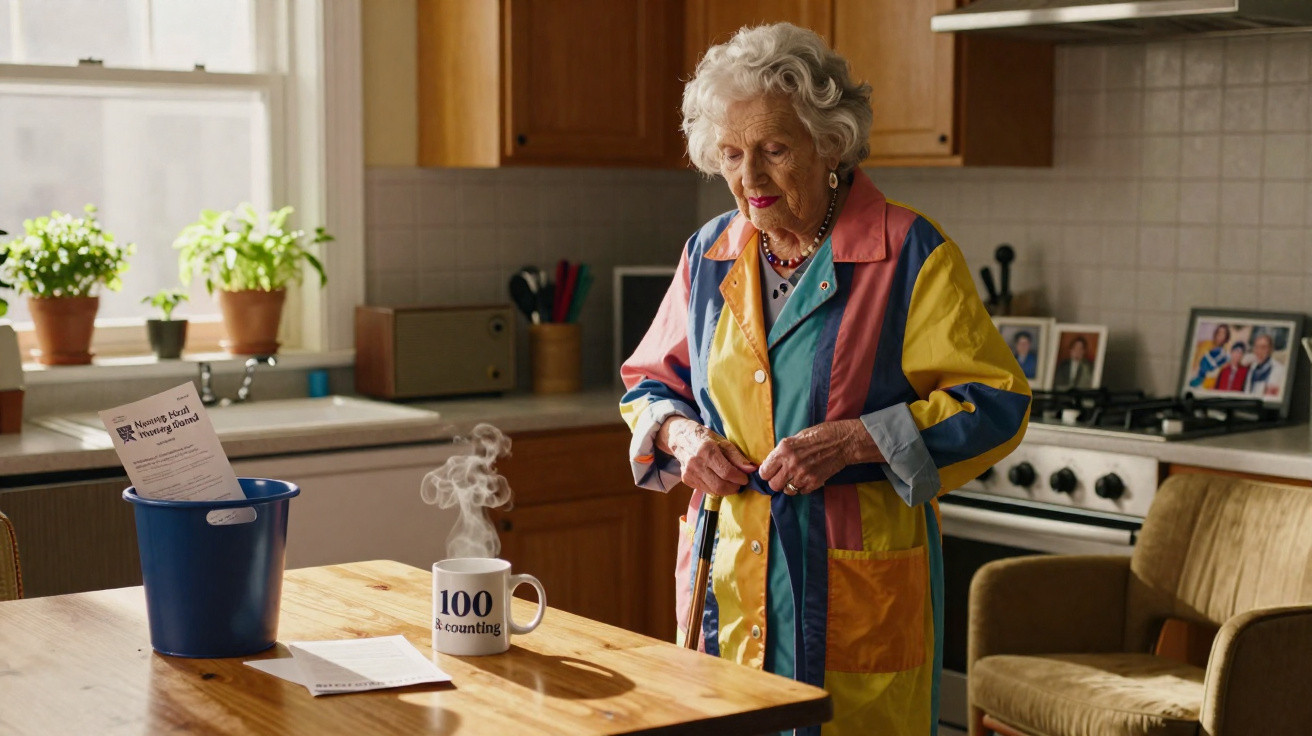
When the nurse bends closer and asks, “Have you thought about a retirement home, Margaret?”, silence fills the room. The old wall clock ticks too loudly, fluorescent lights buzz overhead, and the slight 100-year-old woman straightens her cardigan as though preparing for a business negotiation rather than a discussion about her future. She has no need to raise her voice. “I’m not going anywhere,” she says. “My plants need me.”
Her doctor lets out a sigh, looks towards the computer and scrolls through the figures, risks and guidelines. Margaret’s home is ageing, she lives by herself, and her children are urging her towards “something safer”. She acknowledges them politely, her lips tightly pressed, yet a defiant glint remains – one that has no intention of retiring with her peers. Her case is straightforward, almost harsh: it is her everyday routines that keep her alert and alive, not the prescriptions waiting in the chemist’s bag.
She knocks her cane against the floor, meets the doctor’s eyes and delivers a line that lingers like a dare.
“I’m 100, I still live alone – tell me again why I need a home?”
On a drab Tuesday in a small English town, Margaret puts on her coat at 7 a.m. and heads into the cold. Her neighbour’s curtains have not yet been opened, and the bus stop is deserted. She moves at an unhurried but sure pace, a cane in one hand and the small canvas bag she has owned since the 1970s in the other. She knows every crack in the pavement as well as the words of an old song.
She is not travelling to a clinic or day centre. Her destination is the bakery, following the same path and observing the same ritual. She buys a fresh roll, exchanges a few words with the baker about the weather and, when fortune allows, hears fresh gossip about somebody’s grandchild. The ten-minute walk there and ten-minute return trip are her daily commitment. There are no app reminders or blood-pressure notifications.
“Sitting all day makes you old,” she says. “I’d rather be late to the grave than early to an armchair.”
Her family first raised the prospect of a retirement home when she was 93. Her son brought out glossy leaflets showing cheerful older people doing aqua aerobics in warm pools. She leafed through them with the indifference of a bored reviewer. “Looks like a cruise I can never leave,” she said dryly. When she had a minor kitchen fall at 96, the suggestion turned into pressure. This time, doctors joined the refrain, citing fracture risks, isolation risks and every other danger.
Margaret heard them out, gave a nod, then took another route. She reorganised her flat: shelves went lower, and the rug that had caused her fall was removed. She purchased an inexpensive bathroom grab rail and asked her neighbour’s teenage son to fix it to the wall. It took 15 minutes – no specialist or consultation required, merely common sense and a screwdriver.
Her doctor suggested further examinations. She agreed to one or two and rejected three. “I am 96,” she reminded him. “Are you planning to make me immortal?” By the time she reached 100, celebrated with a modest party and a letter from the King, that same doctor had to concede what nobody had voiced: her determined routine appeared to be effective.
Her views on medicine are not an extreme conspiracy theory. She takes a low-dose blood-pressure tablet and keeps antibiotics in the cupboard “for real emergencies”. But she arches an eyebrow at people who treat doctors as priests in a new faith. “You lot worship check-ups,” she laughs. In her view, too much medicine can lead people to neglect their own responsibility. Why take a pill for circulation when you could walk? Why avoid proper food when supplements claim to offer miracles in one capsule?
She has witnessed both extremes: friends who dismissed symptoms until it was too late, and others who went from one scan to another until anxiety became their principal condition. Her stance may be blunt, but it is clear: doctors are valuable, not all-powerful. “They don’t live in my body,” she says. “I do.” To her, walking, cooking, talking and getting an early night are the genuine treatment for the long term. Everything else provides support, rather than salvation.
The small daily rebellions that keep her out of retirement homes
Margaret has never written down her “programme”, but follows it with the quiet devotion of a faith. She rises at a fixed time, opens the window even during winter and lets the cold air nip at her face. Tea is brewed in a teapot, never made in a mug. She butters one piece of bread rather than five. At the sink, gripping its edge, she performs a few gentle stretches and slowly turns her head from side to side.
Her food is uncomplicated: vegetable soup, some fish, potatoes and stewed fruit. There is nothing elaborate and no so-called “superfood”. She always eats at the table rather than in front of the television. “If I’m going to live alone,” she says, “I can at least keep myself company.” During the afternoon, she waters the plants, checks the post and writes one letter each week – proper letters, with stamps and ink that will smudge if she is careless.
That is the full extent of it. There is no smartwatch or fitness app, only modest, unremarkable actions which, repeated over decades, have become a kind of armour.
She readily admits that she is not always eager to do them. On certain days, the bed seems weighty, her knees protest, and the world feels excessively loud and quick. She permits herself to complain, but never to give in. Once, a neighbour found her sweeping the front step in the rain. “You’ll catch a cold,” he called from across the road. She shrugged. “If the cold wants me, it knows where to find me.”
Statistics support some of her account, though figures hold little interest for her. Many centenarians describe comparable patterns: movement every day, social connections, regular meals and little drama. That does not make as striking a headline as a miracle cure, however. It is hardly glamorous to report that she has reached 100 largely through soup, walks and avoiding trouble. Yet there she is, carrying the laundry basket to the washing line behind her house, her thin arms maintaining a steady rhythm.
One aspect of “ageing at home” is frequently overlooked: its emotional choreography. Margaret knows neighbours by their first names rather than merely their house numbers. She greets children on their way to school, while the postman stays at her gate for an extra minute. Each tiny encounter sews her into the life of the street. Long before an emergency alarm on a lanyard is needed, that unseen web serves as a safety net.
Her objection to doctors is, in truth, an objection to passivity. “People want to be fixed,” she says, “not to change.” Refusing a retirement home is not simply a matter of pride for her; it is a means of remaining active, both physically and mentally. “Homes are fine for some,” she concedes, “but too often we send people there the moment they become inconvenient.” The remark cuts because it feels uncomfortably accurate in a world that favours neat answers and orderly corridors.
What her habits reveal about our own choices
From the outside, Margaret’s routine can seem almost absurdly basic, but it contains a system. Rather than waiting to feel motivated, she arranges her day as a chain in which every link draws the next forward: get up, open the window, boil the kettle, make the bed. Each minor task removes a little disorder. By 9 a.m., her body already understands the direction the day will take.
She does not speak about “self-care”; she calls it “keeping myself going”. There is no flawless morning ritual, gold-edged journal or breathing coach. Her only rule is to move something, clean something and speak to somebody. On a difficult day, that could amount to watering a plant and having a two-minute chat at the corner shop. It still matters. That small point of contact with the outside world stops her slipping into the comfort of complete dependence.
She is unsparing in one respect: “If I stop, they’ll put me in a home. So I don’t stop.”
Most people recognise the moment when the sofa wins, a phone consumes an hour, and the day disappears into scrolling and snacks. Margaret has no smartphone. Her diversions are her memories and radio programmes that break the quiet. She listens before getting to her feet. In doing so, she avoids one of the greatest traps of ageing – and, frankly, of life today at any age: allowing convenience to erode your strength without noticing.
She applies the same principle to doctors. She seeks help when something is genuinely wrong, rather than for every small ache. She listens, collects the prescription, then returns home to ask herself the question no one else can answer: “What can I change, myself?” She might eat sooner, drink extra water or go to bed rather than watch a late television drama. Her “method” has no magic in it, but it is active. She will not become a passive file in a cabinet.
She does not question medicine’s worth. What troubles her is the notion that a check-up can stand in for a walk, or that a tablet can undo 30 years of poor sleep. “Doctors are clever,” she says, “but they’re not wizards.” Her comment stings because it touches on something rarely acknowledged: many of us quietly wish another person would take on the difficult work for us. Let’s be honest: nobody truly does that every day.
“You know what keeps me alive?” Margaret says, staring out of her kitchen window. “I keep acting like my life is still my problem.”
Her experience offers practical ideas that anyone can borrow without imitating every part of her life:
- Protect one walk each day as firmly as an appointment.
- Sit at a table to eat, even when the meal is only a sandwich.
- Learn your neighbours’ names and be the first to say hello.
- After each fright, alter one thing at home rather than following every new trend.
- Treat doctors as advisers, not as remote controls for your life.
These are not grand heroic ambitions but small levers. Used often enough, they influence how you age, whether you are 30, 60 or already receiving letters from the monarch.
What her defiance really says about us
Margaret knows she will not live for ever, perhaps more clearly than those of us who still act as though we never consider it. She is not untouched by grief, fear or the hand that now takes a little longer to fasten a shirt button. Some evenings, she lies awake listening to her breathing and counting the seconds between exhalations. She is not without fear; she has simply decided that fear will not have the final say over where she lives.
Her rejection of retirement homes is not so much a battle against institutions as a calm assertion that autonomy is part of dignity, not an optional luxury. This does not suggest that everyone ought to die in the home where they brought up their children. It means the conversation needs to begin sooner, with greater subtlety and less alarm. Each decision about ageing reveals what we truly think about vulnerability, usefulness and the nature of a “good life” at its end.
There is a quiet accusation within her persistence, one that may hurt families, doctors and society alike. When we hurry to arrange beds, care plans and systems, how much comes from real concern, and how much arises from our discomfort with slowness, dependency and bodies that no longer move at the pace of our screens? Her everyday habits hold a mirror before those who would rather look away. They suggest that not everything can be outsourced.
That may be why her story travels far beyond her peaceful street. Somewhere between the bakery doorway and her living-room armchair, she represents a possibility that is both unsettling and appealing: a life in which medicine assists without taking control, a house that grows old with its owner, and a body that refuses to exist solely as a patient. People share her story not only because she is 100, but because she responds to a question they scarcely dare ask aloud.
How much of our future selves do we want to place in experts’ hands, and how much are we still willing to carry, one imperfect step at a time?
| Key point | Detail | Value for the reader |
|---|---|---|
| Everyday movement | Brief, frequent walks and ordinary jobs such as sweeping or gardening | Demonstrates how small actions can gradually create genuine resilience |
| Active relationship with doctors | Treats medical advice as guidance rather than an absolute instruction | Encourages readers to remain involved in their own health decisions |
| Social micro-connections | Conversations with neighbours, shopkeepers and the postman | Shows how small interactions can help counter isolation and decline |
FAQ
- Is living alone at 100, like Margaret, realistic? For some individuals, yes, although it depends on health, mobility, cognitive condition and surroundings; her experience is an example rather than a universal model.
- Does she reject doctors and medicine altogether? No. She accepts basic treatments when necessary, but will not allow medicine to replace her personal daily responsibility.
- Which habits appear to have mattered most in her life? Regular movement, uncomplicated home-cooked food, consistent sleep and genuine social connections seem to be her key foundations.
- Should everyone avoid retirement homes as she does? Not at all. Such homes offer safety and social contact to many people; what matters is choosing one from preference, rather than solely from fear or pressure.
- How can someone adopt her approach at a younger age? Start with one non-negotiable walk each day, one meaningful daily conversation and a modest, regular effort to make conscious decisions about your own health.




Comments
No comments yet. Be the first to comment!
Leave a Comment