
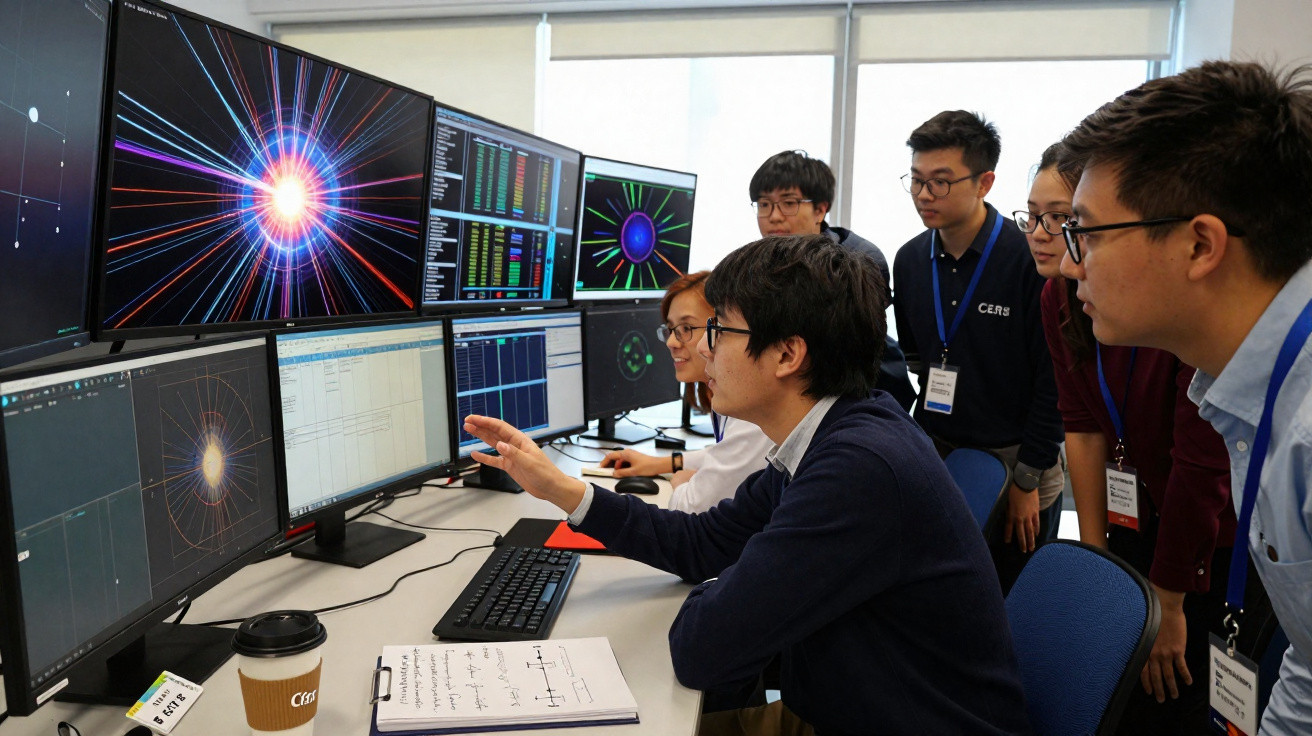
At CERN, the world’s largest particle-physics research centre, an international team has achieved a rare bullseye in the laboratory: an exceptionally heavy particle that had existed only in theory for more than two decades can finally be measured. The observation confirms key assumptions in modern physics while also raising a fresh set of questions about the structure of matter.
What happens beneath CERN
Beneath the ground near Geneva lies the Large Hadron Collider (LHC), a ring measuring 27 kilometres in circumference. Inside this tunnel, physicists accelerate protons - components of atomic nuclei - to almost the speed of light before directing them into head-on collisions. These immensely energetic impacts briefly create particles that would never occur in everyday conditions.
The LHC has already delivered several landmark results, most famously the confirmation of the Higgs boson in 2012. Researchers have now added another: data collected in 2024 contains evidence of a type of particle for which the scientific community has waited for over 20 years.
Within the data noise from billions of proton collisions, a pattern stands out: a tiny heavyweight, around four times more massive than a proton.
A closer look at the composition of matter
To understand why this observation is so remarkable, it helps to consider how matter is built. Everything around us is made of molecules, such as water (H₂O). Molecules consist of atoms, each of which has a nucleus. That nucleus contains protons and neutrons, with electrons orbiting around it.
Protons themselves were once thought to be indivisible. It is now known that they too are made from smaller components called quarks. A proton contains three quarks: two “up” quarks and one “down” quark. Although these names may sound playful, they date back to the 1960s and 1970s, when physicists sought to make their models more accessible to the public.
There are currently six known types of quark:
- up
- down
- strange
- charm
- bottom
- top
Their masses differ enormously. A charm quark has roughly 500 times the mass of an up quark. Such heavy quarks carry considerable energy and form particles that generally decay again after an extraordinarily short time.
The new heavyweight: a double-charm baryon Ξcc⁺
This is where the scientists’ latest work begins. The newly detected particle belongs to the baryon family: particles made from three quarks, like protons and neutrons. Its designation is Ξcc⁺, pronounced approximately “Xi-two-c-plus”.
Its internal structure is distinctive, with two charm quarks and one down quark packed closely together. Compared with a proton, it can be seen as an “inflated” relative: instead of light up quarks, its interior contains two far heavier charm quarks. That makes the overall structure extremely massive - and highly unstable.
To express this mass, physicists use a unit that may initially seem unfamiliar: megaelectronvolts divided by c² (MeV/c²). It follows from Einstein’s well-known equation E = mc², which links mass and energy. For very small particles, converting mass directly into an energy unit is more practical.
| Particle | Mass |
|---|---|
| Proton | approx. 938 MeV/c² |
| Ξcc⁺ | approx. 3,620 MeV/c² |
The new baryon is therefore almost four times heavier than a proton - an enormous difference in particle physics. Its substantial mass also makes it short-lived: it survives for only a tiny fraction of a billionth of a billionth of a second before breaking down into lighter particles.
How a particle that immediately disappears can be detected
CERN’s LHCb detector operates like a gigantic high-speed camera. Taking up to 40 million “snapshots” each second, it records the tracks of all particles produced in proton collisions. No one observes the Ξcc⁺ directly, because its lifetime is too short. Only the fragments produced by its decay can be seen.
Those remnants tell the analysis software that a heavy baryon must previously have existed. By working backwards from the direction and energy of individual tracks, physicists determine which parent particles were involved and what masses they had.
From billions of collisions, the researchers isolated 915 decay events, all showing the same signature and the same mass.
These 915 events cluster around one value: roughly 3,620 MeV/c². This precisely matches theoretical predictions for the Ξcc⁺ and the properties of a “sister particle” identified in 2017. The signal therefore reaches the level of statistical certainty regarded as evidence in particle physics.
Why the physics community is paying close attention
Experiments earlier this century had already raised suspicions that such a particle existed. It later became clear, however, that the data was not sufficiently robust: other teams could not reproduce the results, and the measured masses did not agree with the leading theories.
The current finding meets precisely these demanding criteria. Several independent analyses produce the same picture. As a result, the outcome strengthens the Standard Model approach, the central framework physicists use to describe the building blocks of the Universe.
The Standard Model is considered highly successful. It explains how quarks, electrons, neutrinos and force carriers such as photons and gluons interact. Yet important puzzles remain, including dark matter, dark energy and gravity in detail. Every newly confirmed particle acts as a test of the whole framework: do the equations hold, or are its boundaries shifting?
What the heavy particle reveals about the strongest force in the cosmos
The double-charm component is particularly compelling. Baryons containing two heavy quarks are exceptionally well suited to studying the strong interaction. This fundamental force binds quarks within protons and neutrons, and ensures that atomic nuclei do not fly apart.
Over short distances, it is overwhelmingly stronger than gravity or magnetism. Calculating it is difficult, however, because the equations involved become complex. Particles such as the Ξcc⁺ provide ideal measurements for testing and refining these calculations.
- They contain both heavy and lighter quarks.
- Their mass can be measured very precisely.
- Their decays produce clear signals in the detector.
They therefore serve as a laboratory for the strongest known fundamental force. Understanding how quarks remain bound in such exotic particles also clarifies why ordinary atomic nuclei are stable and why matter can form structures at all.
What non-specialists can take from the finding
Anyone who does not work through equations every day may ask: what changes in practical terms? At first, nothing in daily life. The Ξcc⁺ decays far too quickly ever to become part of technology or medicine. Its value lies instead in understanding the fundamental rules by which the Universe operates.
A practical comparison may help. Matter resembles a machine with many gears. Protons and neutrons are the larger gears, while quarks are the smaller ones. Particles such as the Ξcc⁺ show what happens when two of those smaller gears become exceptionally heavy. Does the machine still run as expected, or does it jam? Current measurements indicate that the model works - although many of its details remain far from fully understood.
Those wishing to explore further will encounter terms including baryons, the strong interaction and the Standard Model. Behind this specialist language lies the central idea that even the smallest particles follow a remarkably strict order. The fact that this order is becoming visible piece by piece in a 27-kilometre ring underground demonstrates both how far measurement techniques have progressed and how many surprises may still await at the quark level.






Comments
No comments yet. Be the first to comment!
Leave a Comment