
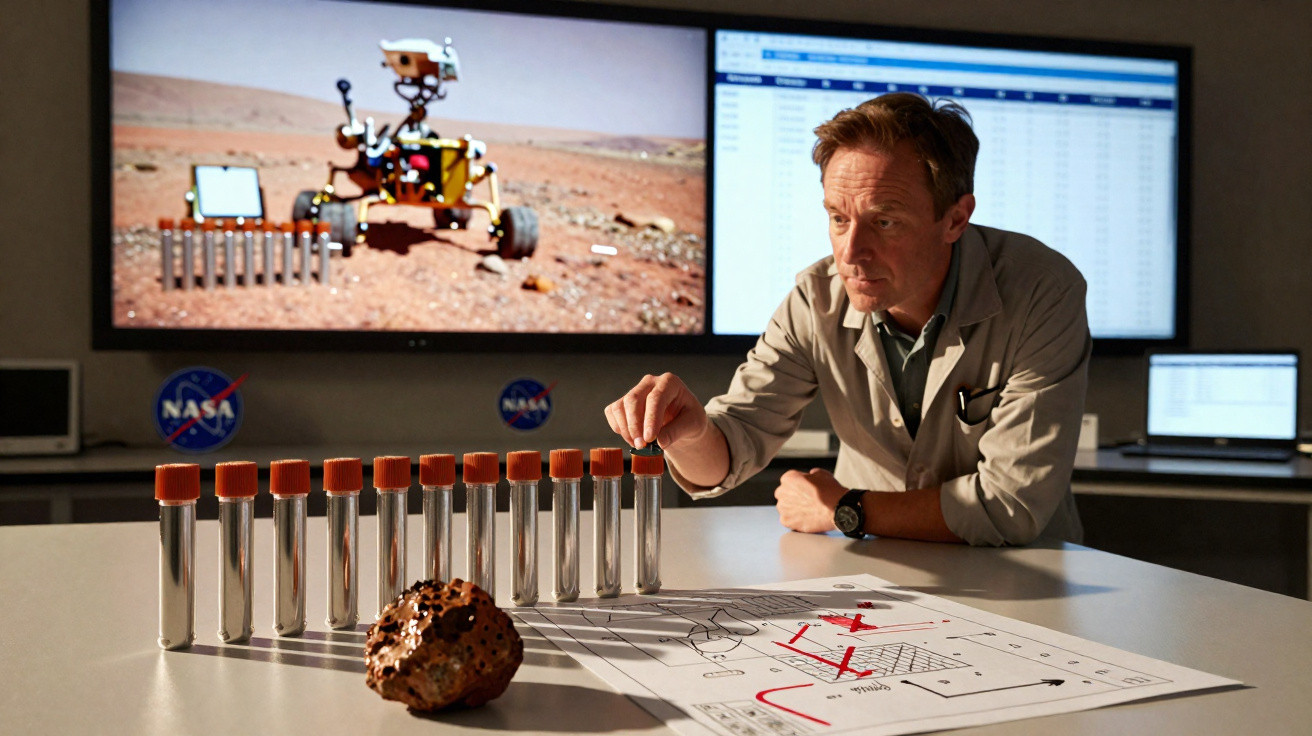
It appears that NASA's Mars Sample Return mission has met a bureaucratic end.
The project was intended to be the defining achievement in Mars research and in efforts to answer questions about the planet's ancient habitability. However, the US Congress has sharply reduced its funding, in effect ending the mission in its planned form.
Mars Sample Return and ancient habitability
Despite many decades of research, technological advances and innovation, establishing whether Mars was habitable has remained challenging. The Curiosity and Perseverance surface missions have broadened and refined our knowledge of the planet, producing compelling evidence that Mars once experienced warm, wet phases that could have supported life.
The planned next stage was to bring Martian rock samples back to Earth, allowing them to be examined using the full capabilities of modern laboratories.
Returning samples from Mars had already been identified as a major priority for NASA's planetary science work in 2011.
NASA's MSR webpage still states:
"Mars Sample Return (MSR) would be NASA's and ESA's (European Space Agency) ambitious, multi-mission campaign to bring carefully selected samples to Earth.
"MSR would fulfill one of the highest-priority Solar System exploration goals from the science community. Returned samples would revolutionize our understanding of Mars, our Solar System, and prepare for human explorers to the Red Planet."
Perseverance represented the mission's first phase, and it has delivered outstanding results. The rover has collected and cached 33 sample tubes containing notable rocks and dust for eventual recovery by MSR.
What will become of those samples is now uncertain.
Cost and complexity of the NASA mission
NASA understood it was entering difficult territory. The projected cost of recovering the samples rose to 11 billion dollars. Following work on alternative mission architectures, the agency reduced that projected figure to about 7 billion dollars.
Yet these remained estimates, and the unprecedented nature of the operation meant there was significant uncertainty around them.
Funding is the central problem. NASA is under substantial pressure to cut its budget, and MSR was an evident candidate for cancellation because it still needed considerable funding while the technology required to complete it had not been fully resolved.
The mission's design was exceptionally complicated. It called for a lander to be sent to the Martian surface, where Perseverance would transfer the sample tubes. If that could not be done, two small sample-return helicopters would undertake the transfer instead.
The lander would also carry a rocket to lift the samples into Martian orbit. There, the rocket would meet an orbiting spacecraft, which would return the material to Earth. Describing this as a complex operation would be an understatement.
The uncertain future of Perseverance's samples
The budget retains limited funding for technology development connected with future Mars exploration, but the sum is small.
Part of that funding could produce new technology and a less expensive method of recovering the cached samples, although that outcome is far from assured.
It is also conceivable that technology could be created to analyse the samples effectively on Mars itself, removing the need to send them to Earth. But laboratory technology on Earth will progress at the same time, and it is difficult to imagine that analysis on Mars could ever match the effectiveness of studying the material on Earth.
The future remains unwritten and uncertain. MSR may perhaps be reinstated in the future, or ESA may decide to proceed alone. China is planning a Mars sample-return mission, and the cancellation now leaves it with a clear opportunity to become the first nation to bring Martian samples to Earth.
China's planned mission is not as sophisticated as the NASA/ESA project, however. Perseverance's samples were selected carefully to maximise their scientific value, whereas China's mission is closer to a grab-and-go operation.
Fortunately, the tubes will probably remain in place for a long time without significant degradation in Mars' cold, dry conditions.
For the scientists who have devoted their minds and hearts to this ambitious project, though, the news must be devastating.
This article was originally published by Universe Today. Read the original article.





Comments
No comments yet. Be the first to comment!
Leave a Comment