
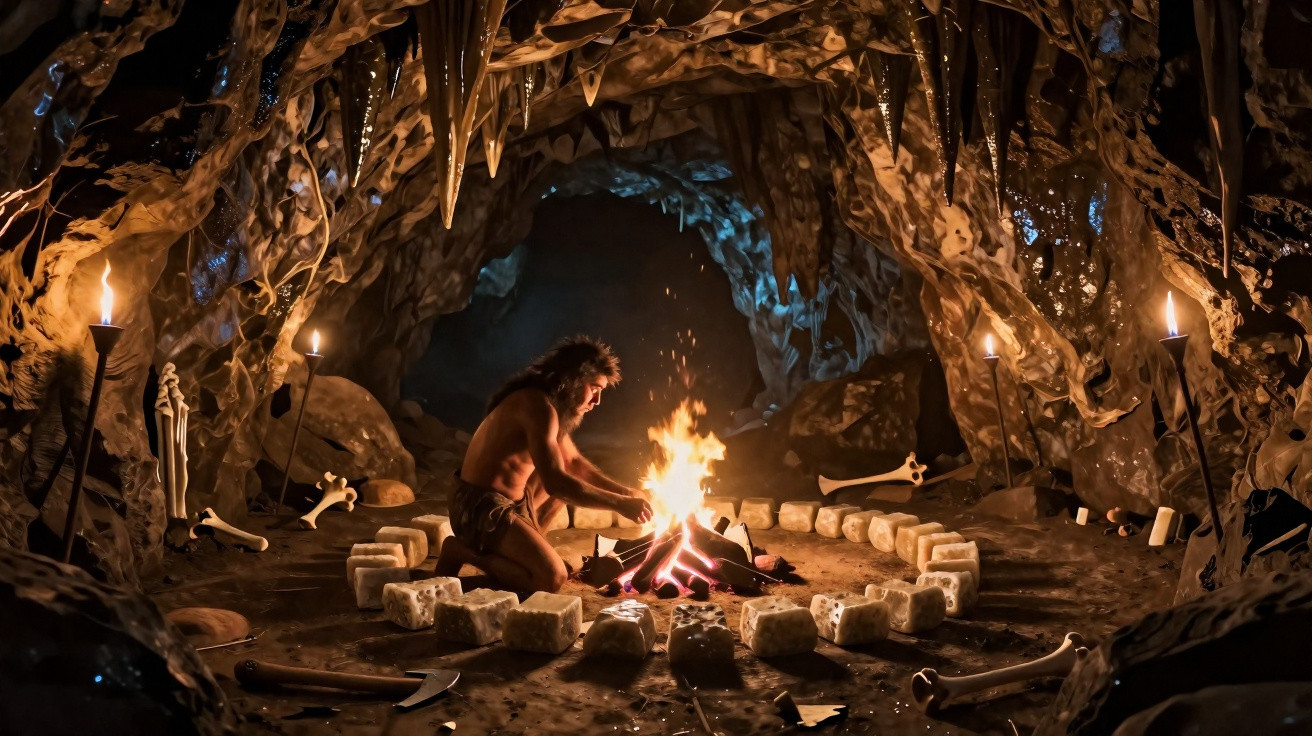
At 336 metres from the entrance, daylight has long since vanished. Beneath the cavers’ boots, the floor of Bruniquel Cave in Tarn-et-Garonne preserves evidence of a lost world: hundreds of broken stalagmite sections, moved and arranged into large rings. The air is cold and the darkness is dense, almost tangible. We all know the feeling when a room without light seems to close in around us; here, that sensation takes on an entirely different scale. These structures were not left by Homo sapiens, our species. Neanderthals built them roughly 176,500 years ago. That date changes a great deal.
At Bruniquel, stone circles emerge from complete darkness
The sight seems unreal: deep within the cave, two large oval constructions lie on the ground, formed from stalagmite sections deliberately broken and then stacked. Some pieces were wedged against one another, as though their builders were seeking a stable, intentional shape. This is not a case of a few rocks having fallen from the ceiling. Nearly 400 fragments have been recorded in this underground area, arranged in a pattern that cannot be attributed to chance.
Caver Bruno Kowalsczewski discovered Bruniquel Cave in 1990 after passing through an extremely narrow passage. Reaching the structures requires crawling, moving carefully, and then continuing for a long distance. The rings stand 336 metres from the present-day entrance: a considerable journey without electric lamps, reliable maps, or the equipment available to modern explorers. Let us be honest: this is not something anyone casually does every day.
Researchers have also identified signs of fire on several calcite pieces and on the nearby ground. Burnt bones, including those of a bear or a large herbivore, were found close by. This indicates that the occupants controlled lighting and probably combustion in an environment where darkness swallows everything. Going so far underground already required a collective decision. Building there also meant planning ahead, carrying materials, providing light, and finding the way back.
Why the dating transformed what was believed about Neanderthals
To grasp the importance of this discovery, it is necessary to consider the mineral deposits that formed again over the broken stalagmites. Scientists used uranium-thorium dating, a technique able to establish very ancient ages in calcite. The result was striking: the structures date to around 176,500 years ago, with a margin of uncertainty. At that time, Homo sapiens had not yet settled in western Europe. There is therefore little doubt about the likely builders: they were Neanderthals.
This should be borne in mind when reading overly hasty accounts of prehistory. For a long time, Neanderthals were depicted as robust and practical beings, restricted to hunting and immediate survival. Yet arranging a place so far underground does not meet any obvious need for food or shelter. It required torches, fuel, people to break the stalagmites, and others to guide the group. Such an undertaking points to some degree of organisation, perhaps even to shared rules.
Archaeologists remain cautious about the rings’ exact purpose, and that restraint is appropriate. No sign tells us what happened in this chamber, and no object offers a definitive explanation.
“The Bruniquel structures bear witness to Neanderthals using the deep cave, long before modern humans arrived in Europe.”
Three points are especially helpful when interpreting this discovery without distorting it:
- do not confuse a hypothesis with certainty;
- recognise the technical complexity without inventing a “temple”;
- remember that the absence of writing does not mean the absence of thought.
What the Bruniquel rings still reveal about our own perspective
The urge to find a dramatic answer is strong: a ritual, a shelter, a secret gathering place, a territorial marker? All of these possibilities have been raised, but none can currently be proven. The soundest approach is to begin with the physical evidence: a deep location, moved mineral elements, hearths, repeated construction, and a very ancient date. This discipline may be less romantic, but it prevents us from projecting modern scenarios onto people who lived in another world.
Another common mistake is to assume that prehistoric intelligence can be judged only through figurative art or the finest tools. The Bruniquel rings show that ability may be less conspicuous: cooperating in darkness, planning an action that lasts, keeping a flame alive, and passing on a route. We may never know what exchange preceded the expedition. Yet someone must have said, by gesture or voice: let us go further.
The cave is not freely open to visitors, and that protection is necessary. Mineral deposits are fragile, and the traces of burning even more so, while human presence quickly alters a cave’s humidity and balance. For curious visitors, the simplest recommendation is to favour resources produced by scientific teams, local museums, and documentaries based on published research. Between a captivating image and reality, there are often valuable nuances.
| Key point | Detail | Value for the reader |
|---|---|---|
| A very ancient construction | The Bruniquel rings date from around 176,500 years ago. | Understand that they substantially predate the arrival of Homo sapiens in western Europe. |
| Unexpected builders | The builders were Neanderthals. | Reconsider an overly simplistic image of this extinct human species. |
| A mystery that remains open | The structures’ purpose has not been demonstrated with certainty. | Distinguish archaeological evidence from appealing but unverifiable narratives. |






Comments
No comments yet. Be the first to comment!
Leave a Comment