
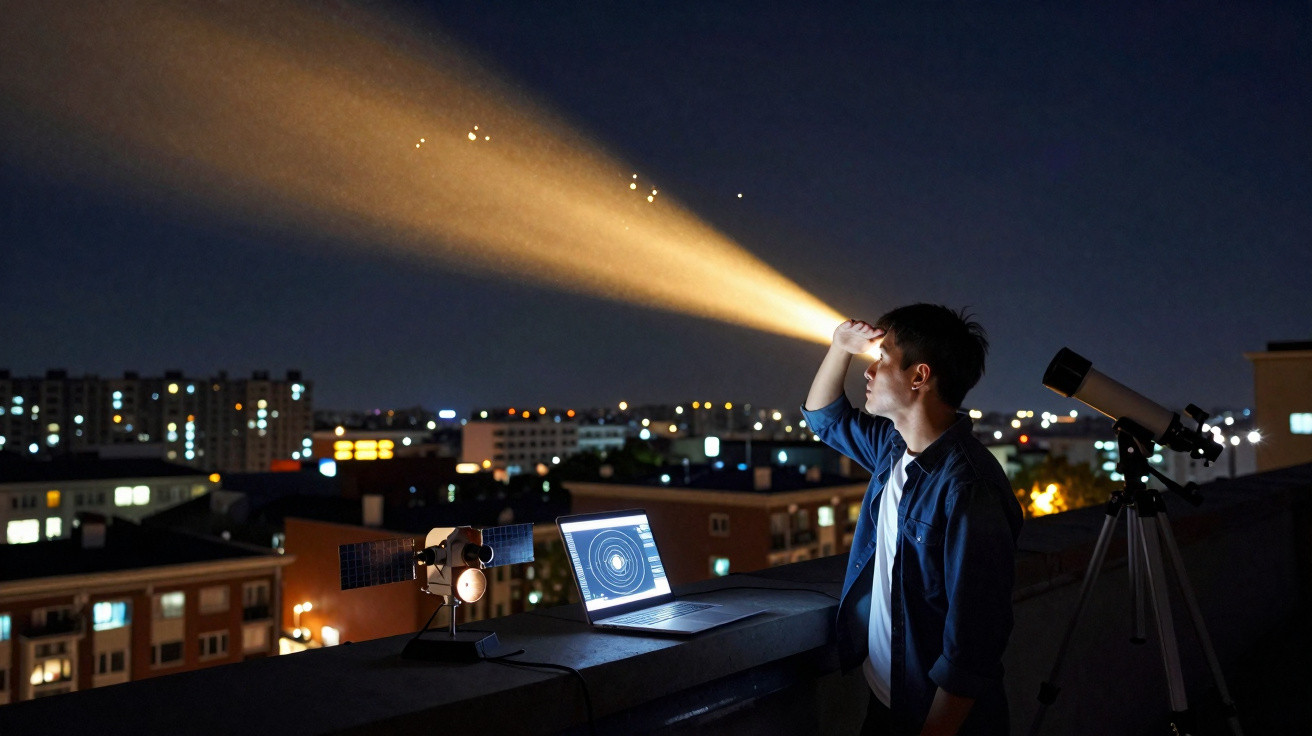
A proposed satellite constellation is causing serious concern among astronomers. Whereas conventional satellites create light pollution incidentally by reflecting sunlight, the satellites proposed by US start-up Reflect Orbital are intended to generate it.
The company says it can provide "sunlight on demand" by using mirrors to direct sunlight towards Earth, allowing solar farms to continue operating after sunset.
Reflect Orbital intends to begin with Earendil-1, an 18-metre test satellite for which it has applied to launch in 2026. Latest reports indicate that it could ultimately be joined by around 4,000 satellites in orbit by 2030.
How severe could the resulting light pollution become? More fundamentally, is it possible for Reflect Orbital's satellites to perform as promised?
Reflect Orbital satellites and reflected sunlight
Much as sunlight can be reflected from a watch face to create a bright patch, Reflect Orbital's satellites would use mirrors to send light towards a chosen area of Earth.
The difference, however, is one of enormous scale. The satellites would orbit roughly 625 km above Earth's surface and, eventually, carry mirrors measuring 54 metres across.
Reflected from a watch onto a close wall, sunlight can form an intensely bright spot. Direct it at a wall much farther away, though, and the spot becomes wider - and less bright.
That happens because the Sun is not a single point of light: it occupies half a degree of the sky. At great distances, sunlight reflected by a flat mirror therefore spreads at an angle of half a degree.
What would this look like in reality? Consider a satellite reflecting sunlight across approximately 800 km. A satellite at 625 km altitude will not always be directly overhead, so it would need to aim its light at an angle. The area lit on the ground would be at least 7 km wide.
Neither a curved mirror nor a lens could concentrate the sunlight into a smaller area, owing to both the distance involved and the Sun's half-degree width in the sky.
Would the reflected beam be bright or faint? For one 54-metre satellite, it would be 15,000 times dimmer than the midday Sun. Even so, it would remain much brighter than a full Moon.
The balloon experiment
Last year, Reflect Orbital founder Ben Nowack shared a short video outlining a test involving the "last thing to build before moving into space": a reflector suspended beneath a hot-air balloon.
During the experiment, a flat square mirror about 2.5 metres wide channels light downwards onto solar panels and sensors. In one test, the team records 516 watts of light per square metre when the balloon is 242 metres away.
By comparison, the midday Sun supplies around 1,000 watts per square metre. At roughly half that level, 516 watts per square metre would be sufficient to offer practical value.
But scaling this balloon experiment up to orbital distances reveals its limits. As noted above, if the satellites were 800 km from the target area, a reflector measuring 6.5 km by 6.5 km - or 42 square kilometres - would be required. Building a reflector on that scale is impractical, which exposes the limitations of the balloon test.
What does Reflect Orbital intend to do?
Reflect Orbital describes its proposal as "simple satellites in the right constellation shining on existing solar farms". Its stated target is only 200 watts per square metre, equivalent to 20% of the midday Sun.
Could smaller satellites achieve that? As one 54-metre satellite would be 15,000 times dimmer than the midday Sun, 3,000 would be needed to provide 20% of the midday Sun. That is a substantial number of satellites merely to light a single region.
There is another problem: satellites at 625 km altitude travel at 7.5 kilometres per second. As a result, any individual satellite would be within 1,000 km of a particular place for no longer than 3.5 minutes.
In other words, 3,000 satellites would provide only a few minutes of light. Thousands more would be necessary to deliver even one hour of illumination.
Reflect Orbital's ambitions are considerable. In one interview, Nowack proposed placing 250,000 satellites into 600 km-high orbits. That would exceed the combined number of all currently catalogued satellites and large pieces of space debris.
Yet, according to the calculations above, even this huge constellation could supply only 20% of the midday Sun to no more than 80 places simultaneously. Cloud cover would reduce the number of locations that could actually be illuminated.
Moreover, because of their altitude, the satellites could provide light to most places only around dawn and dusk, when mirrors in low Earth orbit are exposed to sunlight.
Recognising this limitation, Reflect Orbital plans to position its constellation around Earth above the day-night boundary in sun-synchronous orbits, keeping the satellites continuously in sunlight.
Bright lights in the night sky
Are mirror-equipped satellites a realistic way to produce affordable solar power after dark? Probably not. Could they create catastrophic light pollution? Absolutely.
Satellites and space debris are easy to spot in the early evening, despite not being designed to shine brightly. Under Reflect Orbital's proposal, even the test satellite, if it functions as intended, would at times appear substantially brighter than a full Moon.
Such a mirror constellation would be ruinous for astronomy and hazardous for astronomers. Seen through a telescope, each mirror's surface could be nearly as bright as the Sun's surface, creating a risk of permanent eye injury.
The resulting light pollution would make it harder for everyone to observe the cosmos, while light pollution is also known to affect animals' daily rhythms.
Although Reflect Orbital intends to light particular sites, the satellites' beams would sweep over Earth as they travelled between locations. Flashes brighter than the Moon could illuminate the night sky.
The company did not respond to The Conversation's questions about these issues before the deadline. It did, however, tell Bloomberg this week that it intends to redirect sunlight in ways that are "brief, predictable and targeted", while avoiding observatories and publishing satellite locations so scientists can plan their observations.
The consequences would be dire
Whether Reflect Orbital's scheme will ever take off remains uncertain. The company could launch a test satellite, but that is a considerable distance from deploying 250,000 vast mirrors continually orbiting Earth to give certain solar farms a few additional hours of operation each day.
Nevertheless, it is a project worth monitoring. If successful, the effects on astronomers - and on anyone who prefers a dark night sky - would be dire.
Michael J. I. Brown, Associate Professor in Astronomy, Monash University and Matthew Kenworthy, Associate Professor in Astronomy, Leiden University
This article is republished from The Conversation under a Creative Commons licence. Read the original article.






Comments
No comments yet. Be the first to comment!
Leave a Comment