
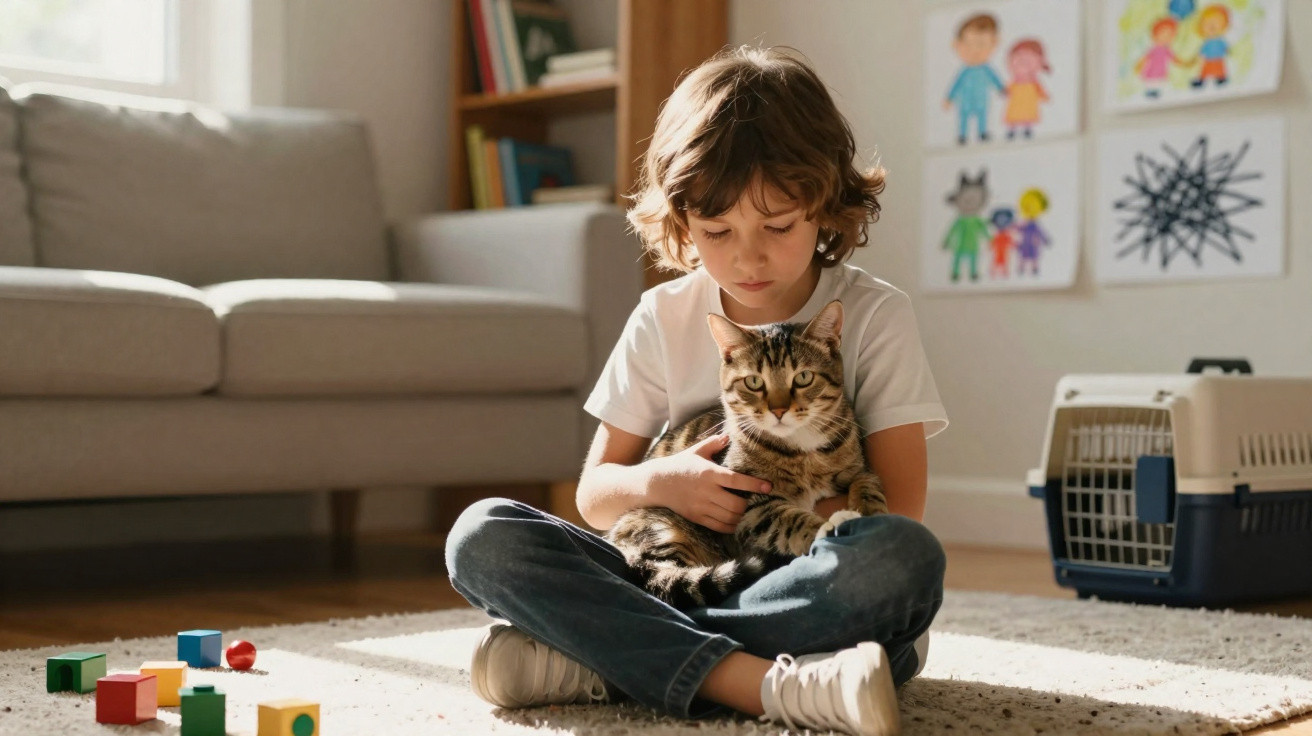
Parents go to great lengths to look after their children’s physical and mental well-being, from endless journeys across town for karate lessons to blitzing a million peas or sitting through innumerable CoComelon marathons.
Bringing a pet into the household is another widespread choice, but does evidence support the idea that animal companionship benefits children?
A study published in late 2025 is among the limited research examining these effects in children aged 7 to 8, and its findings are unexpected.
Spanish epidemiologists, writing in the World Journal of Pediatrics, gathered years of information on pet ownership. This included much-loved cats, dogs and birds, as well as animals such as hamsters and reptiles.
The striking finding was that cats appeared to be linked with poorer mental-health measures in children. Other pets, including rabbits, reptiles and amphibians, appeared to be associated with the reverse.
Pet ownership and children’s social development
Attachment - the development of emotional bonds - is essential to social development. These bonds need not exist solely between children and carers: they can also develop between a child and an animal companion.
As a result, having a pet in childhood could offer a range of socio-cognitive advantages, including greater compassion for animals and "powering up a child's responsibility and moral norms," the researchers explain.
Pets may also help children develop the abilities needed for strong relationships with people, by helping them interpret non-verbal communication and encouraging prosocial behaviour.
Earlier research, however, has produced inconclusive findings.
The INMA study of pet ownership and child mental health
To investigate further, Spanish researchers began the Infancia y Medio Ambiente (INMA; Environment and Childhood) project in the early 2000s. It involved nearly 1,900 mother-child pairs from seven regions of Spain.
The project was originally created to examine how environmental influences, including pollutants, affect child development. It has subsequently been widened to cover other factors, including pet ownership.
For this study, the team drew on medical records, information about parents’ sociodemographic backgrounds, and questionnaires completed during follow-up appointments in pregnancy, at birth, at age 1, at ages 4–5 and at ages 7–8.
When the children were aged 7–8, parents also filled in a behavioural screening questionnaire. It asked about emotional symptoms, conduct difficulties, hyperactivity, problems with peers and prosocial behaviour.
The researchers focused on internalising and externalising behaviours. Internalising behaviours are stress responses directed inwards, potentially involving internal distress linked with depression or anxiety. Externalising behaviours are directed outwards, may breach rules or social norms, and can cause distress to other people.
Roughly one-quarter of the 1,893 families had owned a pet throughout the period, with dogs and cats the most common choices.
Cats and other pets produced contrasting findings
The study found that cat ownership, but only when children were aged 4–5, was linked to a higher risk of both internalising and externalising problems.
By contrast, ownership of "other" animals - meaning pets other than dogs, cats or birds - at both early-childhood follow-ups appeared protective. It was associated with a lower risk of internalising and externalising problems.
None of the remaining pet-companionship patterns showed significant links with the children’s mental health.
The researchers propose several explanations for the absence of observed mental-health benefits. One attachment-based model suggests emotional bonds may not fully develop until the age of 18, meaning any benefits could emerge later.
Alternatively, ‘small’ pets such as rodents, fish and reptiles might lead to weaker emotional connections because they are evolutionarily more distant from humans.
Yet companionship with these other animals was the only pattern associated with improved mental health. This may be because they are often seen as "children's pets" that are easier to look after.
The way owners engage with their animals could also play a role. Cats generally do not join their owners in mental-health-supporting outdoor activities, such as jogging and fetching, and usually remain indoors.
The results may instead reflect the kinds of pets that parents select for their children. Because this was an observational study, it cannot separate these influences, leaving researchers able only to speculate.
Animals differ in their relationship patterns and attachment styles. The researchers suggest that cats can be "less affectionate, exhibit avoidant attachment, and are often chosen by families with children who have mental health conditions, due to their lower maintenance needs."
Another explanation is that the feline-associated imbalance in behaviour identified in the study could be affected by toxoplasmosis. The infection affects about one-third of the world’s population and may negatively affect cognition and mental health in children.
"Collectively, our data highlights the complex relationship between early pet ownership and child mental health," the researchers conclude.
This research was published in the World Journal of Pediatrics.
This article was fact-checked by Rachel Garner and edited by Clare Watson. Although we take pride in our process, we are only human. If you notice an error, please let us know.





Comments
No comments yet. Be the first to comment!
Leave a Comment