
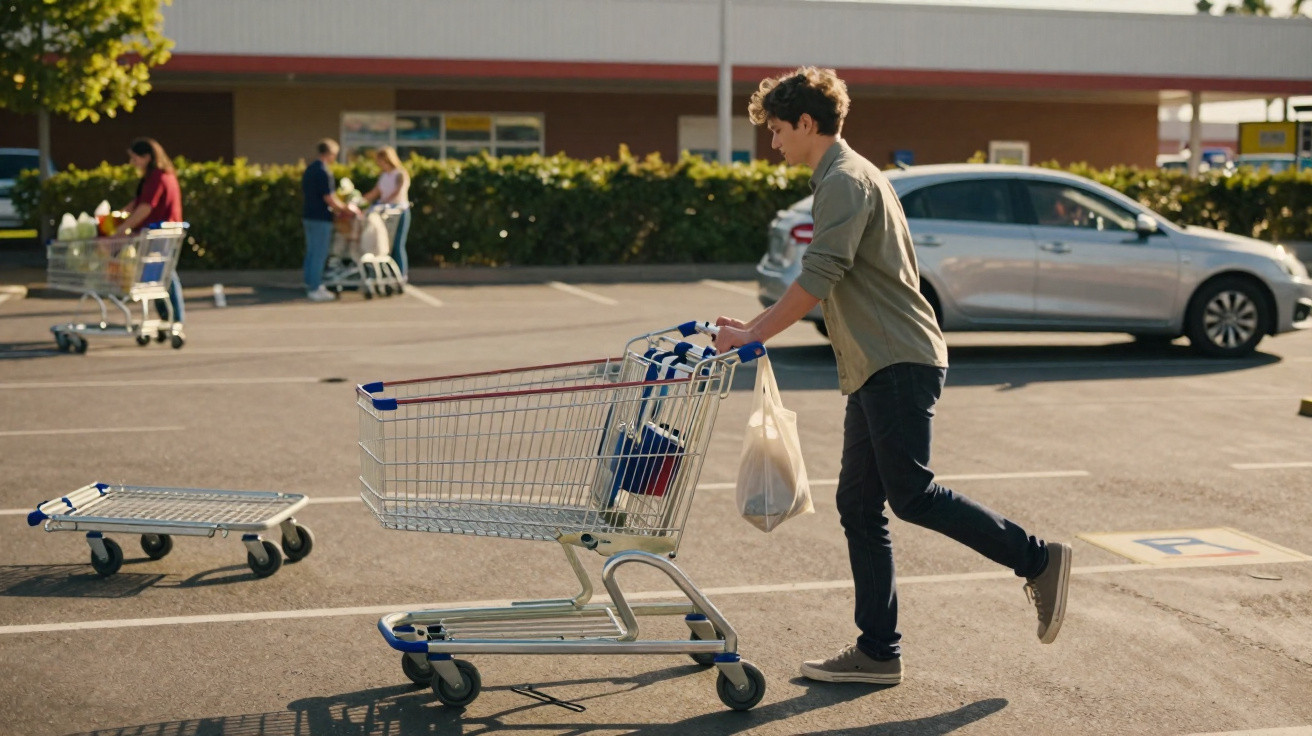
It is 6.42 pm in the supermarket car park. The boot has just shut, the shopping bags are on the verge of toppling over on the passenger seat, and a light rain is beginning to fall. A few metres away, a lone trolley is almost blocking a parking space. Another shopper walks around it, then calmly takes their own trolley to the designated shelter, sometimes at the far end of the car park. We all know that moment when tiredness makes us want to drive away without looking back. Yet some people make that small detour even when nobody is watching. This ordinary act may reveal something far deeper than simply obeying a rule printed on a sign. Research into everyday behaviour links the habit to a particularly recognisable personality trait. And it is about more than mere politeness.
Returning your trolley often reflects a strong awareness of other people
The shopper who returns their trolley is not necessarily trying to lecture anyone around them. They often do it almost automatically, as though leaving a cumbersome object in another person’s way feels difficult to them. This response is associated with conscientiousness, a psychological trait encompassing responsibility, organisation and the ability to consider the consequences of one’s actions, however minor they may seem.
In research into so-called “prosocial” behaviour, small public actions can sometimes act as indicators. Returning a trolley, holding a door open, picking up a dropped piece of litter or letting somebody go first cannot, of course, define a person on their own. However, such actions suggest a willingness to respect a shared rule without expecting an immediate reward.
It may be said that an abandoned trolley is only a trolley. Even so, it can be blown by the wind, hit a car, obstruct someone carrying heavy items or add to the workload of an employee already racing against the clock. The person who puts it away anticipates that small disruption before it happens: briefly, they feel connected to the people who will come after them.
This everyday detail is not a moral test
Before forming an opinion about someone in a car park, it is worth considering the circumstances. A person with a crying child, back pain, an overly heavy bag or a genuine emergency will not always be able to make the return trip to the trolley bay. The sensible approach is to make a simple effort: place the trolley in the nearest available space, or secure it neatly out of the way if it is truly impossible to go any further.
Let us be honest: nobody manages this every single day. Anyone can be rushed, distracted or simply exhausted after a long day, and that is not an irredeemable character flaw. The more common mistake is allowing a poor habit to become automatic by thinking, “someone will come along after me anyway”.
What matters is the repeated practice of modest consideration, rather than perfection. As a frequently repeated idea in social psychology puts it:
“Character is revealed less in grand declarations than in what we do when nobody is watching.”
- Returning your trolley frees up a space and makes the car park safer.
- Doing it with a child can become a practical lesson in living alongside others.
- Watching someone do it often encourages others to copy this quiet behaviour.
A small detour that reveals our relationship with the collective
This action cannot be used to sort “good” people from bad ones, nor can it reveal an entire personality in three seconds between two rows of cars. Instead, it highlights a tendency: seeing shared spaces as places we should leave reasonably usable for everyone else. Civic-mindedness can sometimes begin with the sound of trolley wheels on tarmac. There is something reassuring about this almost unnoticed scene.
Behavioural studies remind us that our habits are also shaped through imitation. When a car park is tidy, trolleys are returned and shoppers repeatedly see this action, the norm becomes clearer. Conversely, a space that is already cluttered can easily encourage carelessness: why make the effort if everyone else appears to have given up?
That leaves a fairly simple, almost personal question. When you return your trolley, do you do it to prevent a car being scratched, to help staff, because your parents taught you to, or because putting things back in order makes you feel calmer? These reasons are not necessarily of lesser value than one another. Above all, they reflect our individual way of occupying places shared with strangers.
| Key point | Detail | Added value for the reader |
|---|---|---|
| A revealing gesture | Returning your trolley may be linked to conscientiousness and consideration for others. | Understanding that an ordinary habit can reflect a collective mindset. |
| No hasty judgement | Tiredness, disability, a child or an emergency may explain why a trolley has been left behind. | Taking a fairer view of other people’s behaviour. |
| A contagious habit | A tidy car park more readily encourages respectful actions. | Recognising the tangible effect of a small, repeated effort. |






Comments
No comments yet. Be the first to comment!
Leave a Comment