
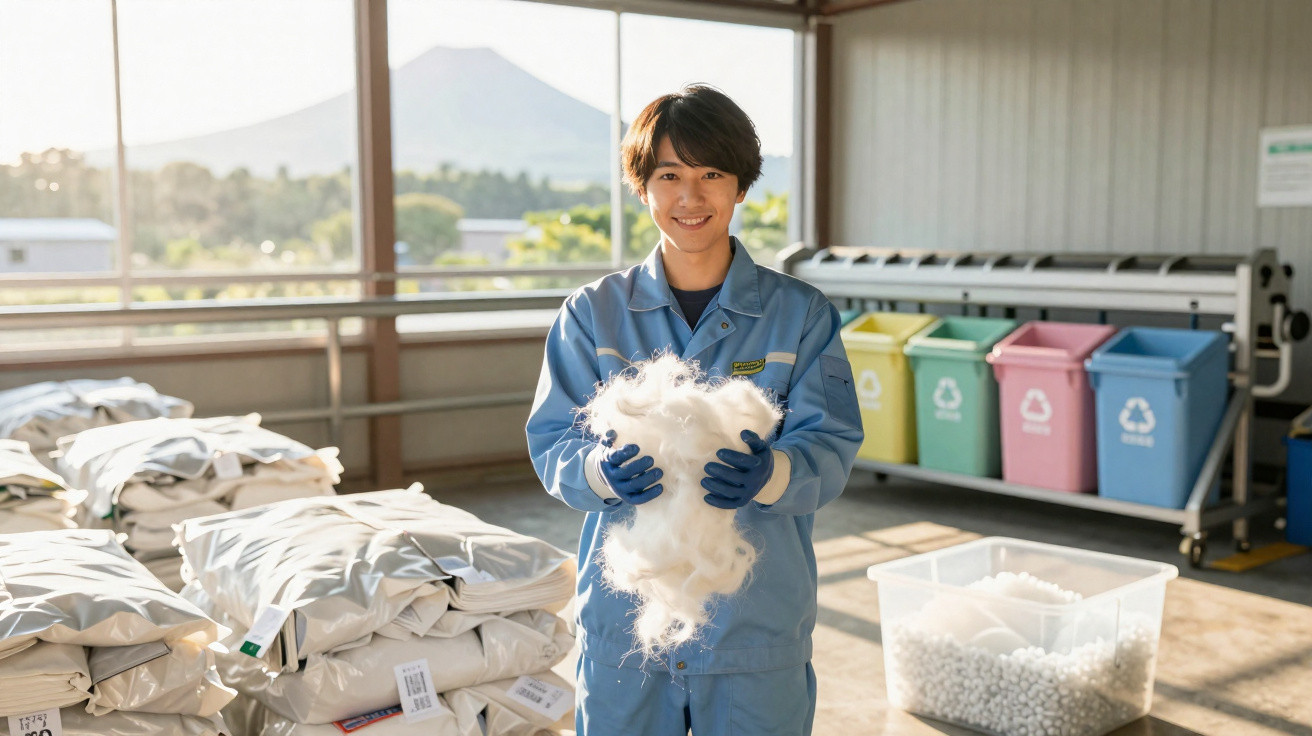
In the south of the Japanese archipelago, two local authorities are trialling a scheme that could reshape the way millions of tonnes of sanitary waste are handled. The concept may initially seem far-fetched: collect used nappies, sanitise them, then use their materials to make new products of the same kind.
Adult nappies now outnumber baby nappies
The issue has taken on particular significance in Japan, where a low birth rate coincides with a rapidly ageing population. Demand for nappies used by older people and those requiring care is consequently rising each year.
The figures illustrate the scale of this shift. Japanese manufacturers produced 9.6 billion adult nappies in 2024, compared with 8 billion baby nappies. Only a few years ago, products for infants clearly dominated the market. This change is forcing manufacturers, hospitals, care homes and local authorities to reconsider their practices.
“Japan could discard 2.6 million tonnes of soiled nappies every year by 2030, up from around 2.2 million tonnes in 2020.”
Such waste is most commonly incinerated or sent to landfill. Yet a disposable nappy combines several materials: cellulose fibres, plastic films, elastic, adhesive and liquid-retaining polymers. This mixture makes sorting and recovering the materials especially difficult.
As volumes continue to grow, some local authorities fear that their treatment capacity could be overwhelmed. The costs of collection, transport and incineration also place pressure on local budgets.
A trial in two Kagoshima local authorities
Two communities in Kagoshima Prefecture are now testing a solution developed by Japanese manufacturer Unicharm. Their recycling rate for this waste stream stands at 80 %, four times the national average cited for this type of waste.
The scheme is not simply about converting used nappies into lower-value items such as paper or fuel. It has a more ambitious purpose: to recover some of the materials used to make nappies and feed them back into a new manufacturing cycle.
This method is known as closed-loop recycling. It is intended to conserve raw materials while reducing the volume of residue that must be incinerated.
Strictly controlled treatment stages
Before they can be reused, collected nappies undergo several processing steps. First, they are shredded to separate their different components as effectively as possible. The materials are then washed and sorted.
- Cellulose pulp is separated from the other components;
- plastics are processed separately;
- superabsorbent materials are recovered where possible;
- the pulp is ozone-treated to sterilise, whiten and deodorise it.
Pulp is a core material in the production of nappies. It helps distribute liquid and contributes to the product’s comfort. Its processing must therefore meet strict hygiene requirements. Ozone, a gas made up of three oxygen atoms, is used here to reduce odours and microorganisms without using chlorine for whitening.
“The innovation is not simply shredding waste, but the intention to reuse sanitised cellulose to make new nappies.”
A limited scheme, but with a timetable already in place
Nappy recycling is not entirely new. In several projects, recovered materials are already used to manufacture toilet paper or other products. Reintroducing components directly into new nappies, however, requires a far higher standard of control.
Unicharm plans to broaden the process. By 2028, the group hopes to recycle plastics and absorbent materials as well, incorporating them into the manufacture of new products. This is a crucial stage, since a nappy is not made from cellulose alone.
| Deadline | Announced objective |
|---|---|
| 2028 | Recover plastics and absorbent materials as well |
| 2030 | Encourage at least 100 local authorities to recycle this waste or begin discussing it |
The Japanese government wants 100 of the country’s more than 1,700 municipalities to have begun work on this issue by 2030. Not all of them will be able to establish a dedicated plant straight away. Some may start by arranging separate collections or assessing the volumes generated by care facilities.
The challenge of separate collection
Technology alone will not be enough. To recycle nappies, they must be collected under suitable conditions. Medical facilities and care homes for older people are an obvious starting point, as they produce large and relatively consistent volumes.
Arrangements are more complicated in households. A dedicated collection system would require suitable bins, extra collection rounds and clear instructions for residents. Local authorities will also need to provide reassurance about hygiene and prevent this waste from being mixed with materials that cannot be processed in the same way.
An issue extending beyond waste management
Reusing pulp could lessen reliance on certain resources, particularly wood-derived cellulose. However, the actual environmental benefit will depend on several factors: the distance between collection points and the plant, the energy consumed by washing, ozone treatment and the amount of material genuinely recovered.
The scheme could also ease pressure on incinerators in urban and ageing areas, where disposable nappies account for an increasing share of household waste. In Kagoshima, the trial is therefore serving as a full-scale test. Above all, it shows that waste long regarded as impossible to recover is beginning to be seen as a material industry wants to retain.



Comments
No comments yet. Be the first to comment!
Leave a Comment