
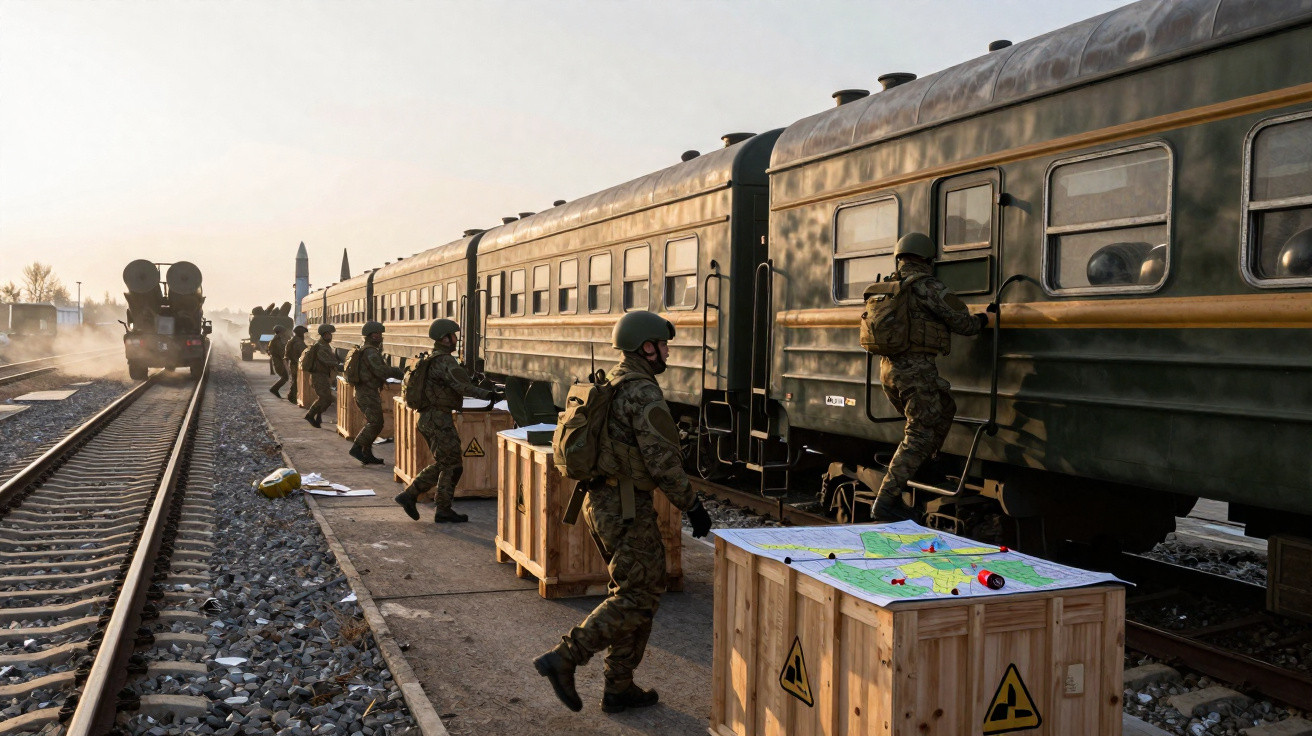
South Korea has again detected indications that North Korea is continuing preparations to send an additional military contingent to Russia, potentially taking military co-operation between Moscow and Pyongyang to a new level. According to estimates previously released by Ukrainian officials, the deployment could involve between 30,000 and 50,000 soldiers.
For now, South Korea’s Ministry of National Defence says it has not identified firm signs of an imminent mobilisation. Nevertheless, its assessment, presented to MP Yu Yong-weon, suggests that Pyongyang is still putting in place the conditions required to expand its direct role in Russia’s military effort.
North Korean troops could reinforce Russia
The prospect of another troop deployment follows a warning from Volodymyr Zelensky that Russia could receive tens of thousands more North Korean personnel. That estimate was subsequently disputed by Kim Yo Jong, Kim Jong Un’s sister, who dismissed the Ukrainian president’s claims.
North Korea’s involvement in the war, however, extends well beyond the issue of troops. Seoul estimates that Pyongyang has already supplied Russia with more than 15 million artillery rounds, as well as short-range ballistic missiles and other weapons systems. The scale of these transfers has made North Korea a significant external supplier to Russian forces since military ties between the two countries began to deepen.
The war in Ukraine may be helping to modernise North Korean weapons
A major concern for South Korean intelligence is that systems supplied to Russia could be returning to North Korea in the form of operational experience and data gathered directly on the battlefield.
Information relayed by Yu Yong-weon’s office indicates that certain North Korean missiles used against Ukraine may have been refined after their performance in real combat conditions was assessed. The evaluation also takes into account the possibility that Russia is providing technical assistance and component-related support for specific military programmes in Pyongyang.
Against this backdrop, Seoul believes that several North Korean projects involving ballistic missiles and multiple-launch rocket systems are approaching completion. These weapons would primarily be intended to strengthen North Korea’s capabilities in any potential conflict with South Korea.
Among the systems being monitored is the Hwasong-12, an intermediate-range ballistic missile that Pyongyang is thought to be preparing for possible operational service. Its range would allow it to strike Guam, where the United States maintains a major military presence in the Pacific.
North Korea has also developed intercontinental ballistic missiles with a theoretical range sufficient to reach the continental United States. Seoul stresses, however, that certain critical capabilities of these systems remain unproven, particularly whether their warheads can survive atmospheric re-entry. The issue is still unresolved because North Korean tests have chiefly used lofted trajectories, unlike the conditions a missile would encounter on a conventional operational trajectory.
Ukrainian intelligence also reports North Korean missiles in Russia’s arsenal
The information released by South Korea adds to a recent assessment by the Main Directorate of Intelligence of Ukraine’s Ministry of Defence (GUR), which says Russia holds approximately 50 North Korean ballistic missiles in its arsenal. The estimate covers systems from the KN-23, KN-24 and KN-30 families, although Ukrainian intelligence did not specify how many of each variant were available. Their presence demonstrates how North Korean support has come to supplement output from Russia’s own defence industry.
Moscow and Pyongyang deepen military co-operation
Since 2023, Pyongyang is believed to have supplied Moscow with large quantities of ammunition and missiles. North Korean troops then began being dispatched to support Russian forces from 2024, according to assessments by South Korea, Ukraine and Western governments.
Therefore, even without evidence that a fresh mobilisation is about to take place, the possibility of a contingent of up to 50,000 troops is another indication of the increasingly deep partnership between Russia and North Korea. For Seoul, concern lies not only in the immediate effect such reinforcements could have on the war in Ukraine, but also in the military and technological benefits Pyongyang could gain through its growing co-operation with Moscow.





Comments
No comments yet. Be the first to comment!
Leave a Comment