
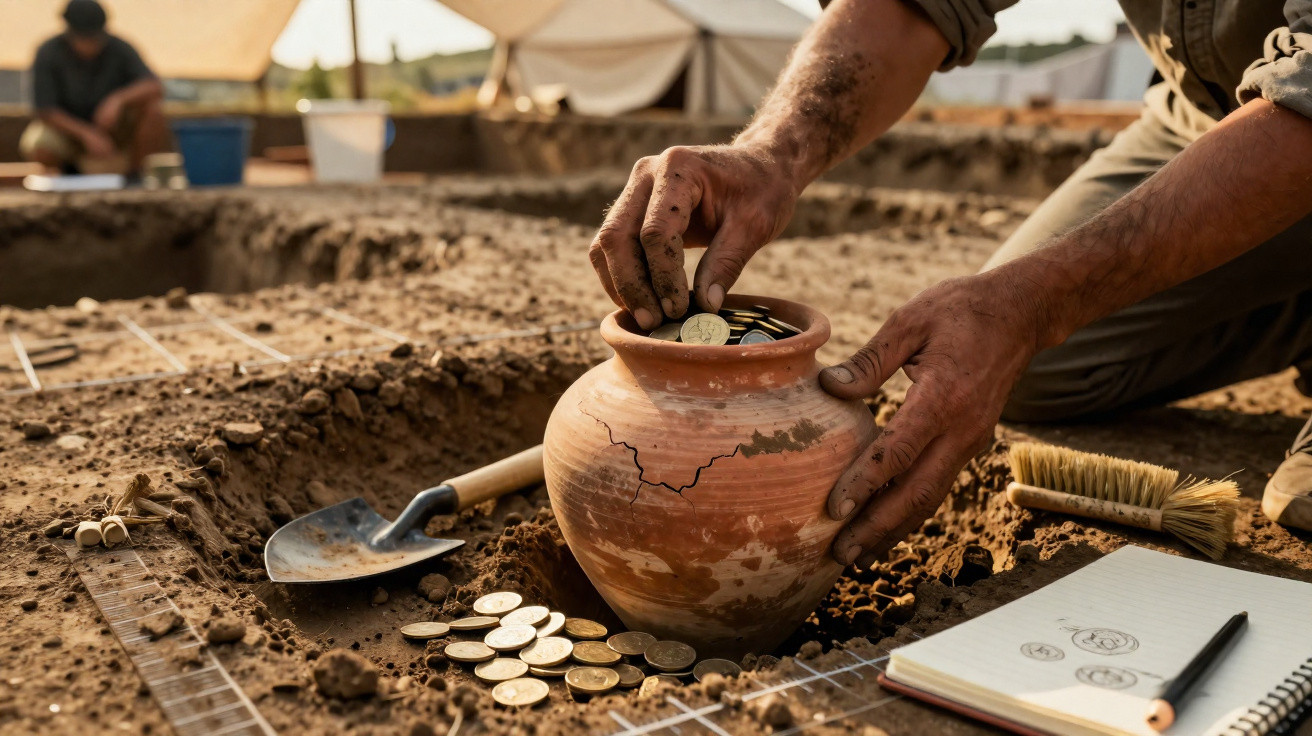
Mud still clings to the gloves when the first glint of metal emerges from the bottom of the excavation. At first, it is merely a dark, almost unremarkable coin. Then another appears beneath the brush, followed by another: the French archaeologists realise they have uncovered something extraordinary. Buried for almost 1,800 years, a ceramic jar held tens of thousands of Roman coins, packed tightly together as though its owner had put the lid back on only yesterday. We all know the feeling of finding an old box in the loft, and that slight shiver of wondering who left it there. Here, however, the scale is entirely different. The mystery remains unsolved.
A Roman treasure that reveals far more than forgotten wealth
The vessel uncovered by the French teams was not a spectacular chest covered in gold. It was a modest container, hidden beneath the ground, yet its contents turn every clod of soil into evidence: tens of thousands of Roman coins, gathered during a period of intense political and military strain within the Empire. To the naked eye, the coins can look alike, coated in corrosion and dust. Yet their imperial portraits, inscriptions and mint marks create a kind of buried economic record.
Dating back roughly 1,800 years, the coins belong to the turbulent centuries of the late Roman Empire. At the time, people used currency of widely differing value, minted amid changes of ruler, civil wars and monetary reforms. The person who owned the jar may have saved throughout their lifetime, or kept a reserve for commercial activity. The scale is staggering: handling tens of thousands of coins one by one takes months of work, and sometimes longer.
Why was such a large sum concealed and never retrieved? Archaeologists suggest several possibilities without presenting them as facts: a hurried departure, a local threat, an interrupted inheritance, or a deliberate hiding place that was forgotten over time. A treasure is never simply a sum of money: it is also an absence. These coins therefore speak as much about the person who buried them as they do about the Roman world around them, with its very real anxieties and acts of survival.
When a discovery becomes a painstaking investigation
With an assemblage like this, specialists do not begin by counting the coins at the site. They secure the deposit, photograph every stage, collect the soil surrounding the jar and record its exact location. This approach may appear slow, but it prevents the loss of invisible evidence: fibres, wood traces, textile remains or pieces of a lid may show how the cache was prepared. A single coin can already reveal a great deal; a treasure retained in its context tells a complete story.
When an old coin is found during a walk or while carrying out work, it is tempting to clean it straight away to reveal its design. This is a common mistake, often made with good intentions. Scraping, rubbing or using household cleaning products can remove a patina, damage an inscription or destroy archaeological evidence. Let us be honest: nobody deals with this every day, and many people do not know the right steps to take when an ancient object comes out of the ground.
The most useful course of action is straightforward: leave the object exactly as it was found, record the precise location and notify the appropriate services, particularly archaeologists or local heritage authorities. As professionals often remind people on excavation sites:
“What gives an object its historical value is not only what it is, but where it was found.”
- Do not wash or polish the coin or container.
- Take photographs without moving the items unnecessarily.
- Record the date, location and circumstances of the discovery.
- Contact the relevant archaeological services promptly.
Thousands of coins and countless lives to imagine
This jar full of Roman coins is striking first because of its sheer quantity, but it is also moving on a deeply human level. Someone held these coins, counted and sorted them, perhaps hiding them at a time when the future had become uncertain. Behind the emperors’ likenesses and symbols of victory lie fear of want, the habit of saving and the need to safeguard what matters. These concerns do not seem so distant.
| Key point | Detail | Added value for the reader |
|---|---|---|
| An exceptional cache | A jar contained tens of thousands of Roman coins dating back about 1,800 years. | Understanding the rare scale of the discovery. |
| Valuable context | The deposit’s position and the traces around the coins matter as much as the coins themselves. | Seeing how archaeology truly works. |
| An important response | A chance discovery must not be cleaned or moved carelessly. | Protecting heritage that may still reveal its secrets. |
Every coin must now be examined, catalogued and compared: the metal used, engraved portrait, mint, likely date and state of preservation. This patient work may reveal unexpected details, such as coins originating from distant regions or a striking concentration from a brief period. The treasure then becomes an archive, far more dependable than a legend retold centuries after the events. It may also reshape what was thought to be known about trade and the movement of money in this part of the former Roman world.
Some uncertainty remains, and that is perhaps what makes this find so compelling. Its owner left no name, message or map explaining their intentions; only this jar and its silent mass of metal survived. The discovery encourages us to look differently at the ground we cross each day, at gardens, fields and old walls. Beneath our feet, history is not always asleep: sometimes, it is simply waiting for a brush to lift the right handful of soil.





Comments
No comments yet. Be the first to comment!
Leave a Comment