
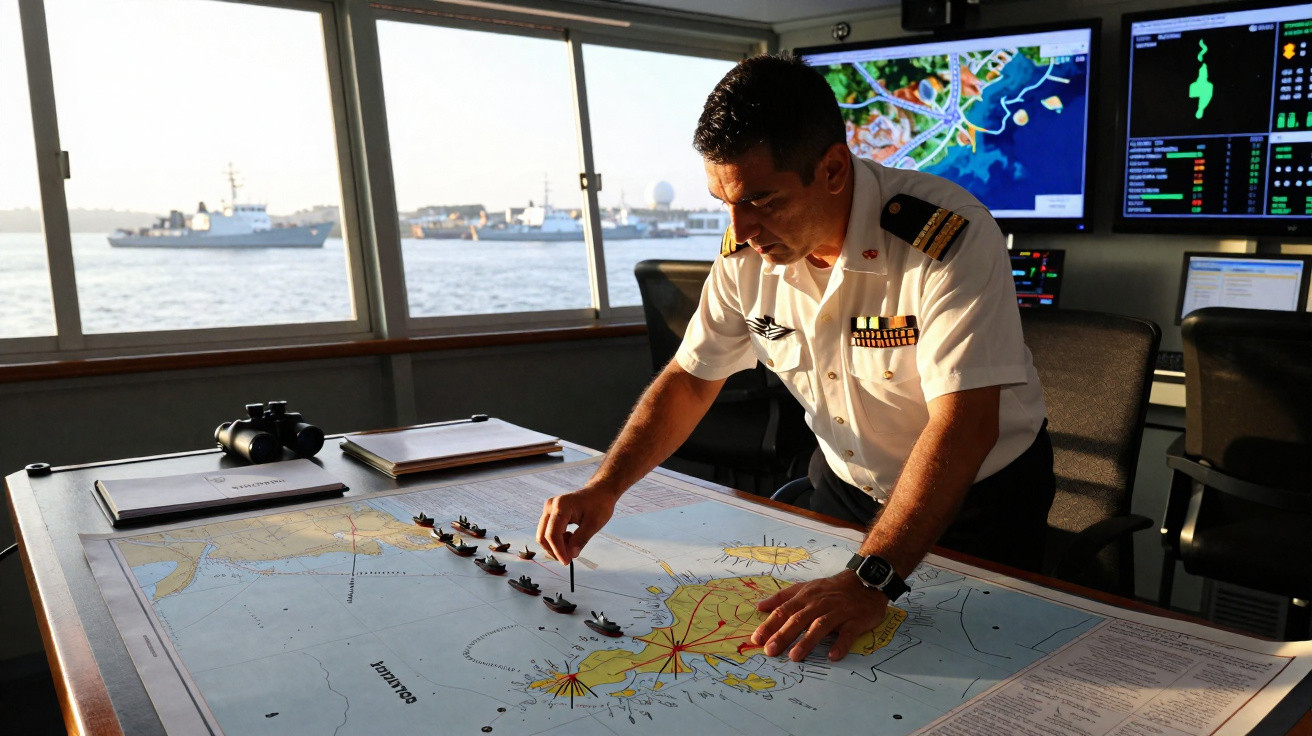
The President’s message was clear, concise and necessary. It must be said plainly, because we do not hand out praise lightly in these pages. Faster, wider-ranging sanctions against the Sea Lion corporate chain; an emergency decree for the Integrated Naval Base and telecommunications; and a bill establishing a National Security Council and providing the State with a framework to protect critical infrastructure, as well as aerospace and maritime domains.
That said, two points need putting in order before applauding what is, for now, rhetoric. First, it is late on several fronts-and not by just a few months. Second, the measures are welcome only if they have practical value and are matched by earmarked funding and decisions that are not delayed any further. Otherwise, they are documents full of words.
Sea Lion, not the Presidential Palace, set the timetable
Let us consider the timing. This national broadcast has come when room for manoeuvre is smaller, not greater. At the end of August, Rockhopper reported that infrastructure on the islands-jetties, onshore facilities and accommodation-is progressing in preparation for the platform. Development drilling is scheduled for early 2027, with first oil expected in the first quarter of 2028. Once that happens, Argentina will be in a weaker position to constrain the occupation of the archipelago, because a producing field acquires economic and political momentum that no note of disapproval can undo.
It is true, and evident, that there has been a sharp dose of reality. The Falklands Cause has returned to the forefront with a force the Government did not anticipate, while the episode surrounding the match against England slipped beyond the authorities’ control. There is an element of opportunism in the response, and there is no point denying it. Yet this must also be stressed: the Government is already three-quarters of the way through its term, and that does not remove the need to tackle the issue seriously. Being late does not make it wrong. It makes it urgent.
The difficulty is that determining whether there is real substance behind the announcements requires time-and time is precisely what is lacking. So, to assess whether the Government is building policy or creating a fog of uncertainty, five specific short-term issues must be watched.
1. Whether South Atlantic rhetoric is merely rhetoric again
Social media users and those who have only recently taken an interest in defence speak of a renewal of military capability. There is an effort, certainly, but it is driven far more by what can be done and how it can be done than by genuine political backing. And political backing, always and everywhere, means funding.
The figures speak for themselves. According to SIPRI, Argentina allocated 0.56% of its GDP to defence in 2025: the lowest percentage in the historical series, a record low rather than a record high. In May this year, a budget amendment cut more than 48.9 billion pesos from the Defence portfolio, including several external credit lines. Investment funding is being held together with makeshift solutions to keep projects alive. That deserves a separate column.
There is a divide between the characters posted on X and what happens inside the institutions. Yet, as has been the case for 40 years, the country does what it can with what it has.
2. The assets available to monitor millions of square kilometres of water
Speaking about the South Atlantic means discussing the ability to monitor, observe, gather intelligence on and patrol an immense maritime area. In terms of assets, the Argentine Navy is a shadow of what it was during the last century. The ARA Almirante Brown was delivered in 1983 and is nearing 45 years of service. Submarine capability has been inactive for nine years, while the letter of intent for Scorpène submarines signed in 2024 remains dependent on financing. Naval strike aviation was formally brought to an end three weeks ago with the retirement of the Super Étendards.
There has been investment in projects that had stalled and were subsequently unlocked: the P-3C Orions. They provide presence and surveillance, and that is far from insignificant. But today, there may perhaps be something by 2027; there is no political commitment to modernise the core capabilities the service requires. A maritime protection framework without the means to enforce it is merely a framework-and Argentinians who follow defence matters are used to that. Defence rhetoric without capability-based thinking.
3. The Integrated Naval Base and passing the responsibility around
It is striking how responsibility for this base is passed back and forth. One side laid the foundation stone when construction began in 2022, while the other has, in three years, built no more than the concrete slab. The reality, without partisan labels, is that bureaucratic inertia has meant Argentina is only now receiving its first real push on the matter, five years later. If the emergency decree brings funding with a clear purpose and deadline, and that funding becomes concrete action, it will be welcome. If it provides a general allocation that is later reassigned, it will be a familiar story.
4. Do not tie national planning to the mood of others
In my view, this is the most serious strategic analytical error of the moment. There is talk of a window of opportunity because Trump raised doubts about United States support for the United Kingdom’s sovereignty over the archipelago. That opportunity may exist. But Argentina cannot tie its strategic planning and its actions to the short-term contingencies and whims of others, because that ultimately binds national interests to other countries’ dynamics.
Could there be an opportunity to bring the Falklands issue closer to the United Kingdom? Yes, certainly. But it must be pursued from a national perspective, not an ideological one. Ideology changes. It always does. And when it changes, the party left hanging from that rope is the one with the least power to stand alone.
5. Sanctions and the Council: the two indicators to watch
The sanctions are entirely right. They are late, but they uphold a position shared by Argentina’s two principal political blocs. At last, a point of agreement. There is only one measure by which to judge them: sanctions that are genuinely enforced and activated against companies, shareholders and suppliers. If the rule amounts to a tirade with no enforcement behind it, it is worthless.
The National Security Council is the most ambitious measure and the easiest one to hollow out. It should be judged against the National Defence Council, a body that has never carried weight since the National Defence Act was enacted. Not an ounce. It did not advise, did not formulate long-term policy, and existed only on paper.
At Zona Militar, we have repeatedly written about how the National Security Council operates in the United States: staffed by personnel who do not answer to party-political instructions, working beyond presidential terms, and tasked with maintaining criteria, negotiating with stakeholders and authorities, and encouraging the country to sustain long-term direction. These institutional mechanisms prevent pendulum-like policies in strategic positioning. It remains to be seen whether it will have any practical influence here or whether it is simply an idea for creating committees where matters are never resolved.
What is needed to ensure this is not just another national broadcast
The measures are positive, then. But the written resolutions must be accompanied by three things: decisions shared as widely as possible, funding with a stated purpose and timeframe, and a genuine long-term approach to the Falklands Cause that survives this Government and the next, even if their ideological positions are wholly opposed.
Otherwise, Argentina will merely pull the rope arbitrarily while becoming weaker in its ability to uphold what it regards as its own.





Comments
No comments yet. Be the first to comment!
Leave a Comment