
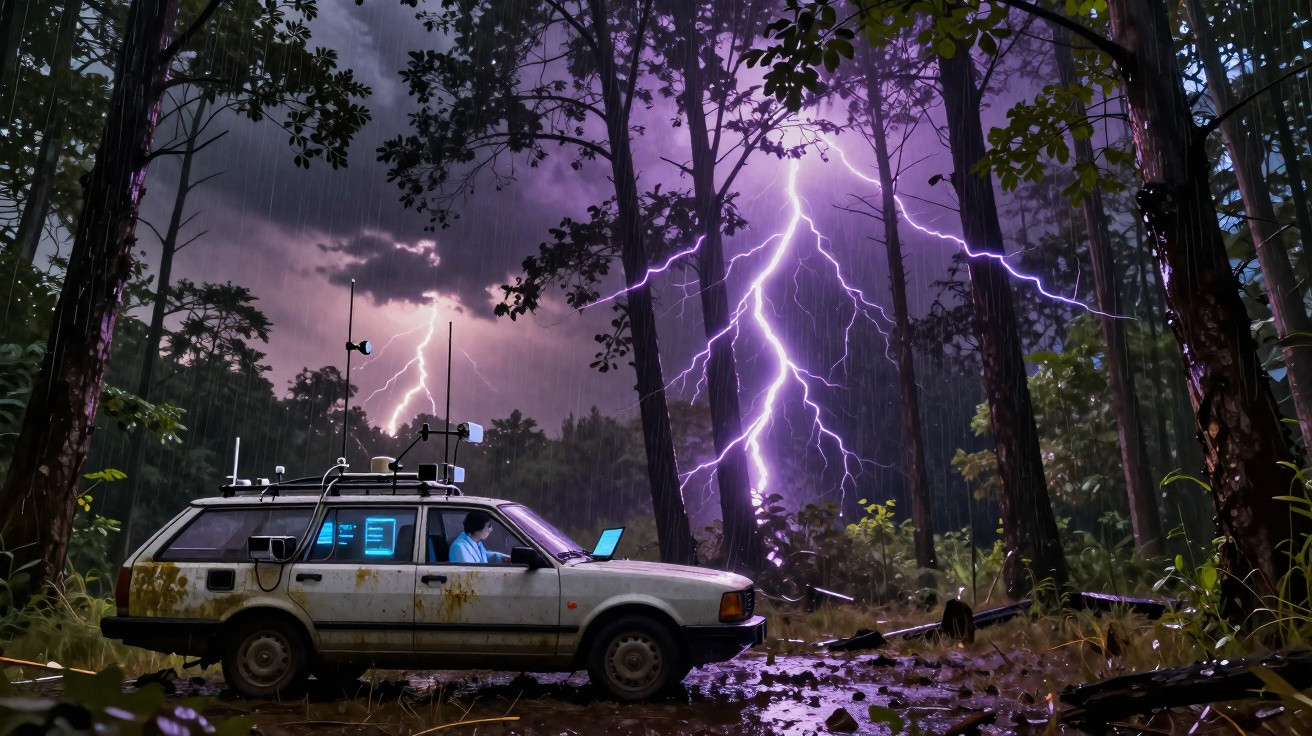
When a storm draws near, everyone tends to look up at the sky. One American research team decided instead to watch the tops of trees.
What they found is unsettling: in the darkness, immediately before or during a storm’s electrical activity, some branches give off exceptionally brief flashes that cannot be seen with the naked eye. Recording them required the researchers to fit a vehicle with highly specialised equipment and travel across several US states in pursuit of storm cells.
Light that is too fast to see
Scientists at Pennsylvania State University had long suspected that trees do not remain electrically neutral beneath a charged sky. Their trunks, branches and leaves may respond to the substantial voltage difference that develops between the ground and the clouds.
Fieldwork has now supported that idea. The team detected extremely short bursts of light in tree canopies. Moving from one leaf to another, these events take the form of small electrical discharges.
“Tree tops do not simply endure a storm: they can release some of the built-up electrical charge as ultraviolet flashes.”
This emission is known as a corona discharge. It occurs when an electric field becomes sufficiently intense around a pointed or irregular object. An aerial, a church spire, a power line or the ends of a branch can all encourage this effect.
For trees, the moisture in the wood and their intricate network of twigs appear to matter. Electrical charge gradually travels up the trunk before concentrating in the finest parts of the vegetation. It then escapes in minute jets of energy.
An old car converted into a mobile laboratory
Capturing these flashes was far from a simple walk through the woods. They are faint, fleeting and largely occur in a region of the light spectrum that humans cannot see. The team therefore converted an old estate car into a mobile observation station.
The researchers mounted several instruments on its roof to monitor the electrical and weather conditions:
- a camera capable of detecting ultraviolet radiation;
- sensors for tracking electrical activity in the atmosphere;
- onboard weather-monitoring equipment;
- optical instruments designed to identify changes in light;
- a system for locating and tracking storms.
Guided by forecasts, the vehicle travelled between North Carolina and Pennsylvania. The aim was to point the cameras at trees at precisely the right time while avoiding unnecessary exposure to lightning strikes.
The footage revealed tiny, rapid bursts of light that are almost impossible to make out in an ordinary recording. According to the study authors, every pulse may release billions of photons. Even so, this is not enough to create a glow that a walker could see.
Earth operates as a vast electrical circuit
The finding forms part of a far broader planetary process. Earth’s atmosphere and ground are linked through a global electrical circuit. A very large voltage difference exists between the ionosphere-a region of the upper atmosphere several dozen kilometres above the surface-and the Earth itself.
Estimates put this at roughly 250,000 volts. Although that figure may sound alarming, it does not mean people are continuously exposed to that voltage. The atmosphere acts as an insulator, while the currents involved are generally extremely weak away from stormy areas.
| Stage | What happens |
|---|---|
| Storm formation | Clouds separate electrical charges. |
| Lightning activity | Electrical exchanges strengthen the circuit between the ground and the upper atmosphere. |
| Plant response | Trees can concentrate and then locally release part of this energy. |
| Return to calm | In clear weather, weak currents gradually help to rebalance the system. |
Lightning has a central role in maintaining this balance. Some discharges can carry negative charges down to the ground, while other electrical processes occur at cloud tops. Trees sit at the heart of this interface: rooted in the soil, reaching towards the sky and often taller than the surrounding vegetation.
Possible consequences for forests
These discharges are not necessarily an immediate threat to every tree. However, they could alter air chemistry locally, particularly around the most exposed leaves and branches. Electrical reactions may generate small quantities of reactive compounds such as ozone and nitrogen oxides.
If repeated, these events could weaken the tips of branches. Scientists are still examining whether certain species are more resistant than others, whether large isolated trees are more affected, and whether damp soil intensifies the effect.
“The observed discharges are too brief to be admired from the ground, but they could help us better understand how forests interact with atmospheric electricity.”
The issue has particular significance in the context of climate change. A warmer atmosphere can hold more water vapour, which fuels convective events. In several regions, researchers expect the frequency or intensity of some storms to change, although trends differ greatly from one area to another.
Why you should not try to observe the phenomenon yourself
This light is plainly no reason to approach a tree during a storm. An isolated tree, a woodland edge, a ridge or open ground can increase the risk of being struck by lightning. The danger comes not only from a direct strike, but also from current spreading through the ground after a nearby discharge.
During a storm, the safest response remains to get inside an enclosed building or a metal-bodied vehicle with the windows shut. Do not shelter beneath a tree, even when the rain becomes heavy. The images captured in Pennsylvania are a reminder of a subtle reality: woodland in a storm is also home to electrical activity that our eyes cannot detect.






Comments
No comments yet. Be the first to comment!
Leave a Comment