
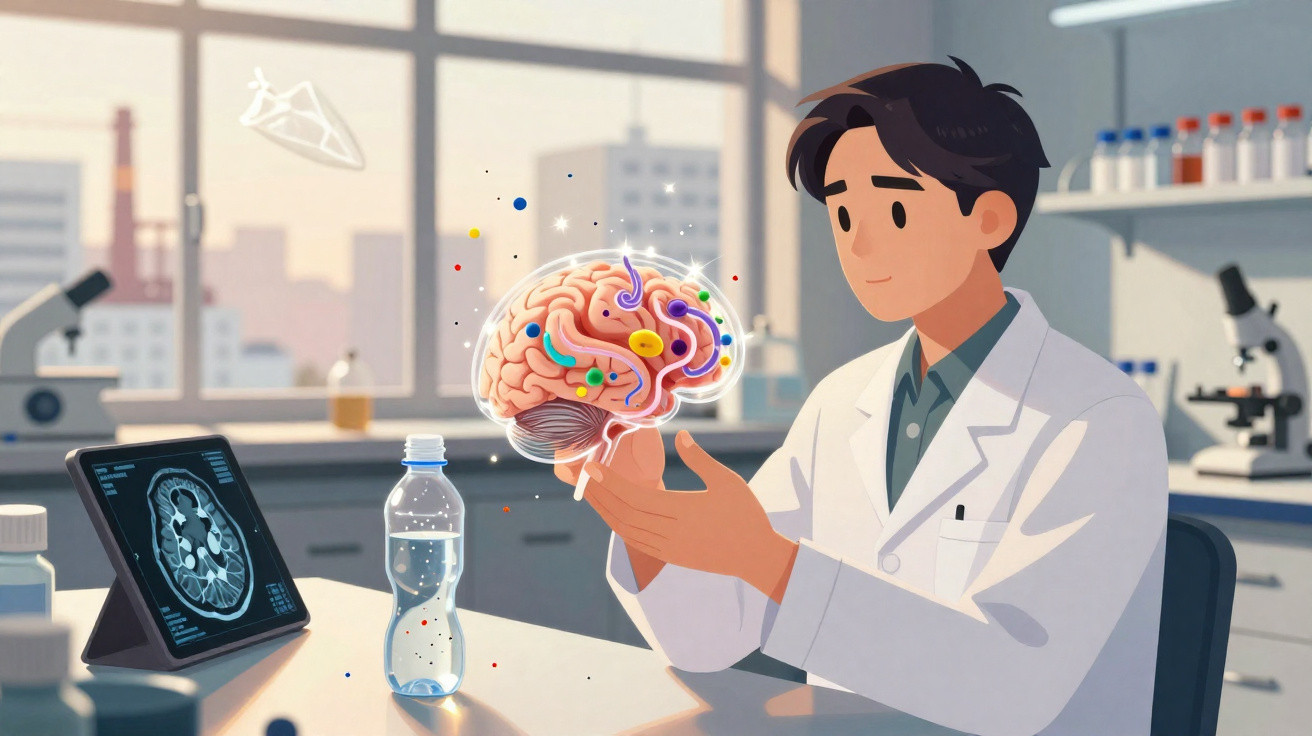
Plastic contamination is permeating the planet, wildlife and human bodies, and a new review of research indicates that minute microplastics and nanoplastics may interfere with brain mechanisms linked to Parkinson's disease.
Parkinson's disease has many recognised risk factors. However, the number of diagnoses is rising - prevalence has doubled over the past 25 years - and increasing levels of environmental pollutants may be partly responsible.
Researchers from Gannan Medical University and Guangzhou Medical University in China drew on more than 100 earlier studies for the review. These included animal research, laboratory experiments and computational models, together building a persuasive case for a connection between plastics and Parkinson's.
It remains uncertain whether microplastics directly cause the condition. Nevertheless, the team says this association warrants closer examination, as substantially more evidence is needed on how these widespread particles can build up in the body and damage human health.
"With the intensification of global plastic pollution, the potential threats posed by micro- and nanoplastics (MPs/NPs) to human health have become a major concern," write the researchers in their published paper.
"MPs/NPs enter the organism through ingestion, inhalation, and skin contact, subsequently accumulating in multiple organs – particularly the brain."
How microplastics and nanoplastics reach the brain
Microplastics are particles measuring under 5 millimetres, whereas nanoplastics are smaller than one micrometre - one thousandth of a millimetre. They are released into the environment in many ways, including the breakdown of plastic rubbish and wastewater from washing synthetic garments.
By bringing together results from earlier work, the review suggests that people consume plastic through food and drink, inhale it from the air and may also take it in through their skin.
These tiny fragments can then reach the brain, either by passing through the blood-brain barrier or by entering through the nerve-cell lining of the nasal cavity.
To consider what plastic may do after reaching the brain, the authors cite studies in which microplastics and nanoplastics promoted the development of toxic alpha-synuclein protein clumps, a feature typical of brains affected by Parkinson's.
Microplastics, nanoplastics and Parkinson's disease pathways
The review also sets out evidence that plastic particles could trigger neuroinflammation, interfere with communication between the brain and gut, and transport harmful metals into the brain through a process called ferroptosis.
Each of these forms of harm has previously been associated with Parkinson's disease.
The developing body of evidence, from microscopic plastics through to Parkinson's-related brain damage, is compelling. Yet the authors describe the available research as "significantly limited", adding that the long-term effects of human exposure and toxicity "remain incompletely characterized." Most of the studies assessed were animal experiments or tests on cells in laboratories, which is important to note.
"MPs/NPs, as pervasive environmental contaminants, infiltrate humans through multiple exposure routes, traverse biological barriers, and accumulate in the central nervous system – constituting a novel environmental hazard for Parkinson's disease pathogenesis," write the researchers.
Wider health concerns and research needs
The potential risks from microplastics and nanoplastics are not restricted to the brain. A growing body of research associates these pollutants with fertility problems, antimicrobial resistance, cardiovascular concerns and other health issues. More recently, scientists have cautioned that contamination and false-positive results are too frequent within this research field.
The authors of the new study call for stronger action to curb plastic pollution, improve waste management and develop biodegradable substitutes for plastics that have become embedded in so many areas of everyday life.
Such changes will be necessary to properly establish the risks that microplastics and nanoplastics present in relation to neurodegenerative diseases. As the world's population ages, the burden of conditions including Parkinson's is expected to keep increasing.
"Future research must systematically compare how MPs/NPs properties – including size, shape, surface charge, polymer type, and degradation state – influence Parkinson's disease-related pathways," write the researchers.
The study was published in npj Parkinson's Disease.






Comments
No comments yet. Be the first to comment!
Leave a Comment